


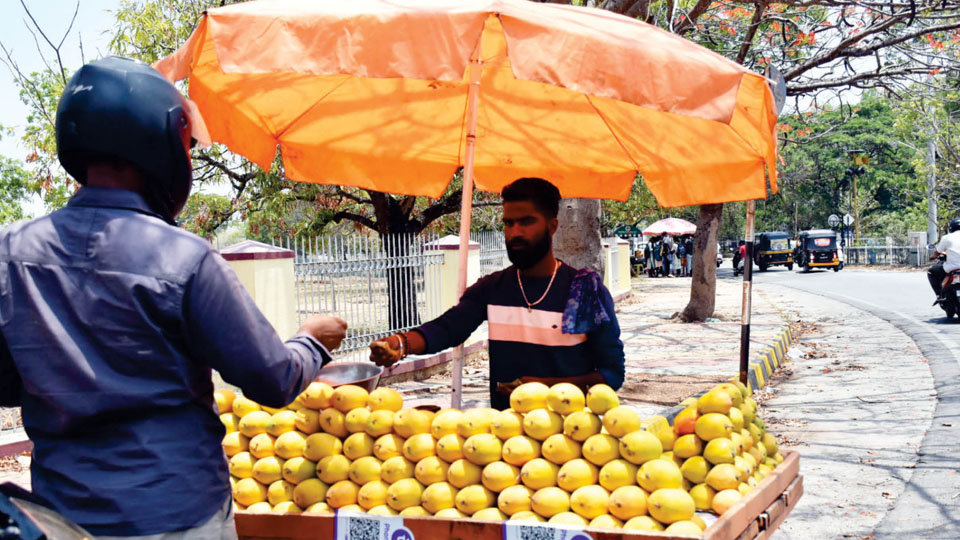
Mango vendor and the art of street deal
By Prof. P.K. Misra
It is indeed a paradox that though mobile street vendors fascinate me, I try to avoid them. Why? Most of the time, after I have made a deal with them and they are gone, I realise I have been mercilessly ‘cheated’.
Then I begin to rationalise that I do not feel the same way when posh shop owners successfully rob me — and I make no complaints about that. But all that can wait. Let me tell you this morning’s story.
I had just returned from my morning walk and was closing the gate. Seeing me there, a mango vendor on a moped approached. There was eye contact, and he understood that I might be his first ‘kill’.
The first sale or ‘boni’
In Mysuru, the local term for the first business of the day is ‘boni’, and I think the term has wide circulation. In India, ‘shubh’ and ‘ashubh’ (auspicious and inauspicious) are strong categories.
If you make a good first deal, it is ‘shubh’ — a good ‘boni’ — and the rest of the day will be successful. Often, the vendor will try to convince you that he is giving you a special concession since it is the first deal of the day, and he wants to begin on an auspicious note.
I didn’t stop him or say ‘no’. He felt encouraged. He got down from his moped and carefully removed the covering from his front basket, which contained selected Raspuri mangoes — a local variety.
He loudly declared that these were meant only for a customer like me. In the basket at the back were less healthy-looking mangoes, suggesting those weren’t for ‘special’ customers like me. I showed some interest, opened the gate, and stepped forward. By this time, he had picked three or four good-looking mangoes and asked, “How many kilos?” Until this point, I hadn’t uttered a word — I neither needed mangoes nor wished to be his early morning victim.
But my silence was interpreted as a willingness to buy. He then pulled out his hand-held weighing scale (an illegal one, mind you) along with weights. By now, he had selected four or five large mangoes and placed them on his preferred balance. You probably know what I mean by his preferred balance.
I protested that I didn’t need so many. As I moved forward to select my own mangoes, he would remove one of mine and add two of his own, conveniently not from his special front basket. I objected again and stepped back to suggest that I was not going to be his customer. Realising he was at risk of losing a potential ‘boni’, he stepped back and allowed me to make my own choices — but still pushed me to buy more. I did not relent.
Price talk
So far, we hadn’t discussed the rate. When I finally asked, “How much?”, he seemed momentarily surprised. After all, that’s usually the opening line in any such transaction. This “opening bracket” typically leads to a round of bargaining from both sides.
Interestingly, both vendor and customer generally know the approximate final rate, but this ritual exchange is essential — without it, the vendor feels robbed of a personalised human interaction.
Seen from this angle, the vendor isn’t merely interested in completing a sale. It goes a little beyond that. That’s what interests me most, and I believe there is a vast space here to explore.
Not long ago, a satire was doing the rounds in the media: A freshly arrived Indian in the US walks into a department store and asks the salesperson what the “real” price of an item is.
Mistaking this for a reading problem, the salesperson simply reads the price tag aloud. Dissatisfied, the Indian follows up with a line that is typical in Indian markets — but absurdly out of place in an American retail setting.
Culture and social norms
In formal terms, the vendor seeks to maximise profit in an open market, while the buyer seeks the opposite. But beyond that lies a larger umbrella of culture and social norms. The transaction isn’t simply a business deal — it’s governed by an unspoken social code, and that begins with conversation. How long this negotiation continues, and how it ends, depends on many factors, but it is a pan-Indian phenomenon.
Vendors employ a range of strategies — clever, adaptive and ever-evolving — to attract potential customers. They are constantly watching for gaps in the supply chain. Let me digress here to clarify that there are many types of vendors, but my focus is on mobile street vendors in urban areas.
Regardless of type, all vendors rely on flexibility, resourcefulness and symbolic creativity, though they remain strangers to their customers. But they are ‘customary strangers’ — a term I use to describe their familiar-yet-unknown relationship with buyers.
The vendor may understand his customers, but the customer typically knows little about the vendor, except that he appears regularly and deals in certain goods.
Change of approach
In earlier days, most vendors came on foot, carrying goods on their heads or using pushcarts. They would announce their presence by loudly advertising what they were selling. Their sales pitch was often delivered in rhythmic, catchy lyrics that glorified their wares.
Today, this has been replaced: Most use two-wheelers and broadcast pre-recorded messages in the local dialect through microphones. This shift alone is a rich area of study for folklorists.
Before I close, I must add this. Hawkers, street vendors, smiths, basket and broom makers, toy sellers, jewellers, jugglers, acrobats, singers, dancers, peddlers, bards, impersonators and trainers of performing animals (now banned), as well as sellers of miracle herbs and medicines — though ancient in origin — have remained a persistent and integral thread in the complex, ever-changing fabric of South Asia’s social system. Lest I disappoint my readers: That morning, I deliberately paid mango vendor slightly less than he initially demanded — just to keep the tradition alive. He was immensely pleased and so was I.
About the author: Prof. P.K. Misra is a retired Professor of Anthropology and has served country under various capacities. His last stint was at North-Eastern Hill University (NEHU), Shillong. An authoritative voice in Anthropology, he was Founder-President of Anthropological Association of Mysuru.




Recent Comments