


By Dr. Devdutt Pattanaik – Author, Speaker, Illustrator, Mythologist
Manu in the Rig Veda gets Soma from a faraway mountain and performs the yagna where he offers Soma as a drink to Indra who in turn provides him access to the land of Aryas. This is suggested in a Vedic hymn composed by Vamadeva (4.26-27) of the Rig Veda.
Curiously, in Vedic Sanskrit, the Hindu Kush mountain range was known as upariśyena and in Avestan, as upāirisaēna. Both mean “beyond the reach of eagles.” Or maybe falcon, which could be tamed and used by hunters of the mountains to collect hunted prey.
This is the path that was taken by the Aryans as they moved from Kazakhstan, towards Afghanistan in their migratory route southwards with horses. It is here that they found this wonderful herb with thermogenic properties that kept them warm in the winter months when the sun was not visible. Soma!
Early scholars wondered what this Soma was, leading to rather colourful research. Was it a magical drink? Some believed it was a mushroom and that it was hallucinogenic. This made people very excited, especially during the hippie counter culture of the 1960s. The belief was that Soma was some kind of psychedelic substance.
But, most sober research in recent times has revealed that this is the ephedra plant that grows in the mountainous regions in the northern part of the Himalayas. Specifically, around the Pamir mountains and the Tarim basin, found north of India and Afghanistan. Soma is a loan word from the Chinese term, Hao-Ma, fire-coloured, hemp-coloured yellow with a tinge of brown. The Aryans as hunters took its juice as an anti-fatigue drink.
The Rig Veda thus captures a memory of a very difficult herb that had to be found and it was believed that only eagles could find it.
In the later Yajur Veda traditions the story changes and we are told that the eagle is actually the Gayatri Mantra. We are told that there is a fight between Kadru, who is Earth and the goddess of sound, Suparna, and she challenges Kadru to fetch the Soma. The goddess of sound has three children, which are the three metres Gayatri, Jagati and Trishubdha.
Gayatri, who is the youngest and the smallest, is able to make the journey and fetch the Soma plant. On the way Gayatri is attacked and parts of her or the plant fall to the ground transforming into trees.
Now here the story is not so much about finding the original Soma plant because the Aryans have now migrated to the Ganga basin. Here, value is being placed on the Gayatri meter, that is, the chanting, with the ability to fetch Soma, which is no longer a plant, but a mystical product. Since Soma is not found easily, we are being told of substitutes. For example, the spoon made from the plant which originated from the fallen Soma twig is good enough to produce Soma, as we are told in these texts. Thus, we see the story changing as geography changes and with time.
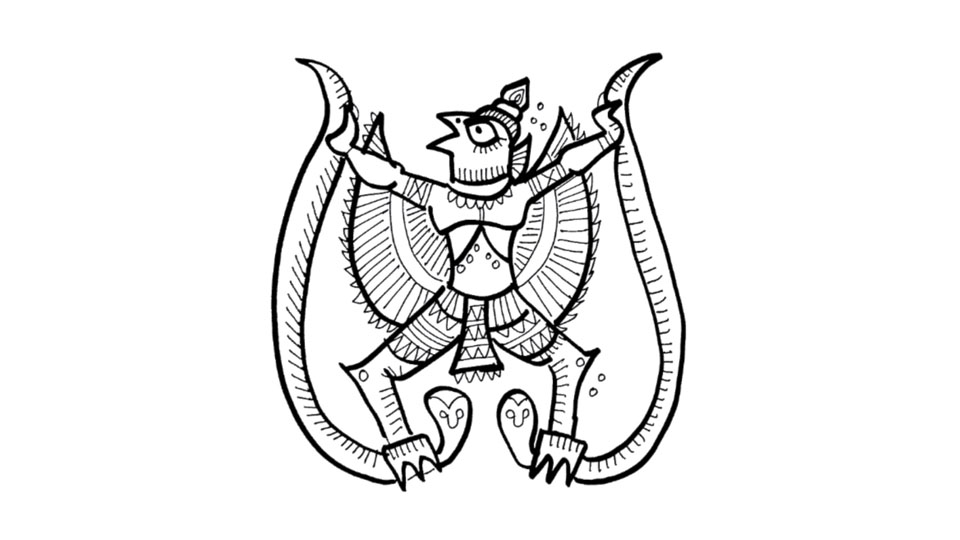
The story changes again in the Mahabharata epic, in the Suparna-akhyana (epic of the eagle), where we are told that there is a competition between the mother of snakes and the mother of birds. Their rivalry leads to the mother of birds being enslaved and the only way she can be liberated is if her child, the eagle, Garuda, can get Amrut from the realm of the gods. Amrut is churned from the ocean of milk, almost the same way Soma juice is churned out by squeezing the Soma plant. But there is no memory of the Soma plant, by this time. There is only this belief of a product of immortality that the gods have. Garuda has to steal this nectar of immortality and give it to the snakes to liberate his mother.
The story further proceeds to show different kinds of power structures. The eagle tricks the snakes into releasing his mother, but ensures the snakes do not drink it, which is why the gods are happy with Garuda. Garuda then befriends Vishnu and becomes his vahana. He impresses Vishnu with his intelligence, strength and humility. Amrut then becomes a symbol of bhakti and devotion, and thus we see the story of Soma transforming into the story of Amrut.
In the original story, the Soma is being stolen for Indra, but in the latter story, Amrut is being stolen from Indra. This is how mythology changes over space and time and new ideas are used or communicated through the same old stories.




Recent Comments