


Calls for planned integration of street vendors while balancing pedestrian rights and livelihoods
Mysuru: In the wake of the Supreme Court’s recent judgment reaffirming pedestrians’ right to safe and obstruction-free movement under Article 19(1)(d) of the Constitution, a study by the Mysore School of Architecture (MSA) has recommended integrating street vendors into the city’s urban planning framework rather than relying on blanket evictions.
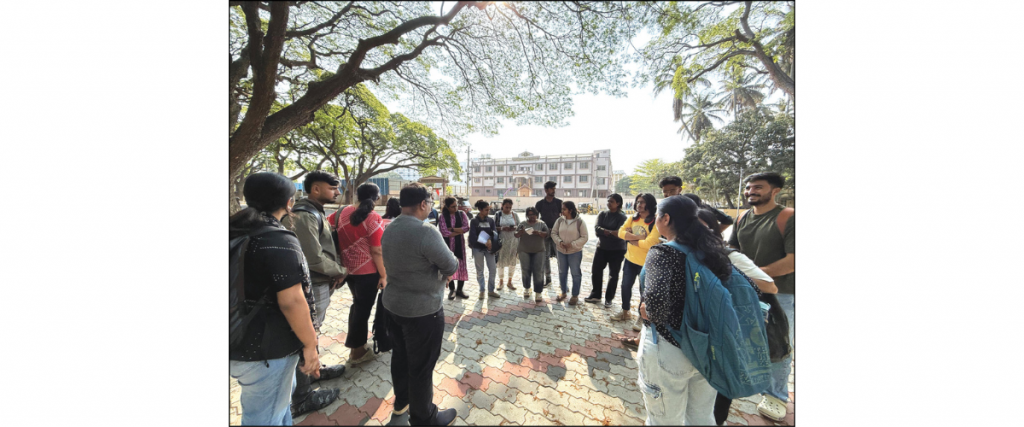
The study, conducted by 8th Semester B.Arch students under the guidance of Dr. H.S. Champa, Director & Dean and Prof. Sandeep Subbakrishna, Associate Professor, examined street food vending across Mysuru, recognising vendors as an essential part of the city’s informal economy, neighbourhood life and public spaces.
According to the study, street vendors not only provide affordable and accessible food options but also contribute to neighbourhood vitality and passive surveillance, enhancing urban safety.
Students carried out a comprehensive city-wide audit of street food vendors. Every identified vendor was documented using GPS tagging and geo-fencing software developed by Oxford University, UK, creating a spatial database of vending locations.
The exercise also analysed surrounding land use, pedestrian movement, traffic conditions and public activities across different Wards.
Ward analysis
Instead of recommending the removal of vendors, the study explored ways to integrate them into the city’s urban framework through designated vending zones that would improve pedestrian movement while protecting livelihoods.
Selected Wards were analysed using the Mysuru Master Plan 2031 and provisions of the Street Vendors Act to identify suitable locations where vendors could operate without disrupting traffic or pedestrian circulation.
The study also supports the concept of 15-minute neighbourhoods, where residents can access daily services within walking distance, thereby reducing dependence on vehicles while strengthening local communities.
Researchers observed that the number of street vendors in Mysuru has increased significantly, particularly after the COVID-19 pandemic. They noted that this growth can be managed effectively through planned vending zones, improved infrastructure and updated planning regulations.
Recommendations to MCC
• Establish dedicated vending zones with basic infrastructure and pedestrian-friendly access.
• Effective waste management systems, seating, lighting, sanitation facilities and organised parking.
• Introduce a regulated licensing and user-fee system for street vendors.
• Recognised as an urban asset, not merely an enforcement issue.
• Ensure transparent regulation and periodic monitoring of vending activities.
• Integrate designated vending spaces into future neighbourhood planning.
• Base policies on consultations with vendors, experts, stakeholders and the public.
• Recognise street vending as an integral part of Mysuru’s urban fabric.
• Implement a transparent regulatory system with regular monitoring to prevent encroachments.
• Promote evidence-based planning to balance pedestrian rights and livelihoods.
• Improve public convenience while enhancing vendors’ safety, dignity and working conditions.
• Protecting pedestrian movement, traffic flow and public spaces.
Recent Comments