


Fleeting Thoughts By Ashvini Ranjan
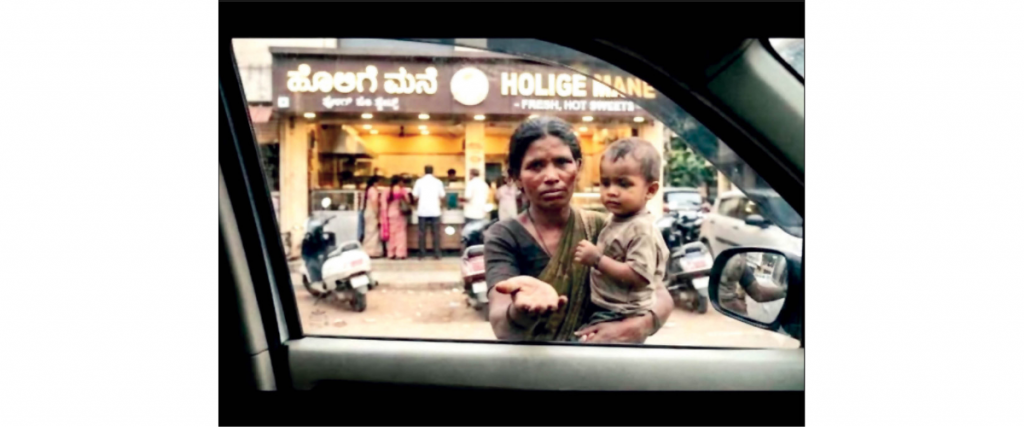
The morning air was thick with the sweet scent of freshly made holiges from the Holige Mane on Temple Road. From the quiet comfort of my parked car, as I waited for my wife to finish her errands, I became an unwitting audience to a quiet drama unfolding right outside my window. A slice of daily life that most of us pass by without a second glance.
On the pavement, a young beggar woman was waging a desperate, exhausting struggle with her toddler. The boy had only recently discovered the sheer magic of mobility on his own two feet. Eager to explore, he kept breaking free from her grasp, drawn irresistibly toward the sweet shop by the intoxicating smell of hot holige !
For the mother, his new-found mobility was proving to be annoyance. She could not hold the energetic child in her arms and simultaneously focus on her daily struggle for survival. Of begging. Every time he broke loose, she had to abandon her place and chase after him.
I watched as she retrieved him twice from the threshold of the sweet shop. But on his third attempt, her patience snapped. She pulled him back and spanked him, a sharp, deliberate smack. The cry of the child resonated through the morning air.
Though hard to watch, but it was not an act of cruelty. It was an introduction into reality. It was perhaps the very first lesson of his life, a painful initialisation into a world divided strictly between those who could casually pay twenty-five rupees for a warm delicacy and those who were only allowed to smell it.
The mother wasn’t hurting him out of anger, she was enforcing boundaries. She was teaching him, in the only language he could yet understand, that he had to learn to resist temptation, even the basic urge for hot food. Learning what to dream of and what to leave untouched is a slow, agonising process, but for children of the street, that reason must dawn early.
A few minutes later, the woman approached my car window, extending her palm. The child had stopped crying. In his tiny fist, he clutched a cheap, brightly wrapped candy, a small token his mother had somehow secured to placate his immediate distress.
“What does your child want?” I asked, looking down at the boy.
She let out a soft laugh. It contained no mirth, only a profound, quiet pain. “He wants many things, sir,” she said stoically. “He does not know yet that those things are not meant for us. But he will learn soon.”
Faced with the stark reality of their existence, a wave of discomfort came over me. “Can I buy him a holige?” I offered.
Even as the words left my mouth, I questioned my own motives. Was I truly trying to help the boy or was I merely trying to ease my own comfortable conscience?
“Please don’t, sir,” she replied gently, shaking her head. “If he eats it today, he will ask for it every day we are here. Besides, it will upset his stomach, he is not used to such rich food.”
Her answer struck me with the force of a sudden revelation. There was immense, protective wisdom in her words. Buying the child a sweet would have brought a fleeting moment of joy, to both of us, but it would have inflicted long-term harm, sowing seeds of desire for a life she could not afford.
As a passing stranger, I wanted a quick, easy fix. But as a mother conscious of the long, harsh road ahead, she had to think long-term. She had to navigate a reality best suited for her child’s survival, guarding his expectations as fiercely as his health.
I handed her the money anyway enough for a holige and told her to buy whatever she deemed best. She expressed her gratitude with a quiet nod and moved on to the next car in line, resuming her relentless daily pursuit for survival.
I sat back in my seat, deeply humbled. I was merely a bystander, a temporary witness to their struggle. But in that brief, ordinary morning, a mother had quietly demonstrated the deepest kind of love, the painful wisdom of teaching her child how to endure the world they were born into.


Recent Comments