


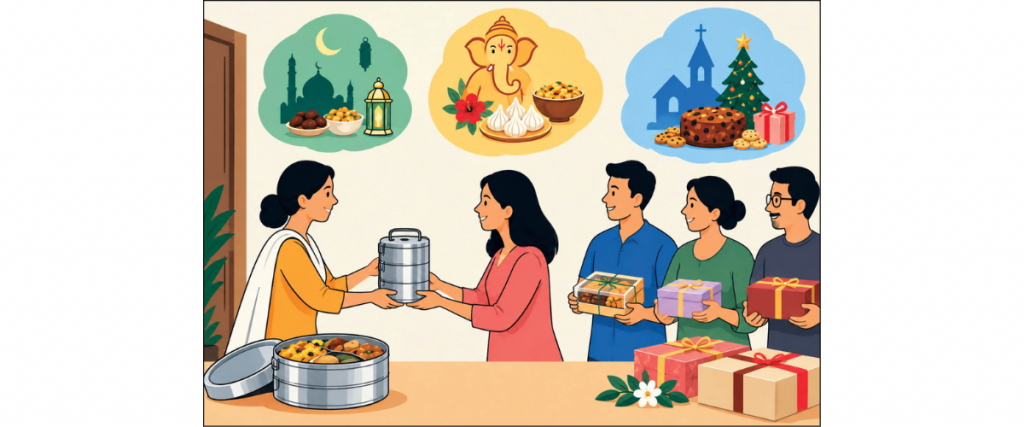

I love three festivals very much: Ramzan, Ganesha Chaturthi and Christmas. No, I’m not attempting an Amar, Akbar, Anthony trick to establish my secular credentials. My affection for these festivals has little to do with religion and a lot more to do with religion’s greatest side effect… food.
Ramzan is over; I am now waiting for Ganesha Chaturthi goodies and then Christmas is almost here. The tiffin boxes are ready to roll.
I have always had a special affection for tiffin boxes arriving at my doorstep and the delicious festival food in them. But now I have a problem while returning the tiffin box.
Earlier, this was easy. You filled it with whatever food your mother happened to specialise in and sent it back. Today, returning a tiffin requires strategic planning.
Everyone is on low-carb diets. Someone is intermittent fasting. Another is gluten-free. Someone else is avoiding sugar. Worse, most of us don’t know how to make snacks and dishes anymore.
So fewer people are sending tiffin boxes and instead sending ‘healthy’ gift boxes, while tiffin boxes are returned with store-bought ‘sugar-free’ sweets.
I sometimes wonder if the Indian festival will eventually become a celebration in which we send each other ready-made gift boxes or sweet boxes. But there is a larger issue here, which is, we are slowly losing the culture of making food for one another and sending a tiffin box.
Food seems to taste better when it comes out of a tiffin box. Some may say it is the anticipation of opening each compartment, not knowing what’s in it, but I suspect it is the joy of knowing that someone cooked it and thought of you. That is the real magic of the Indian tiffin.
The tiffin may have acquired its name from the British, but we Indians turned it into something far more meaningful. It was a sign of affection and love.
For generations, the stainless-steel tiffin has travelled between homes, schools and offices.
Mothers packed them for children. Wives packed them for husbands. Friends sent them to friends. Neighbours sent them to neighbours and during festivals, the tiffin became something even more important. It became a messenger of affection.
Indians have always bonded over food. Festivals, in particular, were never merely about rituals. They were about making something and sending it to someone, which brought us together.
When we were young, we knew our friends’ mothers almost by their signature dishes.
Amar’s mother, Rekha aunty, made extraordinary chakli. Ali’s father, Zubair uncle, made a biryani that could make you forget your manners. Joji’s mother made killer mutton chops and a fruit cake that was practically a Christmas institution.
We didn’t just know these dishes, but we knew who made them and they became the people we cared about. Their kitchens became extensions of our friendships and their recipes became part of our collective memory.
Today, our lives are very different. We are busy with little time to cook and so have outsourced that culture to ready-made gift boxes. They are delicious indeed, but something is missing and that is the emotional ingredient.
Beautifully packaged boxes of sweets are certainly generous, convenient and often delicious, but it can feel strangely impersonal, a little like WhatsApp birthday greeting.
A tiffin is different. A tiffin says: I made this. It took effort. I thought of you. I wanted you to have some. That spirit, perhaps, is something we need to recover, one we need today more than ever.
Today we live in a deeply polarised world and strangely argumentative times. We disagree about everything, but put a plate of hot food in front of Indians and we seem to rediscover our humanity.
We have been doing this for centuries. We have celebrated festivals by cooking for others, breaking bread together, carrying food across neighbourhoods and sending something from our kitchen to somebody else’s.
Perhaps the tiffin was India’s original social media. It connected people without algorithms and saved us from being lost in our own prejudiced echo chambers, reminding us to be kind, open-minded and forgiving.
Maybe it is time we started making a little something for somebody else again. When the tiffin goes, fill it with a homemade snack food. In doing so, fill it with a little of what we seem to be losing, which is the simple habit of caring for one another.
Bring back the Tiffin Effect.
e-mail: [email protected]




Recent Comments