


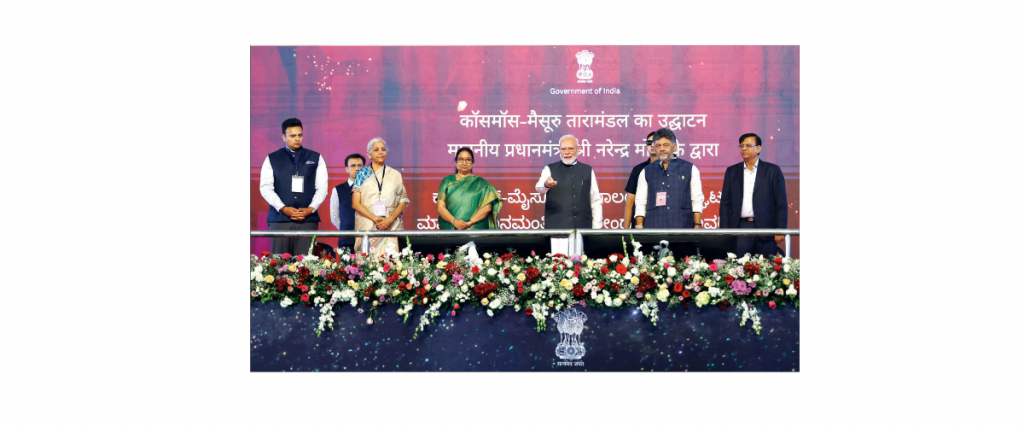
Facility to boost scientific temper among youth, nurture future scientists: PM
Mysuru: Prime Minister Narendra Modi last evening inaugurated Cosmology Education and Research Training Centre (COSMOS)-Mysuru Planetarium, India’s first LED dome planetarium, at the Sri Jayachamaraja Wadiyar Centre for Higher Learning of the University of Mysore, at the foot of Chamundi Hill in city.
Addressing the gathering, Modi greeted the people in Kannada and expressed happiness at returning to Mysuru to dedicate the planetarium to the nation, months after inaugurating the Viveka Smaraka.
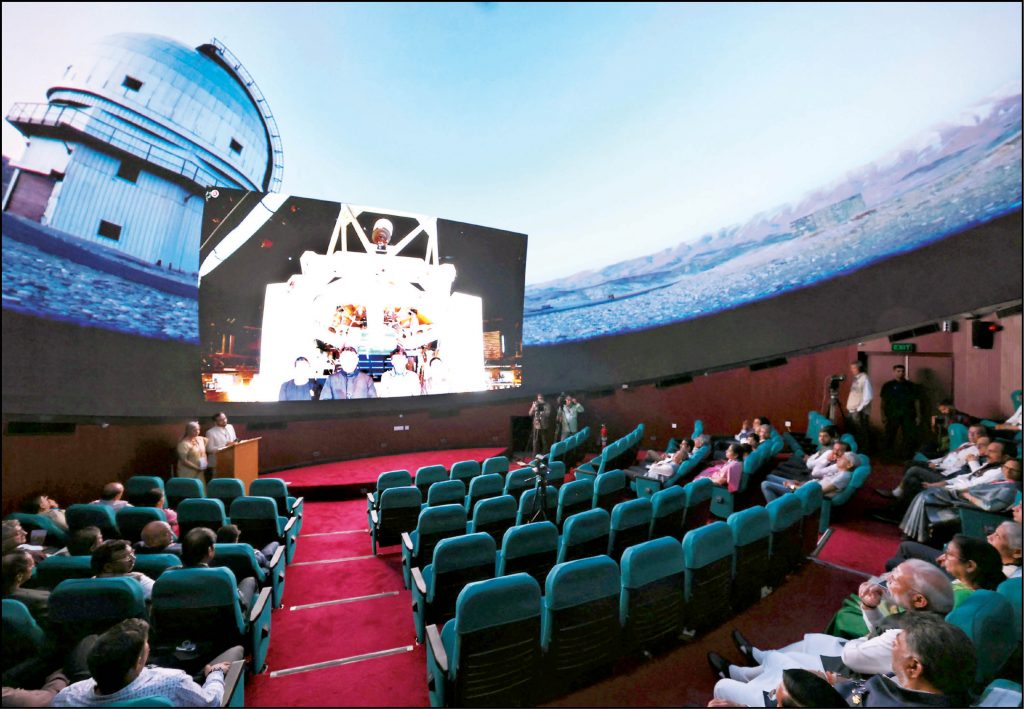
Caption 1: Prime Minister Narendra Modi, along with other dignitaries, watching a show inside the LED dome planetarium in city.
Drawing a parallel between the two landmarks, he said, “Viveka Smaraka inspires introspection and spiritual pursuit. At the same time, planetarium encourages people to look towards the skies and explore the mysteries of the universe.”
Watching a show inside the LED dome was a wonderful experience, he added.
In his 13-minute address, Modi recalled India’s rich astronomical heritage and said, ancient Indian scholars had studied celestial movements, developed calendars and accurately calculated solar and lunar eclipses despite the absence of modern instruments. He cited the contributions of Aryabhata, Varahamihira, Bhaskaracharya and Nilakantha Somayaji.
Mysuru’s contribution to education
He recalled Mysuru’s contribution to education and scientific advancement, particularly the establishment of University of Mysore under Maharaja Nalwadi Krishnaraja Wadiyar and the Royal Family’s role in laying the foundation for the Indian Institute of Science (IISc) in Bengaluru.
Describing the planetarium as a new chapter in India’s scientific journey, Modi congratulated the University of Mysore, the Indian Institute of Astrophysics, Government Departments and others involved in the project.
Referring to India’s growing achievements in science and space exploration, he recalled the country’s successful Chandrayaan-3 landing near the Moon’s south pole, the launch of the Aditya-L1 solar observatory and the successful demonstration of space docking and undocking, making India the fourth country to achieve the feat.
He also referred to an Indian astronaut’s recent visit to the International Space Station, saying the experience and findings would contribute to the country’s ‘Gaganyaan’ human spaceflight programme.
Private participation
Highlighting the growing participation of private players in the space sector, Modi said, the opening up of the sector had enabled Indian startups and young entrepreneurs to develop rockets, launch satellites and explore new opportunities.
He stressed that space technology must benefit ordinary people, citing satellite-based communication systems that help fishermen receive weather alerts and return safely to shore.
Speaking about the importance of nurturing scientific talent, Modi said, more than one crore students had benefited from over 10,000 Atal Tinkering Labs across the country, where they were encouraged to experiment and develop new ideas.
He also referred to initiatives such as One Nation One Subscription, the Anusandhan National Research Foundation and the Rs. 1 lakh crore Research, Development and Innovation Scheme, aimed at strengthening research and making scientific discoveries commercially and socially useful.
Concluding his address, Modi urged the authorities associated with COSMOS to regularly bring school and college students from across the region to the planetarium and encourage their interest in science.
He said, the real success of the facility would be when children who visit it today return in the future as scientists and share their own discoveries about the universe.
Union Finance Minister Nirmala Sitharaman delivered the welcome address, while Chief Minister D.K. Shivakumar made the introductory remarks. Governor Dr. Sudha Yadav, Higher Education Minister Basavaraj Rayareddi and Mysuru-Kodagu MP Yaduveer Wadiyar were present on the occasion.
Recent Comments