


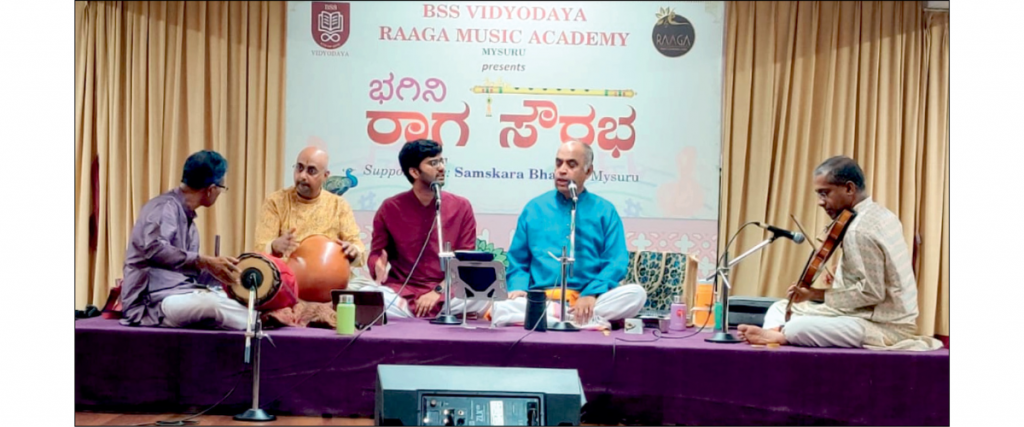
Raaga Music Academy, committed to the holistic well-being of the mind and body through music, organises musical programmes every month. On Oct. 24, in association with BSS Vidyodaya and with the support of Samskara Bharathi, the Academy presented a delightful vocal concert by one of the senior and respected musicians of our State, Vidwan S. Shankar.
Apart from being an accomplished vocalist, Vidwan Shankar is also a writer and music director. Renowned for his uncompromising adherence to the traditional classical style, he lived up to the expectations of his admirers with a concert marked by musical maturity, dignity and uncompromising classicism.
He was ably supported by Vidwan R. Achyutha Rao on violin, Vidwan B.R. Srinivas on mridanga and Vidwan Raghunandan Rao on ghata. Adding a special touch to the concert was his young disciple, B.S. Suhas, who joined his guru in the vocal presentation.
The opening varna in Kaanada, composed by Vasudevacharya, was itself a statement of the maestro’s musical vigour. Though in his seventies, Shankar displayed remarkable energy and command, presenting the composition in his characteristic majestic style.
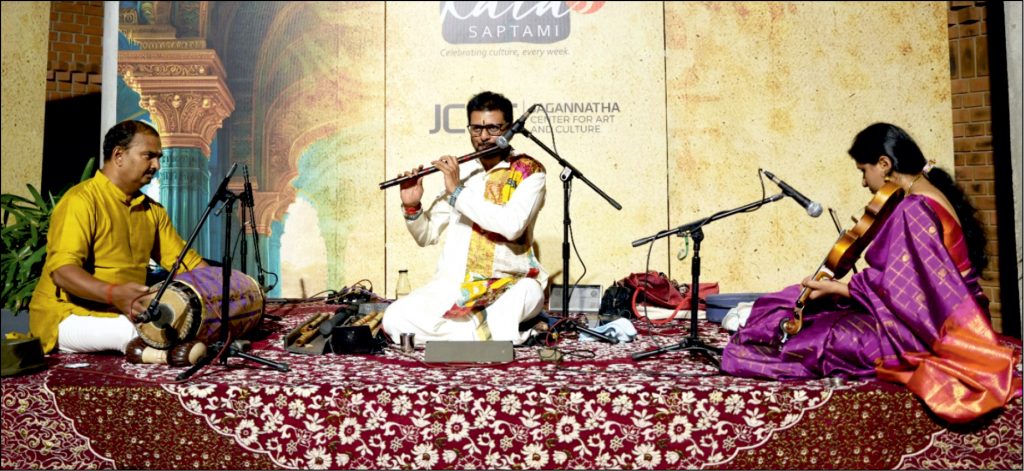
Vid. Mysore A. Chandan Kumar presenting Karnatak flute recital at Jagannatha Centre for Art and Culture (JCAC) in Vijayanagar 1st Stage on Oct. 28. He is accompanied by Vidu. Sindhu Suchetan on violin and Vid. Nanjil Arul on mridanga.
This was followed by Purandara Dasa’s devotional composition ‘Karunanidhiye’ in Valachi and Tyagaraja’s ever-popular ‘Nada Tanumanisham’ in Chittaranjani, which brought back nostalgic memories of the golden era of Karnatak music. His choice of compositions for the evening was particularly appealing, bringing to mind the great masters who had popularised these timeless classics.
Muthuswami Dikshitar’s ‘Annapurne Vishalakshi’ in Sama, Syama Sastri’s ‘Marivere Gati Evvaramma’ in Anandabhairavi, Dikshitar’s ‘Akhilandeshwari’ in Dwijavanthi, Muthiah Bhagavatar’s ‘Sri Meenalochani Amba’ in Todi and Tyagaraja’s ‘Raghuvara’ in Kamavardhini were all presented with great musical sensitivity.
The alapana of Todi and Panthuvarali stood out for their systematic development, clarity and precision. Equally impressive were the neraval passages at ‘Manikya Veenadhari Malayadhwaja Pandyakumari’ in ‘Sri Meenalochani Amba’ and ‘Manasuna Neeke Marulukonnaru’ in ‘Raghuvara.’ These passages offered ample scope for the vocalist to demonstrate his musical depth and command over the nuances of the ragas.
Achyutha Rao’s violin accompaniment was melodious and soothing, blending beautifully with the vocalist’s presentation. The percussion support by Srinivas and Raghunandan Rao was lively and engaging, adding rhythmic richness without overpowering the music.
The concluding pieces, including ‘Sharanu Sri Guru Raghavendrane’, ‘Shringapuradheeshwari’ and ‘Mara Janaka’, provided a melodious finale to an enriching evening.
Young Suhas, singing alongside his guru, displayed confidence and musical promise, giving listeners a glimpse of a bright future. It was indeed an evening of traditional musical excellence, with Vidwan Shankar reminding the audience that age is no barrier to artistic vitality when music is nurtured by lifelong dedication and devotion.
A captivating musical journey
As part of its regular Wednesday programme, ‘Kala Saptami’, the Jagannatha Centre for Art and Culture (JCAC) presented an engaging flute recital by Mysuru’s own talented flautist, Vidwan A. Chandan Kumar, on Oct. 28.
He was accompanied by Vidushi Sindhu Suchetan on violin and Vidwan Nanjil Arul on mridanga.
Chandan Kumar is known for his powerful breath control and distinctive gayaki style of flute playing. Having received guidance and training under eminent gurus, he has steadily carved a niche for himself in the world of classical music through his individual approach and impressive artistry.
He commenced the concert with a brief yet evocative alapana of Shanmukhapriya. The crisp, well-defined notes immediately captured the attention of the listeners and reflected his excellent command over the instrument. The alapana was followed by an equally impressive presentation of kalpanaswaras. The atheethaedupu at ‘Prasiddha Gana Nayakam’ and the imaginative employment of different yati patterns added further interest and sophistication to the presentation.
Sindhu Suchetan provided sensitive and supportive violin accompaniment throughout, responding admirably to the flautist’s musical ideas. The subsequent presentations, ‘Shriman Narayana’ in Bhowli by Annamacharya and ‘Shankara Sri Girinatha Prabho’ in Hamsanandi by Swati Tirunal Maharaja, were both rendered with liveliness and charm.
The highlight of the concert was undoubtedly the Raga-Tana-Pallavi in Hindola. Chandan Kumar’s approach to the raga was refreshingly individualistic, yet he succeeded in bringing out its essential character and emotional depth. The tana, explored jointly by the two melodic artistes, was a particularly rewarding experience, with subtle shades reminiscent of Anandabhairavi and Bhoopalam adding an interesting dimension. The pallavi, ‘Sri Guruvara Charanam Bhavaye’, set to Adi tala, was presented in three speeds, followed by an elaborate neraval and a cascade of imaginative kalpanaswaras. The segment offered a fine demonstration of the flautist’s creativity, technical command and ability to sustain musical interest.
Nanjil Arul, with his accomplished and sensitive mridanga accompaniment, proved himself to be a highly capable rhythmic partner.
The concluding segment included a delightful selection of keerthanas and devaranamas such as Annamacharya’s ‘Narayanathe Namo Namo’ and Purandara Dasa’s ‘Tamburi Meetidava’ and ‘Nara Janma Bandaga.’ An interesting English musical note added an unexpected and refreshing touch to the finale.
Throughout the concert, Chandan’s powerful blowing, expressive phrasing and ability to bring out the emotional nuances of the compositions kept the audience engrossed. His flute seemed bedded in the music.
It was a memorable musical experience and JCAC deserves appreciation for consistently providing a platform for talented artistes and enriching the cultural life of Mysuru through its ‘Kala Saptami’ series.
—Dr. Rama V. Bennur
Recent Comments