


Fleeting Thoughts By Ashvini Ranjan
A small idea to make our surroundings a little quieter
I read Vikram Muthanna’s thought-provoking article titled, ‘When Noise Becomes Harassment’ in Star of Mysore dated Oct. 24, 2026 (Saturday). His observations on the harm noise causes to our health and well-being prompted me to write a sequel or to make more noise about noise, though not literally!
This is a subject that deserves more than a passing mention in a newspaper column. It calls for action, however modest.
My obsession with noise brings back a fond memory from my school days. One standard punishment for failing to do homework, arriving late or making too much noise was to stand outside the classroom. In our co-educational school, the boys were predictably the principal offenders.
On one occasion, after a particularly noisy episode, our teacher sternly reminded us that ‘empty vessels make the most noise.’ The girls promptly seized upon this phrase as their ‘go to’ weapon against us and called the boys ‘Empty Vessels’ for the rest of the term.
The public shaming had a telling effect on our conduct. The neighbourhood residents probably slept more peacefully after that!
Even after seventy-odd years, whenever I meet my former classmates or more appropriately, my fellow ‘Empty Vessels’, we recall the incident and have a hearty laugh. But softly!
Perhaps that old school lesson deserves a second innings.
Not just an inconvenience
We tend to dismiss noise as a temporary inconvenience. Once a festival ends, a procession passes or the traffic moves, we assume the problem is over. But prolonged exposure to excessive noise can disturb sleep, increase stress and damage hearing.
The World Health Organisation recognises environmental noise as an important public-health concern.
Animals, too, suffer from our noisy celebrations. Firecrackers can frighten pets and disturb wildlife. We celebrate while other living creatures may tremble in terror. Surely, our festivities need not come at the cost of somebody else’s peace and well-being.
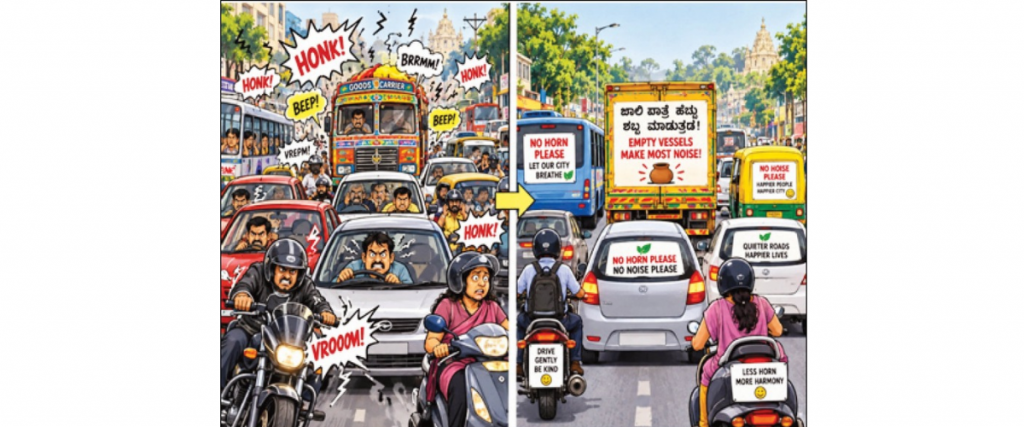
Years later, I found myself at a traffic signal, hemmed in by vehicles. The driver behind me kept blowing his horn, apparently expecting sound waves to part the sea of cars ahead. At the next intersection, I noticed a truck displaying the familiar words “PLEASE BLOW HORN” on its rear.
In Indian traffic however, such encouragement is hardly necessary. We honk when the vehicle ahead is stationary, when the signal is red, when a pedestrian is crossing and sometimes simply to reassure ourselves that the horn is still working!
During a visit to Japan in May this year, we hired a van to take us around Tokyo for three days. Not once did our driver use the horn. To my Indian ears, the silence was almost unsettling!
Curious, I asked our van driver, Mr. Takashi, why he never sounded his horn. He smiled and explained that honking unnecessarily was considered impolite. When drivers followed the rules and respected one another, he said, there was little need to use the horn.
I sometimes suspect that the average Indian will not decide to buy a vehicle until he has tested its horn. The louder it sounds, the greater the probability of him buying it!
Noisy nature
Are Indians naturally noisy? That would be an unfair generalisation. Crowded roads, congested neighbourhoods and the constant din around us often make people raise their voices just to be heard.
But a habit that begins as a response to noise can become a habit that creates even more noise. We must distinguish between circumstances beyond our control and noise we can choose not to make.
Our festivals, family gatherings and religious ceremonies are part of our social fabric. Nobody is suggesting that we abandon their joy. But celebration need not be measured in decibels. A festival can be colourful without being deafening; enthusiasm does not require an incessant horn.
Can a little humour change our behaviour?
Here is a small experiment worth trying. What if we replaced the familiar ‘HORN PLEASE’ message on vehicle rear windows with ‘EMPTY VESSELS MAKE MOST NOISE’ or similar to make the public aware the harm that noise can create?
Imagine seeing this message at traffic signals, displayed in local languages. A motorist about to press the horn unnecessarily might pause for a moment. The thought of being labelled an ‘Empty Vessel’ could perhaps achieve what a thousand traffic advisories have failed to do!
Restrain is maturity
A young driver who regards loudness as an expression of freedom might discover that restraint is a better demonstration of maturity. After all, there is no prize for being the loudest person on the road.
Of course, a slogan alone will not solve noise pollution. Its effectiveness would have to be tested. But a message that makes people smile may also make them think. Why not begin with a voluntary campaign involving schools, colleges, driving schools and responsible motorists?
Traffic authorities and civic bodies could be invited to support it. A small pilot campaign could assess public responses and changes in unnecessary honking before deciding whether to expand it.
The same principle applies beyond our roads. Keep music at a considerate volume. Avoid modifying vehicle silencers to make them noisier, refrain from shouting across public spaces and remember that hospitals, schools, infants, senior citizens and people sleeping after night shifts deserve peace. Use the horn when safety requires it, not to express impatience or assert authority.
We may not silence an entire neighbourhood overnight. But each of us can turn the volume down a notch. Silence is not emptiness; it is consideration for others.
So, the next time we are tempted to honk unnecessarily, raise our voice to establish authority or turn up the music to entertain the entire neighbourhood, let us pause and ask ourselves: “Is this noise necessary or am I just being an Empty Vessel?”
e-mail: [email protected]

Recent Comments