



Dasara is here and the administration says it is ready to welcome Dasara tourists. But the truth is, our so-called ‘Royal City’ is in a ‘Royal Mess.’
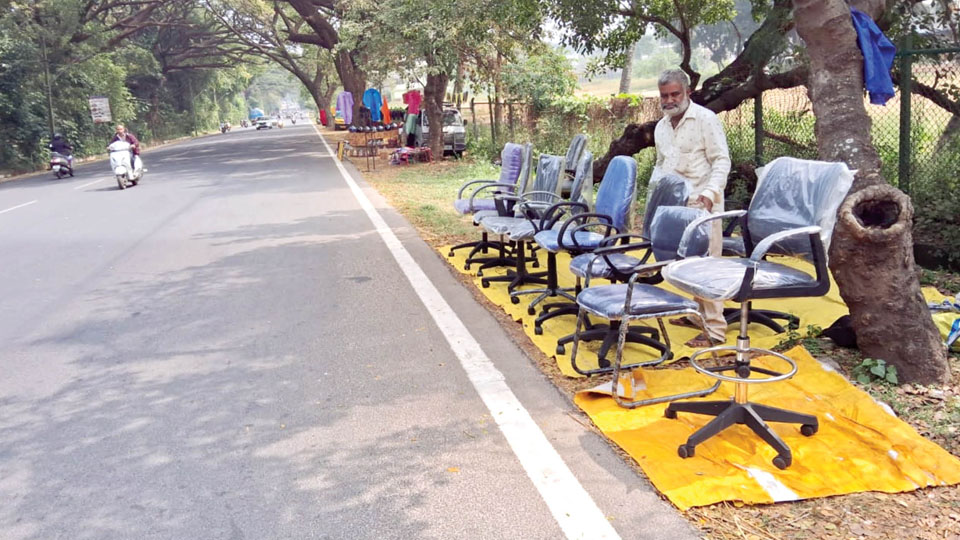
Our footpaths have turned into ‘food-paths’ while our circles and medians have turned into ‘flex parks.’
The city administration has clearly lost control of its streets. Vendors occupy every corner, circle and sidewalk. They are cleared out only when a VIP comes visiting; once the VIP is gone, they are back.
Mysuru’s streets resemble a sprawling supermarket where everything is available: From underwear to vegetables, sofa sets to mobile screens, tender coconuts to even crabs ! And one can buy all this without getting off their bike or car.
We have heard of drive-through restaurants like McDonald’s, but today we have ‘drive-on’ shopping in our city — shop as you drive.
Convenient for customers perhaps, but disastrous for traffic and for law-abiding shopkeepers who pay Property Tax, Trade Licence fee and GST.
Mysuru Trader Associations must protest and warn the administration that they will stop paying taxes if the vendors in front of their shops are not evicted or file a PIL.
While hawkers have taken over our footpaths, flex boards have conquered our circles and medians.
The Mysuru City Corporation (MCC) has made tall promises for nearly two decades. In 2006, it proposed to make heritage circles ‘hoarding-free.’ In 2009, it launched an ‘illegal hoarding drive.’ In 2011, it vowed to file Police cases against violators. In 2024, they said they would issue notices.
What happened? Absolutely nothing. Flex has outlasted them all.
The solutions are simple: Hawkers can be regulated by designated vending zones with nominal fees. Flex hoardings are already banned so implementation should not be an issue.
But both require a spine — a quality sadly absent in today’s bureaucracy and it’s not their fault.
Our officials appear terrified of local politicians who have the blessings of their senior leaders in Bengaluru.
Unfortunately, these senior leaders wield their influence in the interest of their local chamchas instead of Mysuru’s. The result?
Civil servants with the IQ to clear UPSC exams are reduced to clerks, too scared to enforce the law.
For 15 years, Mysuru has suffered the consequences of this bureaucratic castration. That this decay continues even with a Chief Minister from our own city is the tragic irony.
Dasara may still dazzle tourists with elephants and lights, but for Mysureans, the everyday reality is different; we are a city littered with flexes and food-paths.
Unless our leaders or our bureaucrats stiffen their spines, our ‘Royal City’ will remain so only in coffee-table books.
India is beautiful, Indians make it ugly
Earlier this week, Deccan Herald reported that a few paintings by the legendary painter, sculptor and veena maestro K. Venkatappa had to be removed from display at Venkatappa Art Gallery, Bengaluru, because they had developed fungus !
This report reminded me of R.K. Narayan (RKN). The legendary author who, when asked why he sold his manuscripts to an American archive, Narayan famously replied, “If I had given my manuscripts to the (Indian) Government archives, they would have dumped them in some corner where they would have been lying gathering dust, and I would have got an acknowledgement on a buff paper. In Boston, they are preserved in air-conditioned lockers.”
Yes, RKN was right. Not only is his manuscript preserved in a temperature-controlled area, but he also got paid for it.
If he had given it to our Government first, he would have been emotionally blackmailed by the press and litterateurs to give it away for free.
Next, then the Government would have preserved it so well that it would be gleaming — Gleaming with silver fish chomping away at the manuscript.
When art handed down for safekeeping sprouts fungus, it’s not just the canvas that’s rotten… we are.
I say we are a rotten people because we are a nation of vandals — wilful destroyers of what is beautiful or venerable.
Public vandalises public property and our Government vandalises heritage property.
We scrawl love lines on heritage walls, deface public sculptures, slash bus seats and smash train windows.
Remember the Tejas Express train, India’s pride on wheels? It had LCD TVs, headphones, vacuum toilets, touchless taps, the works. By the end of its maiden journey, the LCDs were broken, the headphones stolen, the toilets soiled and the taps yanked out.
To stop vandalism, we have the Prevention of Damage to Public Property Act, 1984. It promises a year of imprisonment for vandalism. Yet, like most Indian laws, it exists only in theory. This emboldens vandals. Here we need to learn from Singapore.
In 1994, an American youth spray-painted a wall in Singapore. He was sentenced to six cane lashes. Even after US President Bill Clinton personally requested leniency, Singapore’s Prime Minister Lee Kuan Yew merely reduced it to four lashes. Today, Singapore remains spotless. India, meanwhile, remains lawless.
Our Prime Minister wants us to ‘Make in India.’ Perhaps first, we should ask us to pledge ‘NOT to Break in India.’ Instead of playing the National Anthem in theatres, the Government should flash citizens’ duties and punishments for damaging public property.
Here’s the truth: India is a breathtakingly beautiful country, but Indians, in their civic sense, are shockingly ugly.
We puff up about our ‘international’ Dasara and ‘legendary’ heritage and history, but until we learn to preserve them, we’re just turkeys strutting around like we’re peacocks !
e-mail: [email protected]

Recent Comments