


Yaduveer to hold Private Durbar from Oct. 11
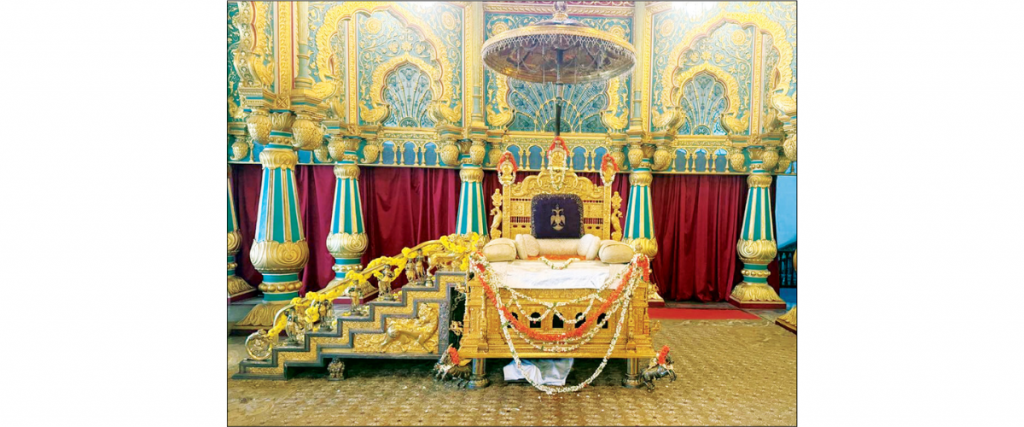
Mysuru: As preparations for the 416th Dasara got underway, the jewel-encrusted Golden Throne, known as ‘Rathna-Khachita Suvarna Simhasana,’ was assembled this morning at the Amba Vilas Durbar Hall of Mysore Palace amid traditional rituals.
The throne is one of the major attractions of Navaratri celebrations beginning Oct. 11, though it is not open for public viewing.
Pramoda Devi Wadiyar, member of the erstwhile Mysore Royal Family, supervised the assembling of the throne. Made of fig wood and covered with gold plates, the throne has a gilded appearance.
Following the rituals, the dismantled parts of the throne were brought out from the Strong Room in the underground portion of the Palace, where it is kept and taken to the Durbar Hall.
The rituals began at 7.30 am with Navagraha Homa, Shanti Homa and Havan at the Strong Room. At 10.20 am, the parts were brought to the Durbar Hall, where the assembling began. The Bhadrasana was assembled at Kannadi Thotti amid tight Police security.
The Golden Throne has 13 parts, including the steps leading to it, a golden umbrella and the main seat with cushions and armrests. Around 20 Palace staff members took part in assembling the throne.
As part of the ritual, the Pattada Aane (elephant), Pattada Kudure (horse) and Pattada Hasu (cow), all dressed in royal attire, were brought in and pujas were performed.
The Mysore Palace Board restricted entry to visitors from 10 am to 1 pm to facilitate the assembling of the throne.
As a security precaution, the CCTV cameras installed along the corridor between the Strong Room and the Amba Vilas Durbar Hall were covered. Palace staff were also not allowed to carry mobile phones inside. Their phones were collected and kept in a locker.
Private Durbar
After the Golden Throne is fully assembled, the lion-head will be fixed to it. Yaduveer Krishnadatta Chamaraja Wadiyar, scion of the erstwhile Royal Family and Mysuru-Kodagu MP, will ascend the Simhasana to conduct the Private Durbar (Khas Durbar) from Oct. 11 and also perform Ayudha Puja on Oct. 20.
The Golden Throne is believed to have originated with the Pandavas and was later adorned by the Vijayanagar kings before coming into the possession of the Wadiyars during the reign of Raja Wadiyar, who began the Dasara tradition at Srirangapatna in 1610 AD.
Even after the Princely rule was abolished, the Wadiyar descendants, now referred to as Titular rulers, have continued the tradition of holding the Private Durbar seated on the Golden Throne during Navaratri festivities, keeping alive the royal tradition.
Recent Comments