


By Dr. R. Balasubramaniam
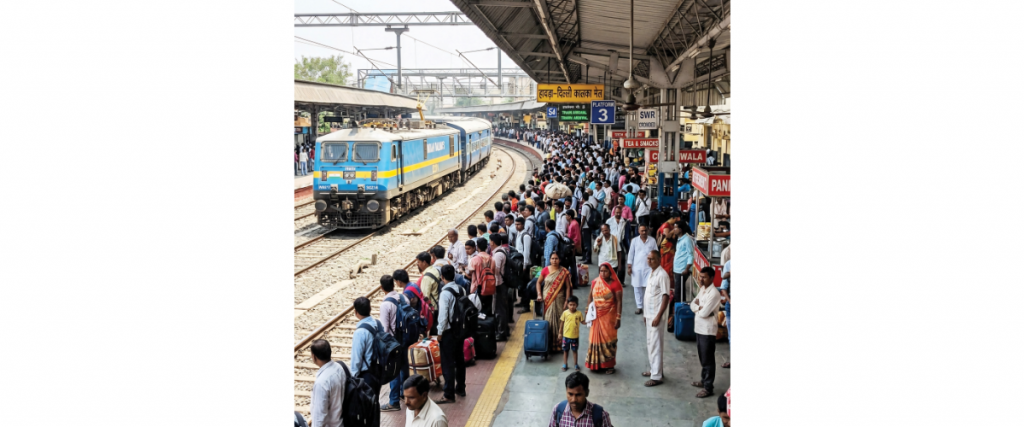
There is something deeply philosophical about an Indian railway platform. It is, if you think about it carefully enough, the only place in the country where everyone, regardless of caste, class, conviction or confusion, arrives at exactly the same level of anxiety.
I must have been around eight years old the first time my father took me to the Bengaluru railway station to receive an uncle arriving from Madras (now known as Chennai). The sheer ceremony of it was overwhelming. Father wore his good shirt. Mother had packed tiffin for the uncle who was, apparently, the kind of man who could not survive a train journey without being received with food. Platform tickets were purchased with the gravity of a financial transaction. And then we waited. And waited. And waited some more.
The train arrived on a platform that was not the one we were standing on and my father, a gentle and unhurried man by nature, transformed instantly into a sprinting philosopher, pulling me by the hand, shouting that we must run or uncle would panic. Uncle, I later discovered, was sitting perfectly calmly in the compartment eating a banana. It was the rest of us who had nearly collapsed.
Those early visits to the station planted something in me. A fascination, really, with the sheer theatre of the place. An Indian railway platform is not merely a transit point. It is a civilisation in microcosm, a temporary republic where the rules of ordinary life are gently suspended and a new, improvised order takes their place.
When I was a student travelling between Bengaluru (then known as Bangalore) and Mysuru (then known as Mysore), the platform was a battlefield. Unreserved compartments were not so much boarded as conquered. The train would arrive and before it had properly stopped, young men would be hanging from doors, hurling bags through windows, negotiating for territory with their elbows. I was no exception.
There was an art to it, a kind of competitive poetry. You had to identify the exact spot where the door would open, position yourself diagonally to absorb the first wave of the disembarking crowd and then surge forward with just the right combination of determination and apology. Getting a seat was not luck. It was strategy. It was character. It was, in retrospect, the finest preparation for public life I ever received.
The platform itself was, as I said, a different world altogether. There were families who had clearly decided that the station was a perfectly good venue for a picnic, spreading out their meals with the relaxed confidence of people who owned the space.
There were others who seemed to have gone a step further and moved in permanently, with bedding, cooking vessels and a general air of having sorted out their housing situation quite satisfactorily. Children ran in every direction simultaneously, defying both physics and parental authority.
There were men in search of water taps who wandered with the focused purposefulness of desert explorers. There were porters who could balance on their heads what three other people could not lift between them. There were beggars who had developed a professional dignity and vendors whose cries had a musicality that no concert hall has ever quite replicated.
And watching all of it was the great Indian crowd, that wonderful, maddening, tender, chaotic, generous, suspicious, spiritual and entirely human mass of people who are, when you strip away the noise, simply going somewhere, trying to get somewhere, hoping that wherever they are headed is a little better than where they have been.
Things have changed, of course. The platforms today are shinier and the trains are faster. There are digital displays and air-conditioned waiting lounges and food courts selling things that cost more than an entire railway journey once did. The Vande Bharat glides in with a quiet efficiency that would have astonished my father and mystified my uncle entirely. The young man no longer leaps from a moving platform. He tracks his train on his phone and arrives with calculated precision.
And yet. And yet, look closely and you will still find it. The man who has taped his broken suitcase with a dedication that engineering schools should study. The family that has converted two square feet of bench into a complete domestic arrangement. The traveller who has missed his train but is already working out, with admirable cheerfulness, what comes next. The jugaad, that magnificent Indian instinct for making do, for finding a way, for laughing in the face of inconvenience and carrying on, it has not left the platform. It has simply put on better clothes.
There is a lesson there that no policy document has ever quite captured. A people who can manage an Indian railway platform, who can navigate its chaos with grace and its uncertainty with humour, who can turn waiting into community and inconvenience into occasion, such a people are not merely resilient. They are, in the deepest sense, free. The platform does not defeat us. We simply board the next train.
[Dr. R. Balasubramaniam is the Founder of Swami Vivekananda Youth Movement (SVYM). ‘The Lighter Side’ is a series of satirical articles meant to bring a smile by highlighting the funny side of everyday life.]

Recent Comments