


By Dr. R. Balasubramaniam
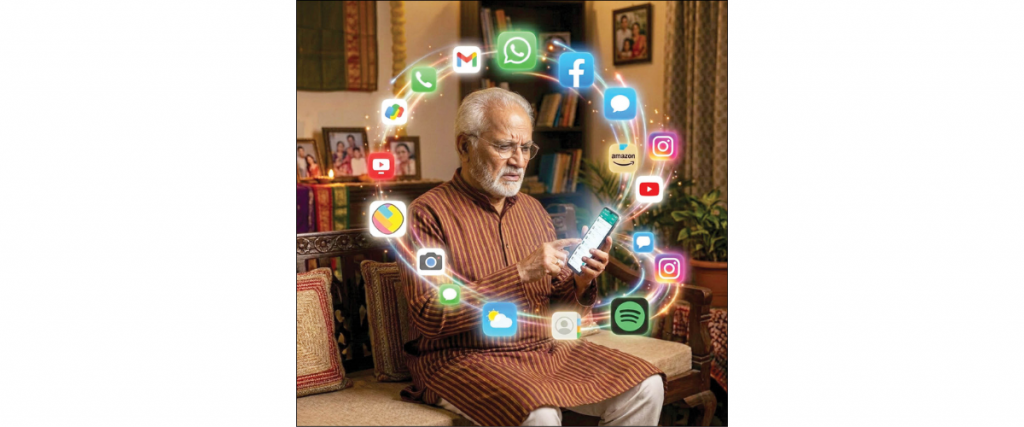
There comes a moment in every man’s life when he realises that the world has quietly marched ahead and forgotten to leave him a note. Mine arrived the morning my old phone, a faithful companion of many years, decided it had laboured enough and began switching itself off in the middle of my most earnest conversations. It was time, my family declared with great solemnity, for me to buy a new one. What sounded like a simple errand became one of the more humbling expeditions of my recent life.
I walked into the showroom with the quiet confidence of a man accustomed to advising on complex matters. I walked out two hours later feeling like a schoolboy who had failed an examination he did not know he was sitting for. The young salesman, who looked young enough to be my grandson, greeted me with a smile I would soon understand was the smile of a hunter sizing up easy prey. I told him, with what I imagined was admirable clarity, that I wanted a phone. He looked at me as though I had walked up to a doctor and asked for medicine without bothering to mention the ailment.
What followed was an avalanche of words I did not understand. He spoke of refresh rates and aperture and chipsets and something called a neural engine, which I assumed was a device that would think on my behalf, a service I was beginning to feel I sorely needed. He told me one model had a hundred and eight megapixels and waited for me to gasp. I obliged out of politeness, having no idea whether a hundred and eight of anything was a blessing or a burden.
Every feature he described seemed designed for a person I was not and would never become. There was a mode that beautified your face in photographs, which struck me as a small act of dishonesty I was not prepared to commit. There was the ability to pay for vegetables by waving the phone near a machine, to count my footsteps and to remind me to breathe. I have been breathing without supervision for over six decades and felt mildly insulted that a gadget now wished to take charge of the operation.
Through all this, one humble question kept rising in my heart. Could I, with this marvel of engineering, simply make a call and hear another human voice. The salesman seemed almost disappointed by the modesty of my ambition, as though I had wandered into a grand library and asked only for a matchstick.
I brought one home eventually, chosen less by my judgement than by my exhaustion. The real education began thereafter. My neighbour’s young children gathered around me with the expressions of patient teachers handling a particularly slow pupil. They swiped and tapped with a fluency that bordered on witchcraft, while I poked at the screen with one cautious finger as though it might bite. When I held it too close, it unlocked by reading my face. When I held it at a comfortable reading distance, it refused to recognise me, a rejection I took rather personally.
The young ones in my office find it endlessly amusing that a man who spends his days thinking about public policy and the architecture of governance cannot locate the button to answer a call. They are too kind to say it aloud, but I can read the gentle mockery in their eyes. Here is a person who can hold forth on the transformation of a nation yet cannot move a photograph from one phone to another without summoning the entire office team. I have made my peace with this irony.
And yet I have come to see something tender in this dependence. Each generation passes on what it knows and for most of human history that knowledge flowed downward from the old to the young. We taught them to walk, to read and to fold their hands in prayer.
Now the current has quietly reversed and they teach us how to live in a world they were born into and we merely arrived at. There is no shame in it, only a reminder that wisdom and competence are not always the same thing.
So, I carry my brilliant phone with its hundred and eight megapixels and its neural engine, using perhaps a tenth of what it offers, content to make my calls and read my messages and e-mails. The machine may well be smarter than me, yet I have stopped treating that as a defeat.
If you too find yourself bewildered by the gadgets your children press into your hands, take heart. Ask them, let them teach you and watch how their impatience melts into affection the moment they become your teacher. We spend our early years instructing the young and our later years being instructed by them and there is a quiet grace in completing that gentle circle. A curious mind willing to learn at any age and a heart humble enough to sit as a student before its own grandchildren, is a possession no device can offer, and no upgrade can ever replace.
[Dr. R. Balasubramaniam is the Founder of Swami Vivekananda Youth Movement (SVYM). ‘The Lighter Side’ is a series of satirical articles meant to bring a smile by highlighting the funny side of everyday life.]



Recent Comments