


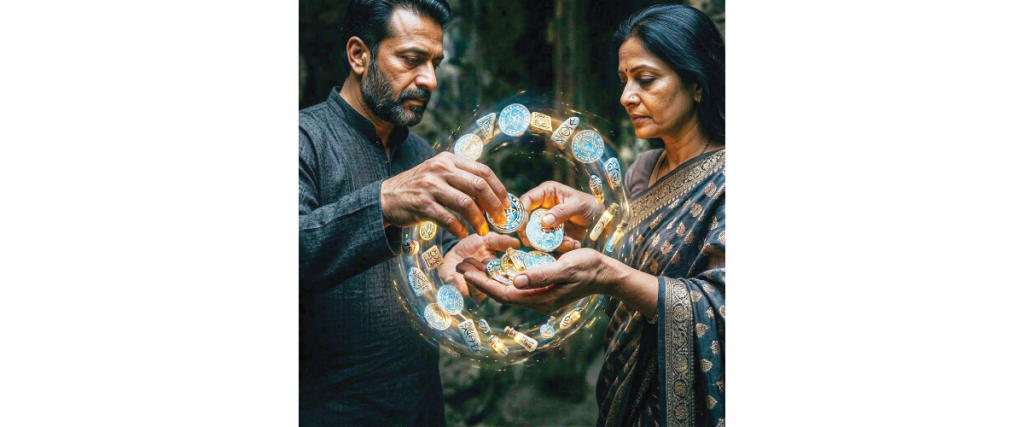
By Dr. R. Balasubramaniam
There was a time or so our grandmothers insisted, when a neighbour dropped in with a plate of payasam simply because it was Tuesday and the mood had struck her. No festival demanded it, no impending favour justified it and certainly no reciprocal plate of anything was expected in return.
I belong to a generation still gullible enough to have believed such stories. Having lived long enough now, I can report with some authority that we have moved on from that innocent republic into a far more efficient one, the Republic of Quid Pro Quo, where every gesture arrives with a small invisible invoice attached.
Consider the wedding invitation, that most sacred of Indian documents. It used to be an announcement of joy. Today it is better understood as a ledger entry. You attended my daughter’s sangeet, so naturally I must attend your son’s engagement and heaven help the relationship if the gift envelopes are not calibrated to within a reasonable margin of what was received the last time.
Uncles who have not exchanged two sentences in a decade suddenly discover deep familial affection the moment a function is announced, because attendance is currency and currency must circulate.
The WhatsApp group, that great leveller of modern civility, runs on the same principle. Someone posts a good morning message with a lotus and a sunrise and forty people must respond with a thumbs up or risk being quietly filed under ungrateful. Wish someone on their birthday and you have purchased, whether you like it or not, a small obligation that they must discharge on yours, preferably with equal enthusiasm and at least one exclamation mark more.
I have watched grown professionals, otherwise occupied with matters of consequence, anxiously scroll back through months of chat history to check who wished whom last year, lest the transaction go unsettled.
Institutions, I am sorry to say, have perfected this art rather than resisted it. The committee that invites you to chair their annual function will remember, with impressive precision, that you were invited, the moment they need a favour from your organisation. The professional body that awards you a felicitation this year will expect, with the confidence of a moneylender collecting on schedule, that you return the courtesy by inaugurating their conference the next.
Boards exchange members the way cricket teams exchange players, less for merit than for the tidy symmetry of you sit on mine and I shall sit on yours. Even academic citations have become a marketplace, where scholars quietly agree to reference each other’s papers with the warmth of two shopkeepers who have decided not to undercut one another.
Nations, being institutions with flags, have simply scaled up the same arithmetic. Diplomatic visits are rarely about affection for a neighbouring people; they are about what concession travels back in the delegation’s briefcase.
Aid is extended with a wink and a runway lease attached, votes at international forums are traded like vegetables at a Tuesday shandy and even climate change, that supposedly shared crisis of our species, gets negotiated country by country as though the atmosphere itself kept separate accounts for each nation’s carbon sins. Alliances that were once described in the grand language of shared values turn out, on closer inspection, to be joint ventures with an exit clause.
What strikes me most is how thoroughly we have convinced ourselves that this is simply how the world works, as if reciprocity itself were the highest form of relationship rather than its most anaemic substitute. We have mistaken the ledger for the friendship, the invoice for the invitation, the vote traded for the value shared.
Somewhere along the way we decided that a gesture without an expected return was either naive or suspicious and a relationship without visible benefit was hardly worth maintaining at all.
I confess I am not entirely innocent of this either. I have caught myself calculating, while accepting an invitation, what I might owe the host by the year’s end and felt a small flicker of irritation on discovering that a colleague who never once returned a favour had somehow expected several. The economics of exchange, it turns out, colonises even those of us who like to imagine ourselves above it.
Perhaps the only real rebellion left to us in the Republic of Quid Pro Quo is the occasional act that keeps no accounts at all, the phone call made for no reason except that someone came to mind, the help extended to a stranger who can offer nothing back, the payasam sent across simply because it was Tuesday and the mood struck. Such acts will not show up in anyone’s ledger and that, I suspect, is precisely why they still feel like something worth doing.
[Dr. R. Balasubramaniam is the Founder of Swami Vivekananda Youth Movement (SVYM). ‘The Lighter Side’ is a series of satirical articles meant to bring a smile by highlighting the funny side of everyday life.]




Recent Comments