


Dr. Devdutt Pattanaik – Author, Speaker, Illustrator, Mythologist
In Vedic times, graha meant malevolent spirits who hurt mothers and babies. It had nothing to do with planets. The 3,000-year-old Vedic Jyotisha had nothing to do with predicting the future. It was a practical science of time-keeping — fixing solstices, calibrating the lunar calendar, scheduling sacrifices.
The Rig Veda mentions no grahas at all. It does, however, preserve a shadowy figure called Svarbhanu who causes a solar eclipse before the sage Atri drives him off.
By the Puranic era, 2,000 years ago, the sky had become a divine family. Vivasvan, the sun, fathered planets including Shani (Saturn) and the old eclipse-demon was elaborated into a fuller drama: an asura tries to steal the amrita of immortality, the sun and moon expose him and Vishnu beheads him — his head becoming Rahu, his body Ketu.
Yet the Puranas could not agree on how many grahas there were. Early reliefs at Eran in Madhya Pradesh from 500 AD show seven, panels on Odisha temples from 800 AD show eight and the complete set of nine appears in stone only after 1,000 AD.
The turning point came after 500 AD, when Greco-Roman astronomy reshaped Indian thinking and Ujjain, located on the tropic of Cancer, emerged as the great laboratory of synthesis. Under the Sakas — horse-riding rulers from Central Asia — the city became India’s astronomical capital. Its greatest figure, Varahamihira, was the first to formally list all nine grahas, though he carefully noted that Rahu was no planet and Ketu was probably a comet — a scientific caution later devotional traditions forgot. He fixed his prime meridian through Ujjain itself. Competing legends reveal the era’s religious politics. Jains painted Varahamihira as arrogant and materialistic. Hindus made him one of King Vikramaditya’s nava-ratnas — the nine gems, echoing the nine planets. A darker Bengali folktale tells of Varahamihira’s daughter-in-law so brilliant at astrology that her father-in-law and husband cut out her tongue in jealousy, naming her Kohna — “don’t say.”
This second-wave Jyotisha was fundamentally different from its Vedic ancestor: no longer about measuring time but about predicting fortune. The grahas became forces pressing on human lives, requiring prayers and gemstones to channel them. This is why the familiar navagraha panels in temples are less than a thousand years old.
Each planet acquired personality: Brihaspati rational, Shukra intuitive, Saturn linked with crows and vultures, Mercury androgynous and riding a yali. Jewels encrusted in gold appeared in India in the Parthian era, roughly 2,000 years ago. Gems were not just jewellery. They were magical talismans protecting humans from dangers of the graha. This was the time when India was being exposed to new ideas about the sky from Greece, Rome and Persia. This is when Zodiac appears for the first time in Indian art and literature. This is when Jyotisha becomes about predicting the future.
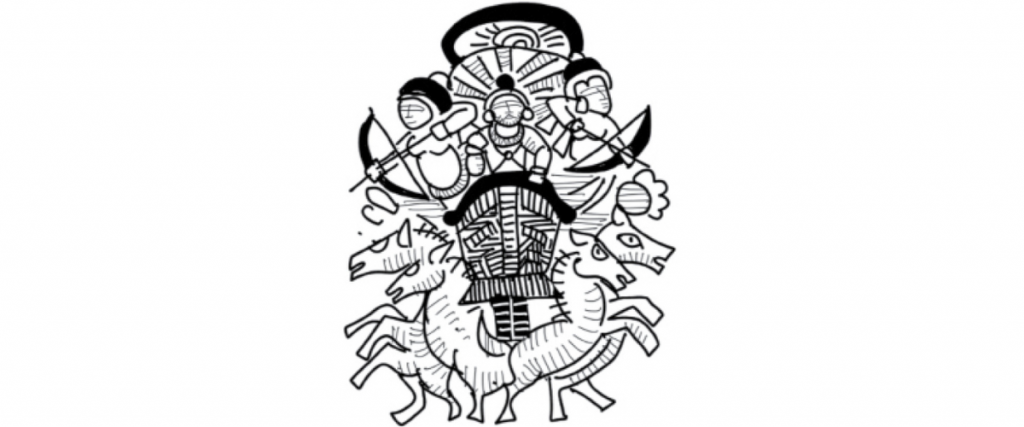
The final transformation was visual, tracking a change in warfare. As chariots gave way to cavalry, Surya’s iconography followed. Early South Indian temples show Surya, the sun-god, barefoot. But later, in North Indian temples, as in Modhera Gujarat (1100 AD), the sun-god is shown wearing leather boots, like Central Asians. This specific footwear ties into ancient iconography dictating that the sun god be dressed in udicyavesha — the Northern or Central Asian style.
Because sun worship was heavily influenced by pre-Islamic Iranian and Scythian traditions, classical artistic guidelines from texts like the Brihat Samhita specified that Surya be shown wearing a coat of mail, trousers and boots rather than traditional Indian sandals.

Recent Comments