


By Dr. R. Balasubramaniam
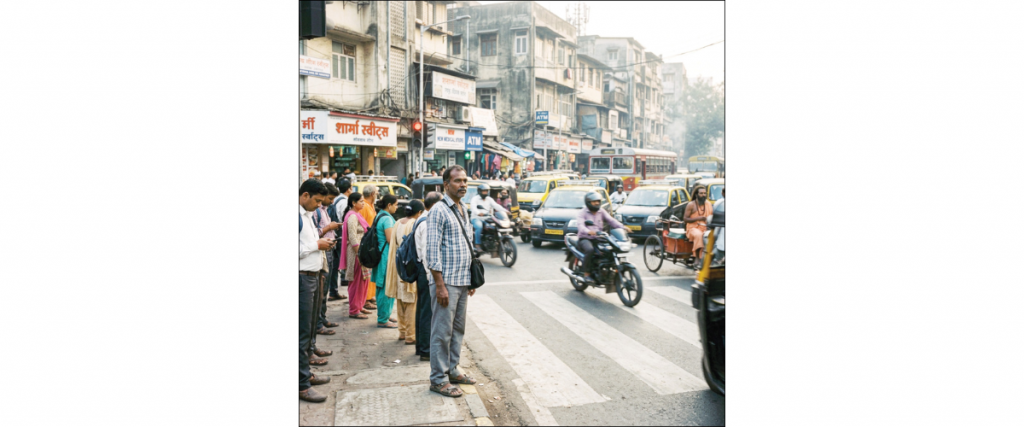
There is a particular kind of faith that gets instilled in Indian school children somewhere between learning the national anthem and being taught not to talk to strangers. It comes wearing white and black stripes and goes by the rather grand name of the pedestrian crossing. Our teachers stood us in rows on dusty school grounds and made us walk, in mock seriousness, across chalk lines drawn to resemble this magical strip of tarmac that would one day protect us from the onrushing tide of traffic.
Look right, look left, look right again and then, only then, cross with confidence, they told us, as if reciting a mantra. I absorbed this instruction the way children absorb most things taught with enough repetition and enough sternness, completely and permanently and to this day, decades later, I still find myself standing at the edge of a zebra crossing with something like devotion, waiting for my moment to walk the sacred stripes.
The trouble is that the zebra, much like its four-legged namesake in the wild, has become something of an endangered species on Indian roads. In many places the paint that once formed those confident white bands has faded into a memory, worn away by the constant passage of tyres and the equally persistent indifference of municipal maintenance schedules.
What remains is a ghost crossing, a suggestion of stripes, visible perhaps to an archaeologist of urban infrastructure but entirely invisible to the average motorist hurtling past at a speed that suggests he is late for an appointment with destiny itself. I have stood at such crossings, faint outlines beneath my feet, feeling rather like a man practising a religion whose scripture has been erased but whose rituals he continues to perform out of sheer habit and hope.
Where the paint has not vanished, a second and more interesting kind of invisibility takes over, the invisibility of the pedestrian himself in the eyes of the driver. I have tested this repeatedly, standing at a well-marked crossing with the studied patience of a man who believes in the system, only to watch vehicle after vehicle sail past without so much as a flicker of acknowledgment that a fellow citizen is attempting to exercise his constitutional right to cross the road.
There is an unspoken and entirely unofficial rule of Indian traffic that seems to tell that the crossing exists for decorative purposes, rather like a rangoli drawn outside a home, meant to be admired rather than used. The pedestrian who steps onto it does so not because he has right of way but because he has decided, in that moment, to test the theory of natural selection in real time.
Occasionally, and I treasure these moments the way one treasures a rare bird sighting, a driver actually stops. He slows down, sometimes even waves me across with a small, courteous gesture and I find myself almost moved to tears by this unexpected display of civilisation. I want to walk up to his window and thank him personally, perhaps ask for his name so that I may nominate him for some municipal award for exemplary citizenship.
But such drivers remain the exception that proves a rather uncomfortable rule, for the overwhelming majority seem to regard the sight of a pedestrian on a crossing not as a cue to slow down but as the starting gun for an impromptu race, one in which the pedestrian is expected to know, instinctively, that he has already lost.
I confess I have never quite given up my old school habit. Force of conditioning, perhaps, or simple stubbornness, but I continue to seek out the crossing, faded or fresh and place my trust in those stripes even when the evidence around me suggests that trust is entirely misplaced. There is something almost quixotic about it, an elderly man tilting at speeding cars armed with nothing but the moral authority of a painted line and a memory of primary school instructions.
But beneath the satire lies a truth that deserves to be taken seriously. A zebra crossing, whether freshly painted or barely visible, is not a decorative suggestion but a legal and moral commitment that a society makes to its most vulnerable road users, the elderly, the young, the differently abled, the ordinary citizen simply trying to get from one side of the street to the other without risking life and limb. When we ignore it as drivers, we are not merely breaking a traffic rule, we are quietly eroding the small daily contract of mutual respect that allows a diverse and crowded nation to function without descending into chaos.
Following such rules is not a matter of fear of the traffic police or the occasional challan, it is a marker of civic maturity and in a country of our size and aspiration, it is nothing less than an act of national duty. The road, after all, belongs equally to the one who drives and the one who walks and only when both remember this will the zebra, real or faded, finally mean what it was always meant to mean.
[Dr. R. Balasubramaniam is the Founder of Swami Vivekananda Youth Movement (SVYM). ‘The Lighter Side’ is a series of satirical articles meant to bring a smile by highlighting the funny side of everyday life.]

Recent Comments