


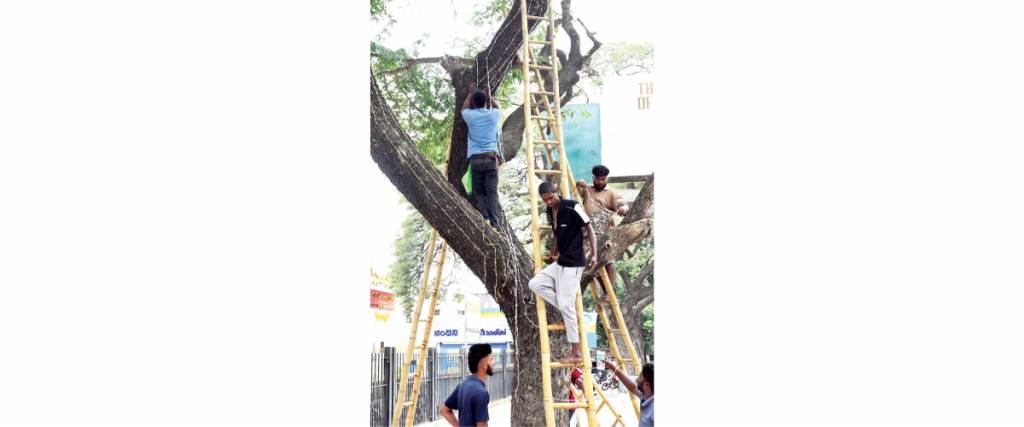
Dasara’s most beloved feature, the illumination, is going overboard and it comes with its own dark side.
Every year, thousands of decorative lights are strung across Mysuru by hammering hooks and nails into roadside trees. When the festival ends, the lights come down but the nails don’t.
Worse, more nails are added with every passing year.
If one looks closely at the avenue trees along our main roads, many of them now resemble a cactus plant!
Their trunks are studded with rusting nails from many Dasaras gone by. It is a tragic sight.
It is a fact that nails, staples and tightly wound electrical wires damage a tree’s protective bark, exposing it to disease, pests and long-term stress.
The damage extends beyond the bark. Like humans, trees, birds and most living creatures live by an internal biological clock known as the circadian rhythm. It tells them when to rest, flower, photosynthesise and feed.
The proximity of prolonged, close artificial illumination disrupts that rhythm of the trees and the creatures in it.
This is no longer merely an emotional argument advanced by tree lovers. Courts and environmental authorities have begun questioning the practice.
The National Green Tribunal has directed that damaging objects such as nails, electric wires and signboards should not be fixed onto trees.
More recently, the Bombay High Court examined whether festive illumination on trees should itself be regulated because of its ecological impact.
That said, illumination is not frivolous; it is emotional architecture. Without it Dasara would feel incomplete. Without illumination Dasara would feel like a wedding without the bride.
We need Dasara lights but we just have to do it right. Many cities around the world have already shown the way.
In Europe during Christmas, heritage streets are illuminated using temporary decorative poles and nets with LED (non-heat-generating) lights are thrown over trees instead of using nails. More importantly, they are turned off after a few hours.
They also use discreet anchor points fixed to buildings permanently to hoist lights. They use tasteful floodlighting and projection mapping to light up the main roads.
Trees remain untouched, yet the spectacle is every bit as magical. Mysuru should adopt the same approach.
The answer, therefore, is not fewer lights. It is smarter lighting.
We want class not chaos
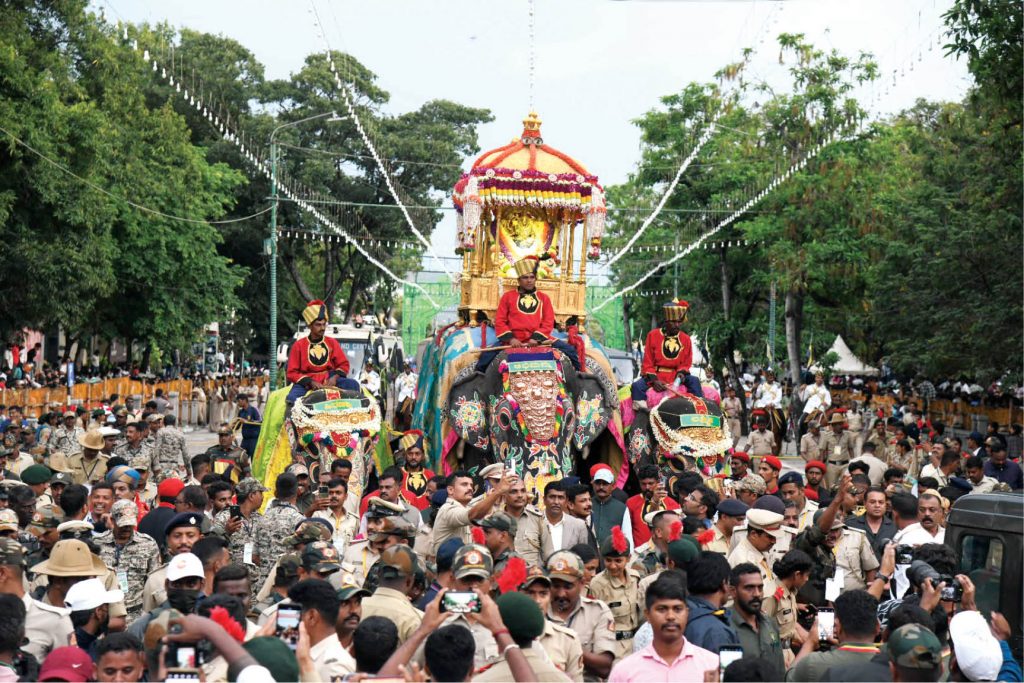
Every September, Mysuru gets its annual Botox shot. Roads are hastily patched, heritage buildings receive a fresh coat of paint, road medians regain their black and yellow stripes and the city suddenly looks camera-ready.
But is Dasara becoming grander and classier like a global tourist event? The answer is no.
Now Dasara has become an event to attract voters, not tourists. Why can’t it be for both?
Dasara grows bigger every year but never better. Sure, size impresses crowds, but quality attracts the world.
At the risk of sounding like a broken record, I repeat: Dasara must become more than a local carnival. It must become Mysuru’s calling card to the world, a festival with the scale, sophistication and prestige to rival the great cultural events of the globe.
Once upon a time, it did. Once upon a time, Dasara was a regal affair. Today, Dasara increasingly resembles a chaotic street fair, a jathre. Tickets are scarce, venues overcrowded and traffic unmanageable.
Yuva Dasara is enjoyable, but a nightmare to get into the venue and exit. The much-touted Food Mela offers neither variety nor hygiene.
The exhibition remains an overcrowded maze of predictable stalls. Even the beautiful illumination creates traffic jams that suck the joy out of it.
Dasara in recent years remains enjoyable, but it no longer feels exceptional. It does not feel grand.
Even the crown jewel, the Jumboo Savari, deserves reinvention. The tableaux often resemble reruns from the 1990s, while the bands and cultural performances have changed little over the decades.
The problem is not with tradition or an increase in population it is with execution.
Perhaps the greatest structural flaw is that Dasara continues to be managed by the Deputy Commissioner (DC), who is also the Dasara Special Officer.
The DC may be an outstanding administrator but administration and event management are two entirely different professions.
Expecting one person to simultaneously run a district and produce an international festival is like asking an airline pilot to serve passengers dinner while flying through turbulence.
Around the world, grand festivals are handled by professionals. Let professionals curate the festival while the administration provides oversight. With the right vision, Dasara could once again become regal and profitable.
Otherwise, it risks drifting further into becoming a jathre, a loud, chaotic and gaudy village fair.
For now, thanks to Dasara, in whatever form, Mysuru gets cleaned, lit and momentarily beautified. But a city should not glow only when it knows it is being watched. A heritage city like ours should shine all year-round.
e-mail: [email protected]
Recent Comments