


Over a cup of evening tea
By Dr. K. Javeed Nayeem, MD
It is a well-known sorry state of affairs in our country that all government agencies, across its vast length and breadth, care two hoots about how they spend tax-payer’s hard-earned money, on all kinds of outlandish experiments and useless projects, that do not do any good to citizens.
Mysuru city is no exception to this kind of widespread madness. We see roads being re-laid, where already perfectly good and usable roads existed, while the roads that are badly in need of much corrective action, languish unattended for years together.
Black-topped Vs white-topped
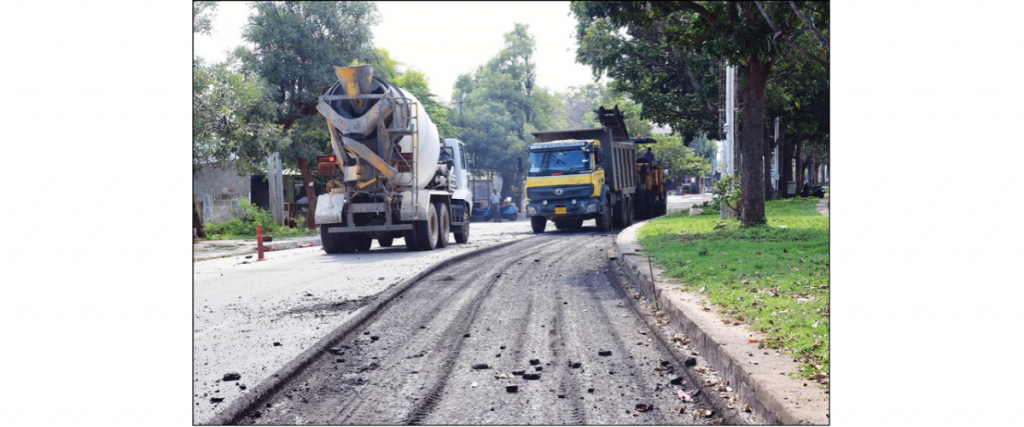
We have all been seeing how some of our excellent black-topped, asphalted roads, are of late being white-topped with concrete, in a completely needless exercise. This very expensive business of laundering our roads from black to white, certainly smacks of being motivated by some very nefarious intentions that I’ve spoken about quite frequently, in relation to many similar misdeeds.
This unholy business is very similar to the many businesses of laundering big money, from black to white, that we see going on, all around us. As I have said, this completely needless but exorbitantly expensive exercise of white-topping, has been happening while there are many areas, not just in the suburbs but also in the centre of the city, where roads are begging desperately, for some attention, to make them usable.
Digging of footpaths
Negotiating them, by any mode of transport or even on foot, especially on rainy days, becomes a Herculean exercise. We see perfectly safe and usable footpaths being relentlessly dug up and pavemented with concrete blocks. This is done without paying any heed to the pleas of citizens, not to deprive our age-old avenue trees of the rain water that they need to survive and remain strong.
Pained and angered by this stark indifference, many groups of environmental activists are often forced to take it upon themselves the responsibility of removing the tightly packed, rainwater impermeable cement blocks from around the tree bases. We see age-old, rock-solid granite slabs covering both our stormwater and sewage water drains, being removed and replaced with expensive concrete covers that are not half as strong as the ones they replace.
While being trapped in this concreting-spree and the business of expanding concrete structures of every kind, no one seems to be giving any thought to the fact that producing concrete, apart from just being very expensive, is also extremely hazardous to our environment, in many ways, some of which we as lay citizens, fail to comprehend.
Here is a small synopsis of what this does to our planet. The process of producing cement and concrete has been contributing nearly 10 percent to our already very large carbon footprint and to our global warming, while depleting sand, forest and freshwater resources, by similar numbers, in a process that is going on around the clock, each passing day.
With it preventing rainwater from percolating into the ground, an excess of concrete all around our living spaces, is the main reason why our groundwater levels are falling steadily to unreachable depths, even as our dwellings that desperately need it, are rising sky-high.
The sad irony here is that their residents, who are forced to make do with water that is conveyed to their apartments in a never-ending stream of tankers, never get to see or even imagine, the dubious sources from which this water comes to them.
The growth of our cities is certainly outstripping what used to be our agricultural land around them, taking with it all the wells, ponds, lakes and tanks that once stood therein.
Trin-Trin bicycle facility
Talking of unplanned and unnecessary misadventures right in the heart of our city, we were told very recently, that the Trin-Trin bicycle sharing facility we had for some years, has now been wound up, perhaps in an ironic Rajyotsava Day gift to us. The reason given for this move was that there were just no takers for the bicycles.
When I wrote an article when this scheme was launched, foretelling this turn of events, many people, including a good many of my friends, said that in a city like Mysuru, with short distances and many things to see, our many tourists would soon be asking for many more bicycles. But this just did not happen.
This app-based facility was launched with great hype by the Mysuru City Corporation (MCC) in association with the Directorate of Urban Land Transport (DULT) as India’s first public bicycle sharing service. It was inaugurated, by our then Chief Minister, Siddaramaiah, on 4th June, 2017 with a fleet of 450 bicycles, across 48 docking stations, at a total project cost of Rs.20.52 crore.
This translates to an astronomical and unimaginably high procurement, establishment and operating cost of Rs. 4.46 lakh per bicycle, that would in those days have procured 450 hatchback cabs, that our Corporation could have rented out to our jobless youth, providing sustenance to them and their families and the MCC could not only have recovered the cost but also shared the profit.
Instead, here is what happened. The whole scheme fell flat on its face, simply because this is not the age when people, including the poorest of the poor, cycle either for work or for sightseeing.
The rich, who do procure a bicycle, do it only for the purpose of personal fitness. And they do this by spending money, that seems like a fortune to the poor, because the cost of just one such bicycle can easily buy a couple of cars for them and their families.
Yes, try Googling names like Pinarello or Colnago, among the brands that are selling quite well in India and see for yourself where fitness bicycling stands now. Recently, as we were going somewhere in my car, I was stunned when a friend told me that to prevent a sore bottom, he had bought a special seat for his long-distance bicycle, by paying a whopping Rs.1.5 lakh. That was like a kick on my bottom, enough to make me jump out of my seat and almost out of the car too!
Since this is the bicycling scenario now, it should not be too difficult to understand why the humble Trin-Trin bicycles, meant for commuting, had no takers in Namma Mysuru, even after they were introduced in their motorized versions, to prevent sore feet.
From the long-gone days of cycling out of sheer necessity, to cycling only to keep yourself fit, the bicycle wheel has now certainly turned a full circle, even as we, the tax-payers stand helplessly and watch how our money is going down the town drain!
e-mail: [email protected]
Recent Comments