


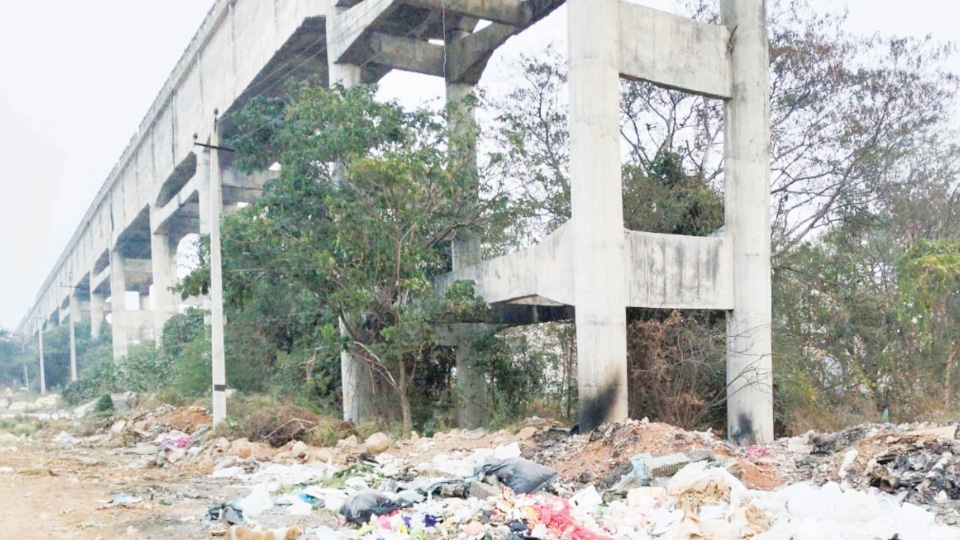
Mysuru, Feb. 16 – The aqueduct of the Varuna Canal near Old Kesare passing over Mysuru-Bengaluru Highway is facing a serious threat due to the open burning of heaps of waste and cables to extract copper at the base of the pillars supporting the overhead structure.
The Varuna Canal stretches about 126 kms and was constructed over 13 years, from 1987 to 2000. Three major aqueducts, carrying 980 cusecs of water, serve as crucial links in irrigating nearly 80,000 acres of agricultural land.
These elevated concrete water-carrying structures are located at Belagola (Mandya), Siddalingapura (Mysuru-Bengaluru Road) and Gejjagalli (Mysuru-Nanjangud Road).
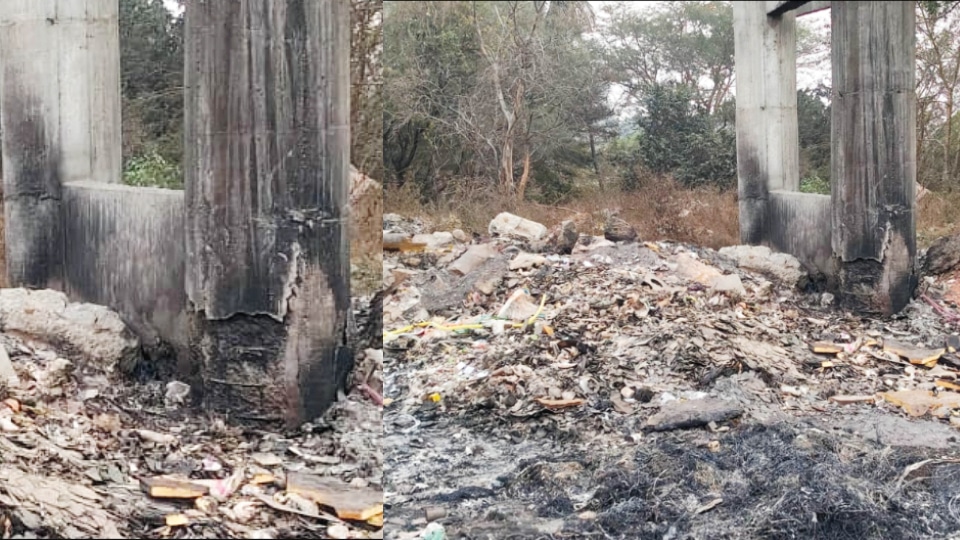
Concern now centres on a 1.8-km stretch of the aqueduct supported by more than 10 pillars. Cracks have developed in parts of the structure, with reinforcement rods becoming visible as the concrete peels away. The damage is believed to be aggravated by intense heat from fires lit on dumped waste below.
Cable burning suspected
Though it remains unclear who is responsible, the secluded area is reportedly being used to burn copper cables to extract metal for sale in scrap yards. The cables may be stolen or illegally obtained, but are destroyed to retrieve copper for a small profit.
Police alert irrigation authorities
The issue has gained urgency after Jayalakshmipuram Police Inspector Kumar, who also holds the additional charge of Narasimharaja Police Station, wrote to the Executive Engineer of Cauvery Neeravari Nigam Limited (CNNL).
In his Feb. 14 letter, the Inspector stated that miscreants were dumping waste and burning wires beneath the aqueduct, causing cracks in the pillars. He urged immediate repairs and strict action against those responsible, warning that authorities could be held accountable for any untoward incident in future.
Risk of collapse and pollution
Speaking to Star of Mysore, Inspector Kumar cautioned that collapse of even one pillar could bring down a portion of the aqueduct, flooding nearby agricultural fields and residential areas. The risk is particularly serious as the aqueduct passes above the Mysuru-Bengaluru Highway near Siddalingapura and the Mysuru-Nanjangud Road near Gejjagalli.
Night-time burning of waste is also causing severe air pollution due to the release of toxic fumes, posing health hazards to residents of surrounding areas.
Apart from nearby villages, several residential areas could be affected, including Amrutha Layout developed by the Karnataka Slum Development Board, Naguvanahalli, Devanur, parts of Rajivnagar, Hanchya-Sathagalli and Bharath Nagar.
Authorities acknowledge grave problem
CNNL officials said, inspections had been carried out and complaints lodged with Siddalingapura Gram Panchayat, but no action followed. Authorities plan intensified enforcement next week, including visits to nearby factories to warn against dumping and burning activities that threaten the aqueduct’s foundation.
CNNL has also written to the Karnataka State Pollution Control Board (KSPCB) regional office in Mysuru, which in turn informed Siddalingapura Gram Panchayat, but the issue persists.
Inspector Kumar had earlier written to the KSPCB regional office in Hebbal Industrial Area on Feb. 2, 2026, seeking intervention in the interest of public health.
Will CM Siddaramaiah, Varuna MLA, intervene?
Any mention of Varuna Canal (D. Devaraj Urs Canal) inevitably brings up the name of Chief Minister Siddaramaiah, the current Varuna MLA, widely regarded as the driving force behind the major irrigation project that has become a landmark structure.
With Mysuru being his hometown, there is growing concern that the present issue affecting the canal’s aqueduct must be addressed without delay to preserve the structure for future generations.
On Feb. 13 and 14, an International Conference on Dam Safety was held in Bengaluru, organised by the Union Ministry of Jal Shakti, Department of Water Resources. Panel discussions focused on ageing dams and state-of-the-art rehabilitation practices, risk-informed decision-making for dam safety and dam failure case studies.
While dams and aqueducts differ in structure, both serve the common purpose of carrying water to irrigate agricultural land. Any failure in such infrastructure could have disastrous consequences and add to the list of man-made disasters.
Recent Comments