


By Dr. C.D. Sreenivasa Murthy, Physician, Cardiologist and Member of Freemasons Lodge Mysore No. 34
Before independence, the British governed India through a dual system. Approximately two-thirds of the country was under direct British control via Presidencies and Provinces, managed by Governors or Commissioners. The remainder consisted of Princely States, which were ruled by local monarchs under treaties with British Crown.
While Britain held suzerainty — acting as the paramount power — these States enjoyed relative administrative autonomy, though defence, communications and external affairs remained under British jurisdiction.
The lapse of suzerainty and the challenge of accession
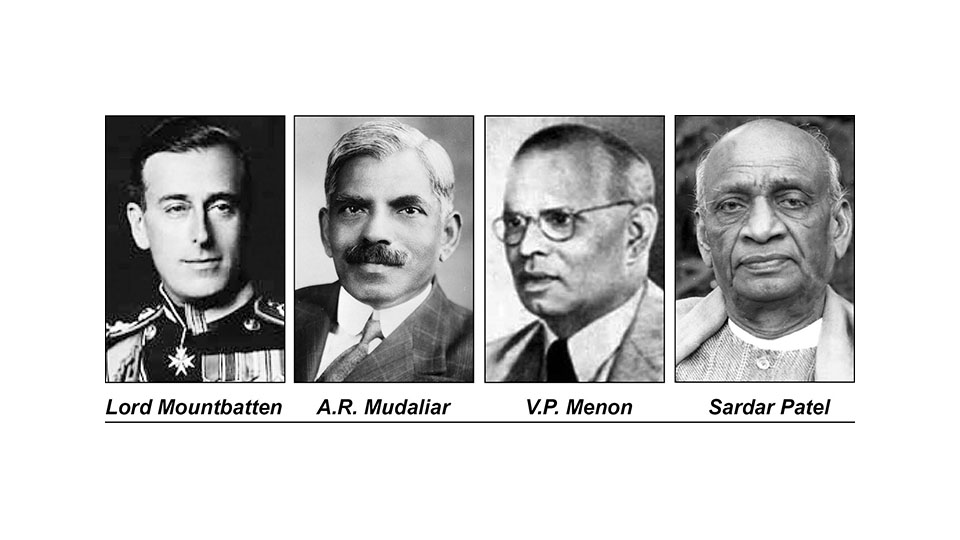
When the British Government decided to exit the subcontinent by partitioning it into India and Pakistan, British suzerainty over the Princely States lapsed. Technically, this rendered more than 540 States independent. Viceroy Lord Mountbatten advised these rulers to join either India or Pakistan, primarily based on geographical contiguity.
At the dawn of independence, the largest of these States were Kashmir, Hyderabad and Mysore. Home Minister Sardar Patel and his Secretary, V.P. Menon, spearheaded the reorganisation of these States. They urged rulers to sign two key documents:
1. The Instrument of Accession: Ceding defence, communications and external affairs to the Central Government.
2. The Standstill Agreement: Ensuring administrative continuity during the transition.
Among the major States, Jayachamaraja Wadiyar, the Maharaja of Mysore, was the first to sign these documents on August 9, 1947. They were formally accepted by Lord Mountbatten on August 16, 1947. In contrast, Kashmir and Hyderabad refrained from signing at the time of independence.
The ‘Mysore Chalo’
Movement
Despite the Maharaja’s early accession, domestic tension rose. The Mysore State Congress and various freedom fighters demanded that the Maharaja replace the rule of the Dewan, Sir Arcot Ramaswamy Mudaliar, with a popular, representative Government. When this transition did not immediately occur, the ‘Mysore Chalo’ Movement (also known as the Palace Satyagraha) was launched.
Led by Sri K. Chengalraya Reddy, the movement saw activists from across the State converge on Mysore City. The agitation occasionally turned violent; notably, a student named Ramaswamy was killed during Police firing at a major intersection. Today, the ‘Five Lights Circle’ on JLB Road in Mysore is named Ramaswamy Circle in his honour.
While Dewan Mudaliar and Private Secretary T. Thamboo Chetty were criticised at the time for allegedly delaying the establishment of a responsible Government, history also credits Mudaliar for his instrumental role in guiding Mysore’s swift integration into the Indian Union.
The path to a sovereign republic
Succumbing to popular demand, Maharaja invited K.C. Reddy to become the first CM of Mysore. The oath of office was administered at the Mysore Palace on October 25, 1947, with A.R. Mudaliar continuing his service as Dewan.
Initially, the Mysore leadership envisioned a federal structure where the State could remain a constitutional monarchy. To this end, a Constituent Assembly was established by royal proclamation on October 29, 1947.
Sardar Patel even sent a congratulatory message, wishing the Assembly success in fashioning a constitution “worthy of the traditions of Mysore.”
However, after members were elected for the Constituent Assembly in March 1948 — with the Congress party winning a landslide 68 of 76 seats — the Assembly ultimately decided against a separate constitution. Instead, they resolved in 1949 to adopt the Constitution of India.
The inauguration of the Republic
On Nov. 25, 1949, the Maharaja issued a proclamation accepting the Draft Constitution of India. On Jan. 26, 1950, Mysore officially became a Part-B State of the Union. The Maharaja’s role transitioned to that of Rajapramukh (Constitutional Governor). The historic day was marked by a grand ceremony:
10.15 am: A special durbar was held at the Mysore Palace, where the Maharaja read the proclamation of the Indian Republic and took his oath as Rajapramukh.
Military honours: A 21-gun salute was fired from the Palace battery.
Public celebration: The Maharaja drove from the Palace to Government House for a ceremonial parade and the unfurling of the National Flag.
Evening festivities: The day concluded with a garden party for 2,000 guests at the Chamundi Gymkhana.
The Mysore Constituent Assembly continued to serve as the State’s provisional Legislative Assembly until the first general elections were held in 1952.
Maharaja Jayachamaraja Wadiyar, born on July 18, 1919, was a towering figure in both stature and spirit — handsome, highly educated and deeply cultured. At the young age of twenty-one, he ascended the throne of the Princely State of Mysore on Sept. 8, 1940, becoming its 25th Maharaja.
His reign came to a historic close on Jan. 26, 1950, when Mysore merged with the newly formed Indian Republic. He stood as the 25th sovereign of the illustrious Wadiyar dynasty, a royal lineage that began with Raja Wadiyar in 1399 and ruled Mysore uninterrupted for 651 years.
On India’s first Republic Day, the magnificent Wadiyar dynasty gracefully passed from the realm of power into the pages of history.
Recent Comments