


By Anirudh Badarinath
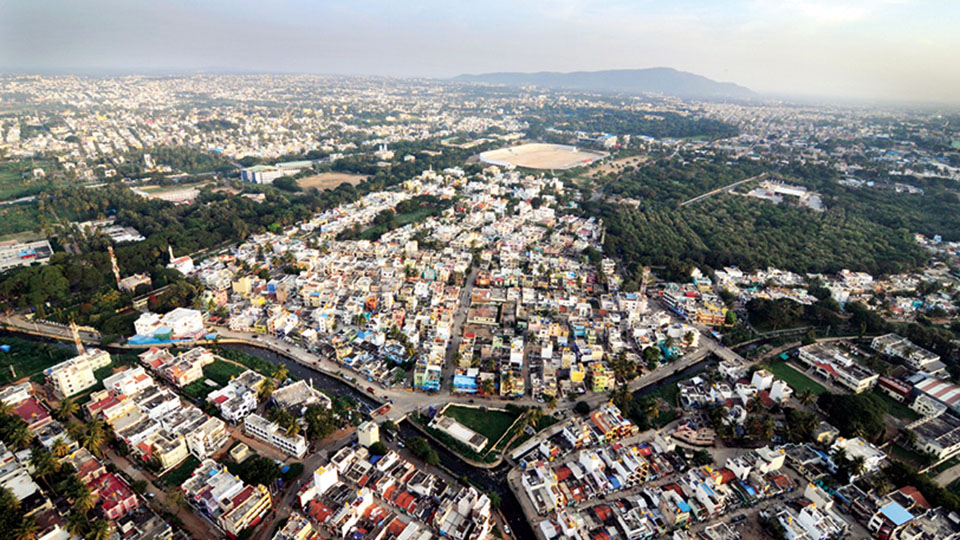
For decades, Mysuru was admired as a city where growth felt measured and well thought out. But now, we are now at a point where Mysuru’s reality seems to be irreversibly changing and it is certainly a good idea for the city to be sufficiently prepared.
For starters, it is about time that local governments and citizens come to terms with the rise in vehicular population. As per official statistics available from the MoRTH, in 2025 and 2024, there were, on average, 83,700 vehicle registrations per year across both the RTOs in city.
To put that in perspective, that is about 230 new vehicles added every day !
When tens of thousands of new vehicles hit the road each year, not only does congestion surge, but the need for parking, road space and traffic management increases.
The flip-side to this conversation is that public transportation in Mysuru has not kept pace with this private vehicle boom.
The Ministry of Housing and Urban Affairs, in its service level benchmark for urban transport, recommends that cities plan to equip their public transport options to a desirable level of at least 60 buses per lakh population.
Although Mysuru does not yet have a city-specific entity operating buses, the KSRTC Mysuru City Division reportedly operates nearly 560 buses, translating to just about 40 buses per lakh population. Simply put, there remains much to be done in strengthening the city’s bus service.
These numbers also convey an uncomfortable truth: The share of “quality buses” and efficiency of public transport in terms of keeping time, modes has grown far more slowly than private vehicles.
Riding a bus often means compromises related to time, comfort and convenience, while private vehicles promise control, even if they come at the cost of gridlock and pollution.
This imbalance is not unique to Mysuru. But what is unique is the city’s window of opportunity to shape its future before hitting a point of no return.
At the heart of this opportunity lies a simple question: who shapes the decisions that guide urban growth?
Too often in Indian cities, major decisions about land use, transport infrastructure and development tends to rest within administrative offices with limited opportunities for meaningful public engagement right from the earliest and formative stages of planning.
Urban planners, professionals trained to think about land use, mobility, environment and social equity, are frequently brought in only after key decisions have been made. Their role becomes technical validation rather than strategic guidance.
Citizens, similarly, are invited to react after plans are approved, rather than being involved before priorities are set. This is not how healthy cities grow.
Cities that have managed rapid growth while retaining liveability — from Singapore to Seoul — share one principle: Planning is central to governance, not an afterthought.
Data on population, travel patterns and land use are made public, discussed in community forums and used to test alternatives before commitments are made.
Mysuru can embrace this model. Three practical ways citizens can play an active role in shaping decisions are, first, Engage early and constructively.
Citizens’ groups, whether neighbourhood associations, student forums or professional networks can prepare constructive inputs ahead of proposals and bring evidence-based alternatives to the table.
Use data and tools that already exist. The VAHAN dashboard and other public transport data platforms provide evidence of vehicle growth, mode shares and trends.
Citizens who understand these trends can push for solutions, not by opposition but by proposing viable improvements in bus networks, cycling infrastructure and walkable neighbourhoods.
When people have access to information early, the questions asked in consultations become rooted in shared facts rather than mistrust.
Growth is not something to be merely opposed. Growth is inevitable. What matters is whether the city directs that growth or merely endures its consequences.
Mysuru’s growth story need not be a tale of congestion, conflict and fragmented decisions. We still have the chance to shape growth deliberately rather than inherit it by default.
It is time citizens get involved in local issues from your local drainage to garbage collection to cities infrastructure and green cover proposals.
Anirudh Badarinath is one of the partners of Beyond Urban, a urban planning and policy consultancy based in Mysuru. A post graduate in Infrastructure Engineering Design from CEPT University, Ahmedabad, Anirudh holds a Ph.D. degree from Architecture and Regional Planning Department at IIT Kharagpur.

Recent Comments