


The French-born celebrated sculptor of the time; William Robert Colton was commissioned to make the statue of Chamarajendra Wadiyar X in white Italian marble. As the statue’s face bore no resemblance to the face of late King, the Queen commissioned Ganpatrao K. Mahatre from Bombay to make the correction
By Dr. K. Javeed Nayeem
Last week, I wrote about the rather unhappy state of some of the statues, both already unveiled and yet to be unveiled, that have been erected in our city and strategically positioned in some very prominent places. In response to this writeup, I received a number of responses, most of which seemed to be in agreement with what most Mysureans feel; that a statue erected as a memorial, should do justice to the likeness, stature and dignity of the personality it is meant to immortalise and that it should be treated with due respect, both before and after its installation.
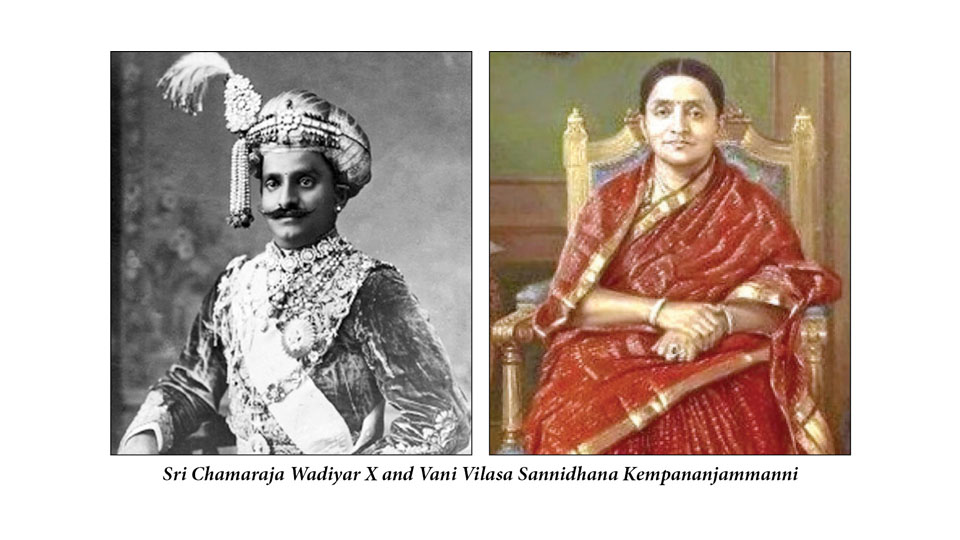
This is the exact spirit that seems to have guided one of our most illustrious late Maharanis, Smt. Vani Vilasa Sannidhana Kempananjammanni, when she got the statue of her late husband His Highness Sri Chamaraja Wadiyar X, the 23rd Maharaja of Mysore, erected where it stands now, opposite to The Mysore Palace. But before I set out to tell you about the most unusual and interesting incident related to the installation of this statue, the lady herself richly deserves more than a brief recap of her own towering personality.
Kempananjammanni, daughter of Narse Urs, was born in the tiny village of Kalale, near Nanjangud in 1866. She was married to the Maharaja on 26 May 1878 at the age of 12 and assumed the prefix ‘Vani Vilasa Sannidhana’ to her name, as was the practice in the Mysore Royal family. In 1884, their first child, H.H. Krishnaraja Wadiyar IV, who later became the Maharaja, was born to the royal couple.
Maharaja Chamarajendra Wadiyar, while on a visit to Calcutta, developed diphtheria and passed away most suddenly, on 28th December 1894, thus abruptly cutting short a promising reign that lasted only 13 years. He was just 32 but he had already left his mark as an excellent and far-sighted ruler.
This unexpected tragedy was regarded as a great national misfortune throughout India and was also termed by the British Government as an imperial loss. The royal family plunged into great sorrow and the citizens were said to have felt orphaned.
Describing the death of the Maharaja of Mysore, G.R. Josyer, in his book, ‘History of Mysore and the Yadava Dynasty’, wrote: “He had gone on a cold weather tour to Calcutta, then the Capital of the Indian Empire. On his arrival at Calcutta, a slight throat infection that he had been feeling during the journey, developed into diphtheria which was beyond medical aid and he passed away.
His family, Maharani Vani Vilasa Sannidhana and two sons and three daughters, as well as Dewan Sir K. Seshadri Iyer, who had accompanied him on the journey, were heartbroken and after cremating his mortal remains in Kalighat, returned to Mysore, widowed, orphaned, disturbed and distraught.”
Since his first-born son, H.H. Krishnaraja Wadiyar IV was only 10 years old at that time, his mother, became the Queen-Regent. Though the death of the Maharaja was a terrible blow to the Maharani, she rose to the occasion and decided to carry on with the administration of the State, ably assisted by Dewan K. Seshadri Iyer and an executive council of three members comprising T.R.A. Thumboo Chetty, P.N. Krishnamurthy and Abdul Rahman.
She was also assisted as her private secretary, by her brother Sri M. Kantaraj Urs, who later became her son-in-law and the Dewan of the State. When she came to power, Mysore was under the grip of an epidemic of bubonic plague, in which nearly half of Mysore’s population was wiped out. Her resilience came through as she increased spending on healthcare and built many hospitals and the Victoria Hospital in Bengaluru was built to help people during the plague epidemic.
During her seven-year regency, the State witnessed much progress, especially in the field of public works, health and education. To provide irrigation facilities to Chitradurga district, a dam across the Vedavathi river was built which was later named as the Vani Vilasa Sagara Dam. The Shivanasamudram Hydroelectric Project was undertaken during 1899-1900 and electricity was supplied to KGF in 1902 and to Bangalore in 1905.
Bangalore was provided with drinking water through pipes from the Hesaraghatta reservoir. She also helped in establishing the Indian Institute of Science there by giving financial support and 372 acres of land for it. In February 1897, a portion of the Mysore wooden Palace was destroyed due to a fire.
The work of rebuilding the Palace, based on a new design prepared by an English architect, Henry Irwin, was completed in 1912. The Maharani laid much emphasis on promoting female education and by 1902, there were 235 public schools for girls across the State with 12,500 girls studying therein.
In 1902, for the first time in the history of South India, two women candidates from the Maharani’s College Mysore appeared for the BA examination and passed it.
On August 8, 1902, when Krishnaraja Wadiyar IV, ascended the throne, at the age of 18 and began his direct rule over the State, the regency of the queen ended, after a most glorious innings. In recognition of her regency, upon the request of Lord Curzon, the British Crown sanctioned the privilege of raising a 19-gun salute on ceremonial occasions, to the Maharani and in 1893, she was conferred the ‘Crown of India’ award. She passed away peacefully at the Bangalore Palace on July 8, 1934.
The earliest memorial Maharani Vani Vilasa Sannidhana Kempananjammanni built, to commemorate the memory of her short-lived husband, was his statue, that now stands under a gold-domed canopy, opposite Northern Gate of our Amba Vilas Palace. Her husband, Maharaja Chamarajendra Wadiyar was the King of Mysore between 1868 & 1894.
Incidentally, although he ruled only for a relatively short period, this 23rd Maharaja of Mysore State, born on 22nd, February, 1863 and groomed and handed the reins of governance by the British on 25th, March, 1881 is credited with many major contributions to our State.
He established the Oriental Research Institute in 1891, Maharaja’s College in 1889, the Maharaja’s School of Sanskrit and the Mysore Zoo, which is now named after him. Most interestingly, he was the person who, just a little more than a year before departing from this world, funded and sponsored the trip of Swami Vivekananda to Chicago where he made the famed address at The Parliament of The World’s Religions, which made him famous all over the world, as India’s tallest ambassador of goodwill.
It is indeed a strange coincidence that this man who helped the sage to become India’s most well-known philosopher and spread his message far and wide across the globe, bid adieu to his own life in the sage’s birthplace! A hale and healthy man, while on a visit to Kolkata to meet Lord Elgin, the Viceroy, he suddenly died of Diphtheria on 28th December 1894 at a very young age of just 31 years. Interestingly, his statue, erected by the lady he married in May 1878, portraying him in a standing posture, wearing his full military gear, has a story of its own.
The French born celebrated sculptor of the time; William Robert Colton was commissioned to make this statue in white Italian marble. He was well-known to the Mysore royal family as he had executed many famous sculptures in India.
Even the eight, fiercely snarling bronze lions positioned in and around the Mysore Palace, are the works of Colton. But when Colton completed his assignment and showed his work to the Maharani in 1918, the queen was aghast! She felt that the statue’s face bore no resemblance to the face of her late husband!
That was when Ganpatrao K. Mahatre from Bombay, arguably the most accomplished Indian sculptor of that time, was commissioned to make the correction. He seems to have done his job to the full satisfaction of the queen and he was therefore allowed to fix it after sawing off the existing head of the king’s statue.
The new statue was then installed on its pedestal and formally inaugurated in 1920. The job has been so deftly done that there are just no visible signs of the radical surgery. But every time I pass by the Chamaraja Circle which I do very often, I cannot help wondering what happened to the infamous head that was chopped off and where it lies now!
(A little more about, Colton, Ganapat Rao and another most unusual statue, next week!)
e-mail: [email protected]
Recent Comments