


Mysuru Literature Festival – 2026
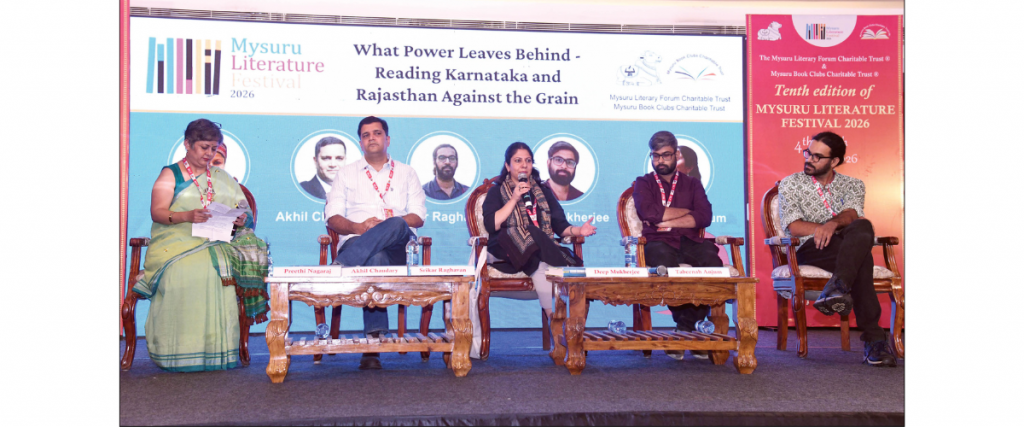
Mysuru: Rajasthan, India’s largest State, stands out for its rich cultural diversity, arts, crafts and traditions. But beyond its vibrant heritage, the State also offers vital insights into the political and social currents shaping Hindi-speaking North India, said senior journalist Tabeenah Anjum.
She was speaking yesterday at the 10th edition of the Mysuru Literature Festival during the English panel discussion on the topic ‘What Power Leaves Behind – Reading Karnataka and Rajasthan Against the Grain.’
Anjum said, book ‘From Dynasties To Democracy’ focuses on the political transformations that unfolded in Rajasthan after Independence. She noted that many former princely rulers quickly realised that participating in electoral politics was the only way to remain politically relevant.
They adapted to democratic system with remarkable speed. Still, caste politics, struggles for community rights, Dalit & tribal assertion and religious polarisation have continued to define the State’s political landscape.
Why politics matters
Describing the book as the culmination of 10 to 15 years of journalistic experience and five years of research, Anjum said it seeks to answer fundamental questions about why politics matters, why caste continues to play a decisive role, how religious politics evolves and how marginalised communities fight for dignity and representation.
She said, Rajasthan was chosen because it reflects almost every dimension of North India’s political & social transformation. “This is not just Rajasthan’s story; it is a lens to understand contemporary North India,” she said.
Responding to a question from senior journalist & author Preethi Nagaraj on caste politics in Rajasthan, Deep Mukherjee said, understanding its complexities requires revisiting the early years after Independence.
While the Congress emerged as the dominant political force across most Hindi-speaking States because of its role in the freedom struggle, Rajasthan followed a different trajectory.
“Congress secured power only after facing stiff resistance from former royals, landlords, and feudal elites, who united to oppose it. At the same time, peasant movements helped strengthen the party’s base, particularly among agrarian communities such as the Jats,” he opined.
Mukherjee noted that the ideological predecessors of the BJP, including Ram Rajya Parishad and Bharatiya Jana Sangh, drew significant support from royal families and feudal groups seeking to preserve their traditional influence. Many members of these sections contested elections either through these parties or as Independents.
Concluding the discussion, Mukherjee said, Rajasthan’s caste politics remains layered and complex. “It cannot be understood in black-and-white terms; it is embedded with multiple social and political dimensions,” he said. The discussion was attended by Srikar Raghavan and Akhil Choudhary.
Recent Comments