


Fleeting Thoughts By Ashvini Ranjan
How inefficient administration chokes our cities
Whenever the subject of increasing traffic congestion in Mysuru comes up, the explanations are almost always the same. There are simply too many cars and two-wheelers on the road. The roads are narrow and full of potholes. Traffic lights malfunction. Road works continue endlessly. While all these undoubtedly contribute to congestion, they are only one part of the story.
There is another important reason that receives very little attention.
Imagine stopping one hundred people travelling on Mysuru’s roads on a normal working day and asking them two simple questions:
Where are you going?
Apart from those commuting to work or school, a surprisingly large number would be travelling to a government office, a court, a bank or some other public institution to complete a task that often requires repeated visits.
Now ask them the next question:
Is this your first visit?
Many would answer, “No.”
Some would be making their second or third visit. Others may have been coming for months, and in the case of legal disputes, even for years.
India’s judicial system illustrates this problem vividly. According to the National Judicial Data Grid, more than 56 million cases are pending across the country’s courts. Many civil disputes take years and sometimes decades to reach a conclusion. Every adjournment means another visit to a court, another day’s work lost, another addition to traffic on our roads.
The same pattern is visible across many government departments. Citizens often make multiple trips because a document is missing, a signature is unavailable, an officer is on leave, a file has not moved or another procedural requirement has emerged. At other times, the concerned official is attending a meeting or is away on official duty. While these situations may individually be unavoidable, together they create a system that demands repeated physical visits from citizens.
Much of this complexity has its roots in administrative systems inherited from the colonial era. These procedures were originally designed for control and verification rather than citizen convenience. Although India has made remarkable progress in digitisation through initiatives such as Aadhaar, online tax filing and other digital public services, many routine interactions with government still require physical presence, multiple forms and repeated verification.
The result is not merely inconvenience; it has wider economic consequences. Every unnecessary trip consumes fuel, contributes to pollution, increases traffic congestion, wastes productive working hours and adds to public frustration. When thousands of citizens are compelled to make repeated journeys every day, the cumulative impact on a city’s traffic becomes significant.
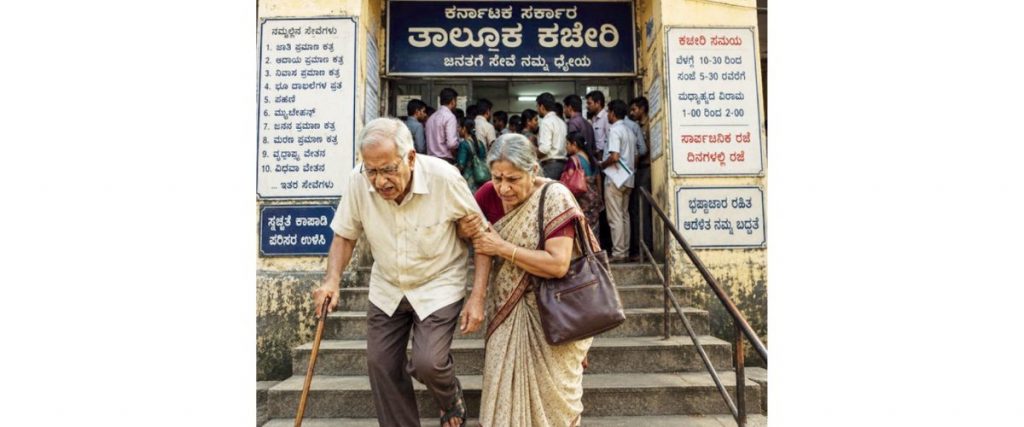
Senior citizens bear a disproportionate share of this burden. Many are required to visit government offices for pensions, property matters, revenue records or legal proceedings. Long queues, uncertain appointments, repeated travel and inaccessible buildings make these visits physically exhausting. For those without digital literacy or family support, there is often little alternative but to endure the process.
The solution lies not only in building more roads or widening existing ones, but also in reducing the need for unnecessary travel. Government departments should adopt a “single-visit” or wherever possible, a “no-visit” approach. Services should be delivered online, appointments honoured on time, document requirements clearly communicated in advance and officials held accountable for service standards. Citizens should be able to track the progress of their applications digitally instead of repeatedly visiting offices.
Traffic congestion is not merely an engineering problem. It is also a governance problem.
Every unnecessary visit to a government office or courtroom adds one more vehicle to the road. If administrative systems become simpler, more transparent and more citizen-friendly, we may discover that one of the most effective ways to reduce traffic is not by constructing flyovers or tunnel roads, but by ensuring that citizens no longer need to make journeys that should never have been necessary in the first place.

Recent Comments