


By Dr. R. Balasubramaniam
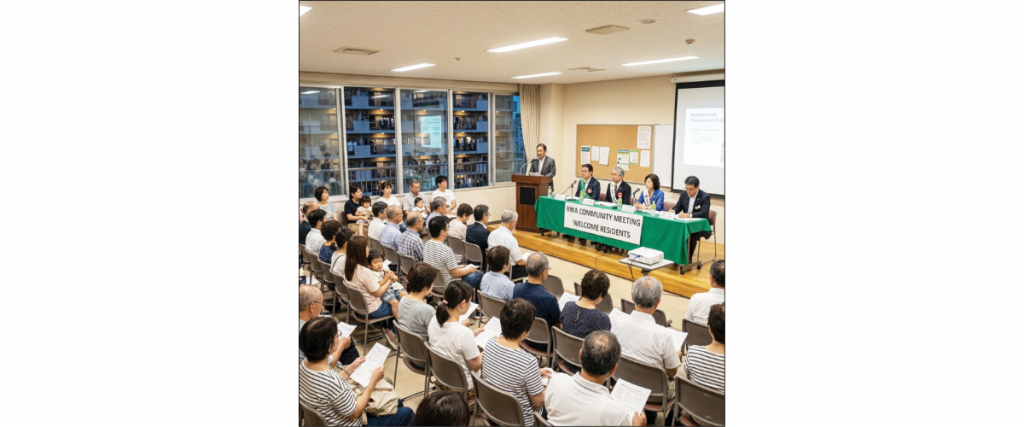
There is a particular kind of democracy that flourishes in India without ever appearing in any political science textbook and I have had the privilege of observing it from two rather different vantage points over the years, first as a resident of an apartment complex governed by its own welfare association and more recently as a resident of an independent house that belongs to an entirely separate welfare association covering the wider locality.
Between these two experiences I have gathered enough material to suggest that if Parliament ever wishes to study the true art of prolonged debate over trivial matters, it need look no further than the nearest RWA (Resident Welfare Association) meeting.
In the apartment complex, the theatre was compact and intense, rather like a pressure cooker with excellent acoustics. Neighbours who exchanged nothing more than a polite nod in the lift through the week would arrive at the annual meeting transformed into passionate orators, ready to hold forth for forty minutes on whether the visitor’s parking slot nearest the gate belonged by tradition, by seniority or by some yet undiscovered constitutional principle to a particular flat.
I recall one memorable evening devoted entirely to a barking dog on the fourth floor, debated with a solemnity that suggested matters of national security were at stake, complete with a sub-committee formed and at least one resident threatening to escalate the issue to a level never quite specified but suitably ominous.
The independent house, I imagined, would offer a quieter existence, free from the intimacy of shared walls and shared lifts. I was mistaken. The locality RWA turned out to have its own considerable appetite for procedure, except that here the debates widened in scope to match the wider terrain, covering everything from the exact timings of the night security guard’s rounds to the far more contentious question of the payment of annual dues and other fees.
Whether the RWA could deny services if the payment was not made or the executive committee members could resign enmasse in frustration were discussions that consumed two full meetings and very nearly a third before a compromise was reached that pleased nobody and therefore, by the peculiar logic of committees everywhere, was declared a success.
What strikes me most, having sat through both varieties of this experience, is how faithfully the RWA reproduces in miniature every feature of larger governance that we usually reserve for criticising from a comfortable distance. There is the perennial shortage of quorum, solved by the same three or four dedicated souls who show up every single time while the rest of the community expresses its views only when the water supply fails. There is the elaborate agenda that somehow always finds time for the least urgent item and runs out of time precisely when the drainage problem, present for eleven months, is finally due for discussion.
There is the Treasurer’s report, read out with the ceremonial gravity of a budget speech, followed by questions from a resident who has clearly not looked at a single figure but feels obligated to ask something. And there is, without fail, the resolution to form a new sub-committee, which experience teaches is the RWA’s most reliable method of postponing a decision indefinitely while appearing to have taken decisive action.
The security question has a way of revealing character. Every household wants the guard alert through the night, yet nobody wishes to pay a larger share for the extra shift and so the meeting circles the subject for an hour before arriving, almost by accident, at the arrangement proposed in the first five minutes.
The borewell dispute follows a similar trajectory, each side citing history, need and fairness in turn, until the plain fact emerges that water, like most things worth sharing, was never going to divide itself neatly along boundary walls.
And yet beneath all this gentle comedy lies something rather more valuable than it first appears. The RWA, for all its meandering meetings and its passionate debates over parking, security and water, remains one of the few surviving spaces where ordinary citizens still practise the old-fashioned discipline of showing up, of arguing their case before their neighbours and of working out a shared life together without waiting for a higher authority to instruct them.
This is self-governance in its most literal form, the same principle our Constitution enshrines in its vision of local self-government, playing itself out not in a legislature but in a modest hall with plastic chairs and a ceiling fan that needs oiling. It is democracy at its most unglamorous and therefore, I suspect, at its most honest, because nobody in that room gains anything by pretending and every decision is felt by the very people who took it, within the same week.
The nation that struggles to agree on grand policy somehow still manages, meeting after meeting, to arrive at a working consensus on water, on safety and on where the garbage bins should stand. If our larger institutions could borrow even a fraction of this instinct, the patient willingness to keep returning to the table until a shared answer is found, governance at every level would be a little less distant and a great deal more humane. The RWA does not know it, but it is quietly keeping alive the oldest and most necessary idea in public life, that a community which governs its small matters together earns, in time, the wisdom to govern its larger ones as well.
[Dr. R. Balasubramaniam is the Founder of Swami Vivekananda Youth Movement (SVYM). ‘The Lighter Side’ is a series of satirical articles meant to bring a smile by highlighting the funny side of everyday life.]
Recent Comments