


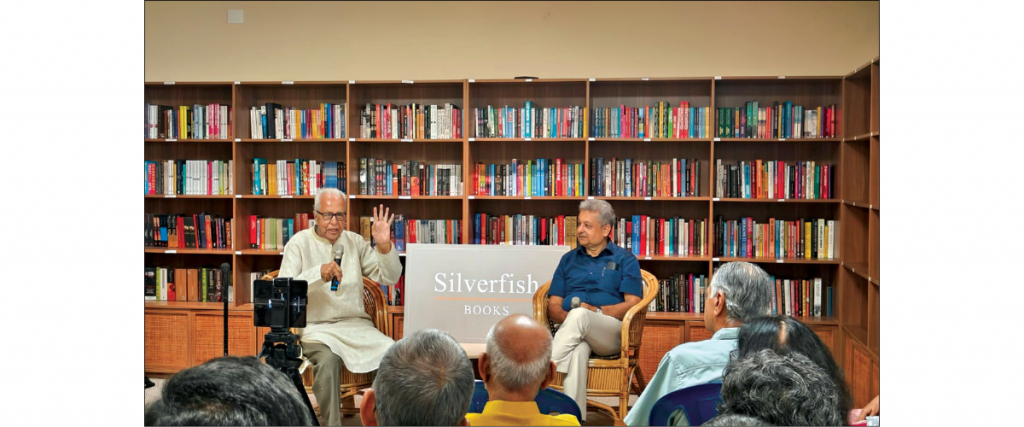
Bharatavarsha and India are two names, but one civilisational space: Padma Shri S. Subbaraman
Mysuru: Padma Shri S. Subbaraman, a nonagenarian archaeologist who has worked on the restoration of the paintings at Ajanta and Ellora and served on Indian delegations to Bamiyan Buddha and Angkor Wat, spoke on the remarkable journey of Indian civilisation over the past 5,000 years.
In a conversation with Dr. Mahesh Rao, a medical entrepreneur and Intellectual Content Curator of Speak History at Silverfish Books on Kalidasa Road here recently, Subbaraman traced how a geographical idea evolved into a cultural world, a civilisation, a collection of kingdoms, an empire, a colonial possession and eventually, a modern Nation-State.
He explained how Bharatavarsha transformed into India through a long history marked by transformative cultural diversity across time and geography. Drawing on Vedic literature, archaeological records and historical evidence, Subbaraman brought alive the story of India’s civilisation and culture for the audience.
He also explored a fundamental question: Did India become a civilisation because it became a country, or did the country eventually emerge because a civilisation already existed? Kingdoms rose and disappeared on this soil, he noted, but civilisation continued to remember its rivers and its past.
“India was called by many names by those who came from beyond its mountains; Bharatavarsha was a name by which civilisation imagined itself. What outsiders called India and what its people called Bharat were not necessarily two different lands, but two ways of seeing the same civilisational space,” he said.
“Between Bharatavarsha and India lies not merely a change of name, but a long conversation between a civilisation and the world. The land remained. But the names changed. The kingdoms vanished. But the memory endured. Somewhere between Bharatavarsha and India lies the story of a civilisation,” he added.
Subbaraman observed that Bharatavarsha was how a civilisation imagined its home, while India was how much of the world came to know it. The transition from Bharatavarsha to India, he said, was therefore not merely a change of name, but part of a long interaction between an enduring civilisation and the wider world.
Recent Comments