


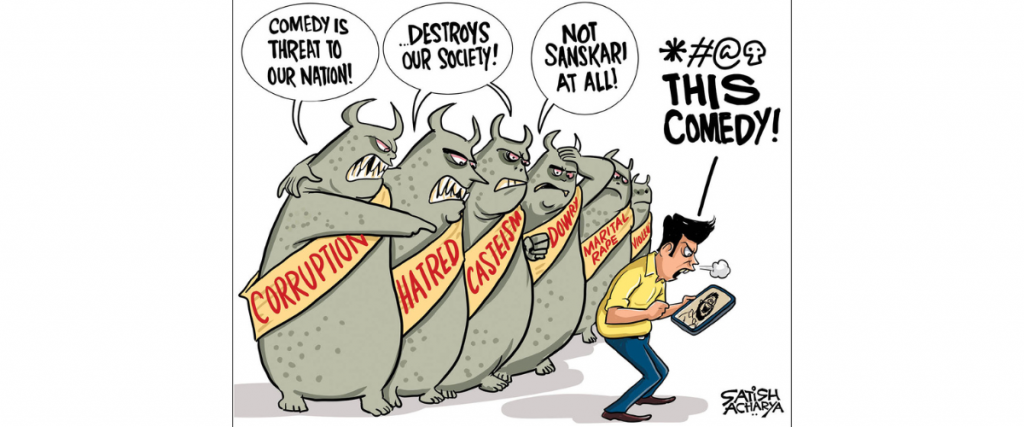
India seems to have developed a peculiar relationship with humour. We are confused about what comedy actually is. Every offensive remark is treated as either a national crisis or a Constitutional issue.
This confusion is becoming increasingly visible as stand-up comedy explodes across the country. Particularly popular is the newer ‘crowd work’ format, where comedians engage directly with audience members.
It is unpredictable, often funny, occasionally offensive and increasingly designed to generate viral moments.
One such moment recently emerged from a crowd-work show where a 22-year-old audience member, while recounting a date he went on, suggested that because he had spent Rs. 370 on biryani, he was somehow entitled to ‘recover’ that investment through physical intimacy.
The remark was immature, sexist and ridiculous. The comedian should have immediately mocked the youngster and shut the idea down. Instead, he let it roll. Why?
Because in the age of social media, outrageous statements generate views. The absurd attracts attention. The offensive fuels engagement. Outrage is profitable.
Another clip involved a medical student joking that she and her colleagues compared the genitalia of deceased male patients.
Predictably, the outrage machine roared to life.
What is remarkable is not that these comments offended people. They should offend people. What is striking is how swiftly remarks intended as humour are transformed into issues of national significance.
This reminds me of last year’s controversy involving influencer and
podcaster Ranveer Allahbadia.
The reaction was not triggered by violence, corruption, abuse of power or any issue affecting millions of Indians. Instead, it was triggered by a crude hypothetical question asked on a show already famous for juvenile and toilet humour.
The question was: “Would you rather watch your parents have sex every day for the rest of your life, or join in once to stop it forever?”
Yes, it was disgusting.
Yes, it was juvenile.
Yes, it was deeply disturbing.
But it was also entirely consistent with the tone and quality of the show. Nobody watches such programmes expecting intellectual enlightenment or even intelligent comedy.
Yet the response was astonishing.
Television anchors practically burst blood vessels on air. Politicians rushed to condemn it. Parliamentary discussions followed. FIRs were filed. Committees were formed. For days, the nation behaved as though civilisation itself was under attack.
All because a 31-year-old influencer asked a stupid hypothetical question on a stupid show.
The episode revealed something uncomfortable about modern India: We increasingly confuse offensiveness with danger.
A bad joke is not the same as a harmful act. Offensive speech is not necessarily dangerous speech.
This does not mean comedians should be immune from criticism. They should be criticised. Mock them. Condemn them. Ignore them. Boycott them if you wish.
But we should also understand what much of today’s online comedy actually is. A large part of it is ‘rage-bait.’
The aim may be to make people laugh, but it is also to provoke a reaction. The more offended people become, the more views the content receives. Every angry tweet, outraged television debate and furious Instagram post simply expands the audience.
Treating every ‘rage-bait’ joke as a serious political or cultural threat merely rewards the behaviour.
What makes this selective outrage even more absurd is what it ignores.
Just days after the Ranveer controversy dominated headlines, the Chhattisgarh High Court ruled that unnatural sex within marriage without the wife’s consent was not an offence under existing law.
Where was the national meltdown then?
Where were the prime-time screaming matches?
Where were the emergency discussions on morality and justice?
Apparently, a tasteless joke was considered a greater threat to Indian society than a legal issue involving women’s rights and bodily autonomy.
The same pattern appears elsewhere. Politicians who lecture the young about decency have often displayed little of it themselves.
Many Indians will remember when former Union Law Minister Salman Khurshid warned Arvind Kejriwal: “Let him come to Farrukhabad… but let him also return from Farrukhabad.”
If that wasn’t enough, he added, “I was made the Law Minister and was asked to wield a pen. Now it is time to replace it with blood.”
Murderous rhetoric from a sitting Union Law Minister? Meh. Didn’t outrage many people.
But a crass joke on YouTube?
NATIONAL CRISIS!
This is the central problem. Our outrage is rarely proportional. It is selective.
Countless YouTube channels are promoting fake medical cures, financial scams, dangerous misinformation and outright fraud. These can cause genuine harm. Yet they rarely attract the same sustained condemnation as vulgar comedians.
Then there is the question of culture.
Whenever these controversies erupt, defenders of censorship claim that Indian culture is under threat.
But what culture are we talking about? The same culture where misogynistic abuse is casually normalised across social classes?
Our children do not learn misogynistic language from stand-up comics. They learn it from adults around them. That is the uncomfortable truth.
If crude humour offends you, don’t watch it. If you disapprove of it, criticise it. Public disapproval is often a far more effective corrective than Government intervention.
Today, comedians make outrageous statements for clicks. Television anchors manufacture outrage for ratings. Influencers provoke anger through ‘rage-bait’ and objectify themselves through ‘thirst-bait’ for engagement.
Everyone is playing the same game.
If you are smart, you won’t take any of these baits.
Save your outrage for more serious issues like politicians normalising violent rhetoric, fraudsters spreading misinformation, and institutions failing to address serious social problems.
For now, the biggest jokers in India are not the comedians. It is the clowns who are outraging over non-issues.
e-mail: [email protected]
Recent Comments