


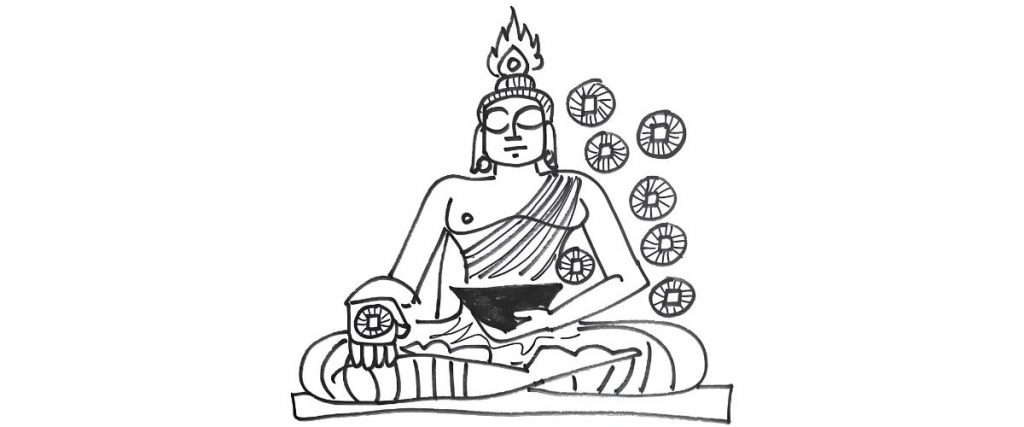
By Dr. Devdutt Pattanaik – Author, Speaker, Illustrator, Mythologist
The historical Buddha is largely an artefact of 19th-century European scholarship rather than a recovered fact, as per scholars like Bernard Faure. He argues that virtually nothing is known about the figure known as the Buddha and historical reconstructions are just as pious and imaginative as the myths and legends they claim to supplant.
Far from a transcription of a real life, the Life of the Buddha was originally a blank, which generations of hagiographers and historians have endeavoured to fill, turning it into a palimpsest. Tracing how the West filled that blank is, in effect, the story of how the colonial-era Buddha was invented.
The Buddha had drifted through European writing for centuries before scholarship took hold of him and the early portraits were wildly varied. Saint Jerome recorded that Buddha, the founder of their doctrine, was born of a virgin and came out from her side — already drawing the Buddha into a Christological orbit.
The medieval Golden Legend absorbed the Bodhisattva’s story almost wholesale into the Christian tale of Saints Barlaam and Josaphat: a king sequesters his prophesied son in a palace, the prince meets suffering on a forbidden outing and an ascetic teacher leads him to renunciation — but the religion he embraces is monotheism, not Buddhism.
Pope Sixtus V actually inscribed “Josaphat” (a corruption of Bodhisattva) in Roman martyrology. Marco Polo, in the 13th century, called him “Sogomon Barchan” and judged that he “would have been a great saint if he had been born among Christians.” A French envoy referred to him as “Sommona Codom” and confused his life story with his Jataka tales, claimed his mother Maha-maya meant “the Great Mary” and reported, with disgust, that the Buddha had plucked out his eyes and slew his wife and children as acts of charity.
This was a corrupted version of the Vessantara Jataka. Jesuit missionaries writing on China around 1700, described the “Idol Fo” as a “Chimerical God” and “Impostor” who preached “Idolatry, Atheism and Nihilism.” The Jesuits in Japan called him “Sciacca” or “Shaka,” a “philosopher, a master of perversity, a stranger to things from above.” Even Sir William Jones, the Indianist of the East India Company, decided the Buddha was the ninth incarnation of Vishnu and had to be of African origin. Faure quotes him fixing the date at “the year one thousand and fourteen before the birth of Christ.”
The decisive shift came with Eugene Burnouf’s Introduction to the History of Indian Buddhism (1844), which launched modern Buddhology on the back of philology and historicism. Burnouf was respectful of the tradition, but his disciples rejected Buddhism. The field was soon divided into two warring camps. One side argued that “the legend of the Buddha does not represent a real life… it is essentially the epic glorification of a certain mythological and divine type” — a solar deity dressed up as a man. The other side insisted that beneath the legend lay a recoverable historical sage, accessible through the Pali canon alone.
Oldenberg famously asked whether anyone “who undertook to write a criticism of the Life of Christ” would “set aside the New Testament and follow solely the apocryphal gospels.” Rhys Davids dismissed Sanskrit works such as the Buddhacarita and Lalitavistara as “developed (or rather corrupted) by the inevitable hero-worship of the followers of his religion.” Foucher tried for a middle way using archaeology and iconography, but Faure shows that it too tilted toward a tidy biographical Buddha.
But the colonial Buddha was useful: a “rationalist” Asian sage who, conveniently, looked like an Eastern Spinoza or Socrates — Edwin Arnold’s The Light of Asia (1879) made him an Eastern Christ for Victorian readers. To produce this figure, scholars privileged Pali over Sanskrit, India over East Asia and “early” over “late,” dismissing the rich Chinese, Japanese, Tibetan, Persian and Southeast Asian Buddha narratives as accretions. In seeming closer to the sources the Indian texts appeared more authentic. But in doing so despite the paucity of reliable documents, they have only replaced one mythology with another.
History had been confused with historicism; a colonial scholarly construction had been mistaken for the man himself. Today, Buddha is seen as a historical figure, one who pre-dates Ashoka by a century or two.
Nehruvian historians propagated this idea to challenge the domination of Hindu mythological heroes. Buddha seemed more rational, more non-violent, more aligned to the newly emerging nation state.
Countering this were other historians who turned Shankaracharya and Chanakya into historical figures to legitimise Hindu claims. Mythology thus became a contested zone and historians had the power to decide who is real and who is not.
Today, we have mytho-fiction writers claiming to write history. How different are they from the colonial missionaries who constructed Gautama Buddha in the 19th century?


Recent Comments