


Dr. Devdutt Pattanaik – Author, Speaker, Illustrator, Mythologist
The goddess we call Saraswati today begins as Vagdevi, the Goddess of Speech, identified primarily with the Vedic deity Vac. Her earliest stories foreground the immense power and sometimes the deceptive nature, of the spoken word. These are found in ritual Vedic texts known as the Brahmanas.
When the Gandharvas stole the sacred Soma, the gods offered Vac as a young woman to trade for it. A competition followed: the Gandharvas recited the Vedas, but the gods sang and played the vina. Vac chose music over recitation, returning to the gods and establishing her eternal link with the instrument. This myth quietly explains how a speech-goddess acquired her vina.
In another tale, Vac disputed with Mind or Manas, over who was superior. Prajapati ruled in favour of Mind, declaring that Speech merely imitates and communicates what Mind has already understood. Offended by this subordinate status, Vac refused to serve as oblation-bearer, which is why Prajapati’s rituals are performed in a low voice today.
In the Sautramani ritual, Vac acts as divine physician, restoring Indra’s faculties and manly energy after he becomes ill from drinking too much Soma. In yet another myth, Vac hid in the waters and then the trees; when the trees gave her up, she was distributed into four wooden objects that sing: drums, lutes, axles and reed-pipes, explaining the origin of musical instruments themselves.
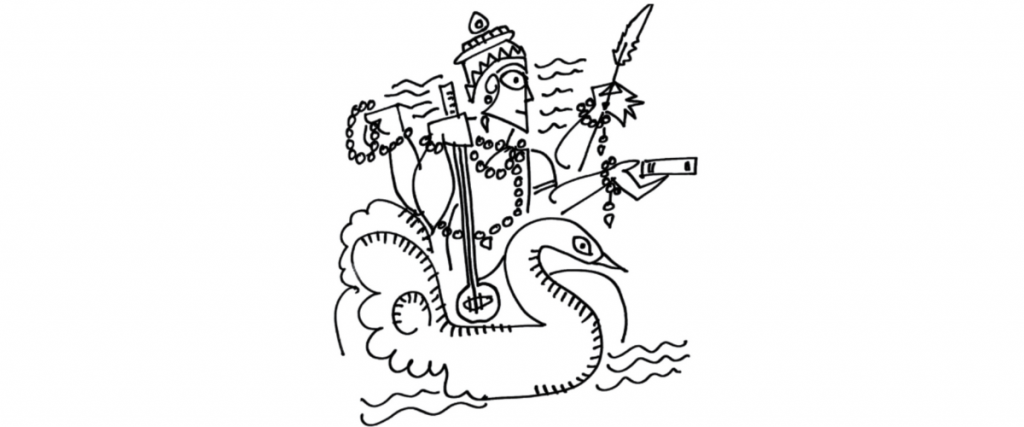
Over time, Vac merged into Saraswati and the figure we recognise today emerged as a composite, assembled over centuries from distinct religious streams. Three separate iconographic traditions converged, each carrying its own theological cargo. Jain Saraswati carries no musical instruments. Instead, she holds accounting beads and books, embodying the Jain code of knowledge, record-keeping and disciplined learning. This form reflects the Jain emphasis on precise transmission of doctrine and the sanctity of the written word. Saraswati here is the guardian of scriptural memory, not the patron of song.
Buddhist Saraswati appears armed. Her weapons mark her as a defender, a fierce protectress of the Dharma. In the Sutra of Golden Light, she figures as the Eloquence Talent Deity or Vagishvari, granting memory and flawless speech to those who preach the Law, ensuring sacred knowledge never goes extinct. The weapons signal that speech itself is a kind of combat, that preserving teaching requires force.
Saraswati with the vina, the form most familiar today, originally belonged to courtesans, singers and dancers. She was the goddess of performers, music and the embodied arts. Only later were these distinct goddesses drawn together into a single figure.
Crucially, the idea of Saraswati as goddess of the Vedas emerges only later, in the Mahabharata. The earlier Saraswati was the Jain custodian of beads and books, the Buddhist armed defender of speech, the courtesans’ patron of music. The Vedic-knowledge identity is a subsequent layer, retrofitted onto an already plural figure. What we now call Saraswati is less a single goddess than a confluence whose seams the unified iconography conceals.
It is from Jain traditions that the practice of linking goose and peacocks with Saraswati began. The Shvetambara sect said the goddess of speech, Shurta-devi, rides a goose that can separate milk and water from a mixture, indicating discrimination. The Digambara sect said the goddess of knowledge, Gyan-devi, rides a peacock, the symbol of male pride and humbles it.

Recent Comments