


By Sujata Rajpal
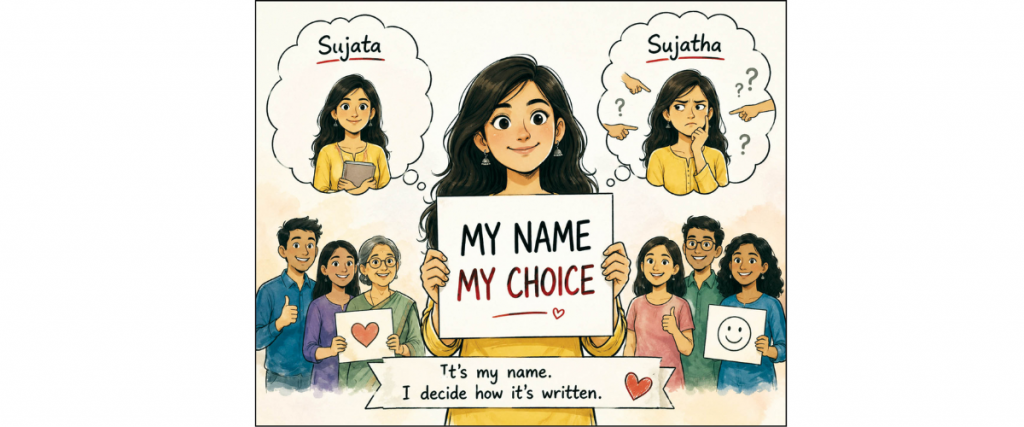
My name is Sujata and there is no ‘h’ in my name.” That’s how I introduced myself when, twenty-five years ago, I made Mysuru my home.
Landing straight from a pakka Punjabi North Indian household into Mysuru, a city deeply immersed in South Indian ethos, was a cultural shock. I noticed that ‘h’ seemed to be the default letter in names ending with ‘t’ or ‘d’ – Geetha, Aniketh, Parvathi, Bharath, Siddhartha… There were simply too many ‘h’s for me to digest.
Initially, I thought the extra ‘h’ was for good luck like the extra ‘a’ some celebrities add to their names for an additional dose of auspiciousness. It was only later that I understood that the extra ‘h’ wasn’t for extra luck.
In the South, people spell names the way they pronounce them, so the ‘h’ naturally finds its place. It wasn’t that people in the South are partial to the letter ‘h’; they love all letters equally.
Because the English alphabet lacks separate letters for these specific phonetic characters, South Indian transliteration traditions use the ‘h’ to signal a harder or aspirated pronunciation: Same name, different linguistic traditions.
My gas connection records and even my bank spell my name as Sujatha. Initially, my Aadhaar card also had an ‘h’. I had to apply for a correction. The authorities obliged, but not before wondering why I didn’t want my name to be ‘spelt correctly.’
Despite repeatedly informing my bank, even in writing, my name continues to be Sujatha. Even though the spelling doesn’t match my Aadhaar card or passport, nobody seems to care. The ‘h’ must follow the ‘t’. Period.
Explaining this every single time became exhausting. Eventually, I stopped resisting and accepted it wholeheartedly. After all, if you can’t convince them, join them.
I, too, started adding an ‘h’ after ‘t’ and ‘d’ in names without a second thought and I was right every time. Well almost. I smiled to myself. Clearly, I had imbibed the culture of my adopted State rather quickly.
A while ago, I interviewed an accomplished woman and wrote her name as Surekha.
“Why did you add an ‘h’? There is no ‘h’ in my name,” she said, as though I had committed blasphemy. I could empathise.
“But you’re from the South, aren’t you?” I reasoned.
“Yes, I am. But there is no ‘h’ in my name,” she said.
Note to self: When you do things blindly, you may be right most of the time, but not all the time.
Another cultural surprise was the practice of using a father’s or husband’s name after a woman’s first name. Initially, I was puzzled. Why did women have two names but no surname?
For years and even now, some people assume Rajpal is my husband’s first name.
“How is Rajpal doing?” they ask.
“Which Rajpal?” I reply. “We have three-and-a-half Rajpals in our family. My husband and sons are authentic Rajpals, whereas I’m only half a Rajpal. Gulati is my maiden surname.”
It took me some time, but I eventually understood the cultural logic behind using a father’s or husband’s name. Once I did, it made perfect sense.
But when you assume that things work the same way everywhere, mishaps happen.
Recently, I met a friend and asked, “How is Kumar doing?” Kumar was her husband’s name.
Pat came the reply.
“You’re the only one who calls him Kumar. His name is Kiran, not Kumar.”
“Oops.”
“Kumar is our family name,” she explained. “We use our family name.”
Another cultural variation.
In many families, especially in South India, surnames don’t always follow the same pattern.
Father, mother, brothers and sisters may all have different second names because they may use their father’s name, grandfather’s name, ancestral village or family name in different ways.
It is fascinating and often becomes a wonderful conversation starter. In North India, surnames often openly signal caste. In Tamil Nadu and Keralam, many dropped caste surnames due to Dravidian movement politics.
Well, that is what makes our country such a beautiful potpourri of cultures, traditions and identities. We may pronounce, spell and name ourselves differently, but every name deserves to be called just as its owner chooses.
My Name. My Choice.
Recent Comments