


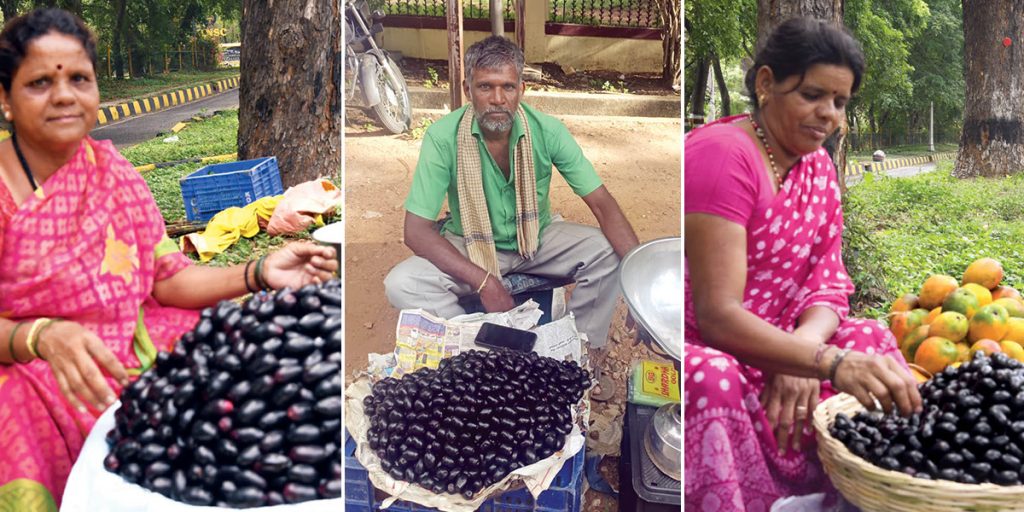
Mysuru – The ‘black beauty’ Java plum, locally known as ‘Nerale’, ‘Jambu Nerale’ or ‘Jamun’, has begun arriving in Mysuru markets, with brisk trading reported along city roadsides and inside Devaraja Market.
The fruit’s distinctive deep purple colour, tangy flavour and reputed medicinal value have sparked a seasonal rush, with citizens lining up not just for its taste, often eaten with a pinch of salt, but also for its perceived benefits in helping manage diabetes.
Native to India, the Java plum tree (Syzygium cumini) typically flowers between February and March, with fruits forming in April-May and ripening by June-July.
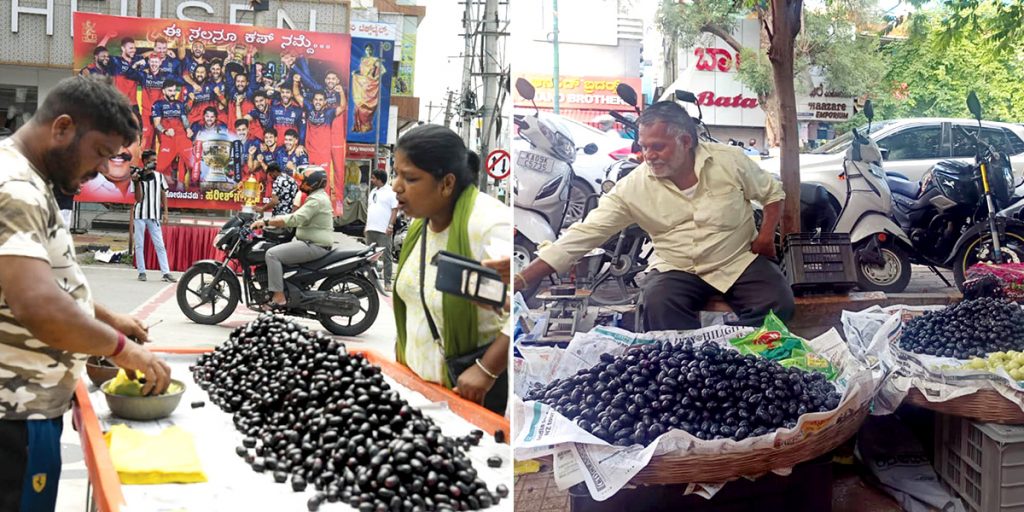
Near the Crawford Hall Railway Gate, farmer Rammanahalli Puttaswamy is seen selling fruit harvested daily from his four trees. “Initially, we sold at Rs. 400 per kilo. Now it’s Rs. 200,” he said. He harvests 10 to 20 kg a day, climbing ladders to pluck each fruit by hand.
“We don’t use sprays. Rain at the right time helps, but heavy showers can cause the fruit to drop and go to waste,” he added.
Sourced from other places
At Devaraja Market, trader Rammanahalli Marichikkanna sources Jamun in bulk from villages such as Tagaduru, Yedatore and Hemmaragala. His stock is priced at Rs. 30 for a quarter kilo, Rs. 50 for half a kilo and Rs. 100 per kilo.
Another vendor, Siddamma from Rammanahalli, sells farm-grown Jamun sourced from Bengaluru at Rs. 150 per kilo. Outside the old Deputy Commissioner’s office, traders retail fruit sourced from Rammanahalli farms at Rs. 200 per kilo.
‘Seeds more effective’

Dr. G.S.K. Swamy, retired Dean of the College of Horticulture, Bengaluru, highlighted the fruit’s nutritional and medicinal value. “It is rich in vitamins and supports diabetes control. Earlier, trees grew naturally in forests and fields. Now, awareness has led to planned orchards and improved varieties,” he said.
Among the improved varieties is EGJ-85, developed after years of research at Kittur Rani Channamma College of Horticulture. The variety produces larger, pulpier fruit and growing demand has encouraged farmers to take up orchards. Maharashtra’s Konkan region has also developed the ‘Bahadoli’ variety.
He pointed out that Jamun seeds contain potent medicinal properties, with seed powder widely used in diabetes management. Grafted saplings are preferred as they begin yielding within 3-4 years, compared to 7-10 years for seed-grown trees. They also remain shorter, making harvesting easier.
Since fresh Jamun has a short shelf life, growers are increasingly focusing on value-added products such as juices, seed powder and processed goods to extend its market reach.
While wild Jamun tends to be smaller and more seed-heavy, cultivated varieties have more pulp and are preferred for consumption. However, experts say the contain stronger medicinal compounds.
“In future, demand for seeds may surpass fruit. Organically grown Jamun offers multiple health benefits,” said Dr. Swamy.


Recent Comments