


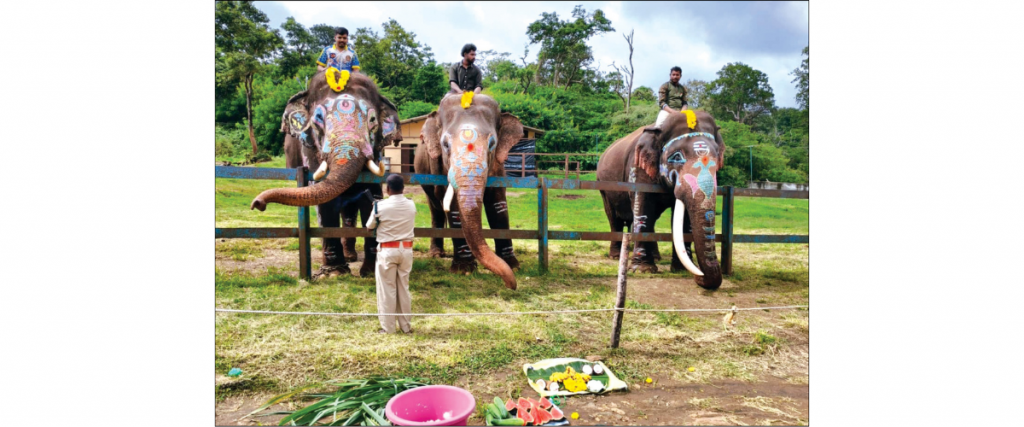
World Elephant Day Today
Mysuru: World Elephant Day, observed globally on Aug. 12 (today), seeks to create awareness about the protection, welfare and conservation of elephants.
However, in Karnataka, particularly the old Mysuru region, human-elephant conflict continues to pose a serious challenge, with both humans and elephants losing their lives.
India is home to the world’s largest population of Asian elephants and conservation efforts have helped increase their numbers. Karnataka, Kerala, Tamil Nadu, Andhra Pradesh and Assam have significant elephant populations. But the rise in numbers has also brought human-elephant conflict into sharper focus.
Traditional corridors shrinking
In Karnataka, elephants move through forests and habitats spread across Mysuru, Chamarajanagar, Hassan, Kodagu, Chikkamagaluru and Ramanagara. These areas form important elephant habitats and movement corridors.
Elephants have traditionally followed the same routes for generations. However, railway lines, roads, canals, plantations and large-scale construction have disrupted several corridors.
With their natural pathways shrinking, elephants are often forced to change their routes and enter human settlements in search of food and water.
H.D. Kote, Saragur, Hunsur and Nanjangud in Mysuru district, besides areas of Chamarajanagar, Kodagu, Hassan, Sakaleshpur, Ramanagara and Kanakapura, have witnessed repeated elephant attacks on humans. In Kodagu, plantation workers, particularly those employed in coffee estates, are among the most vulnerable.
Human toll remains high
The severity of the conflict is reflected in the number of human deaths. As many as 23 people were killed in elephant attacks in both 2021 and 2022, while 21 deaths were reported in 2023. Fatalities remained in double digits in 2024 and 2025, while 10 deaths have already been reported this year.
Over the past two-and-a-half decades, Mysuru, Kodagu, Hassan, Sakaleshpur and Chikkamagaluru have consistently recorded a high number of human deaths due to elephant attacks.
Elephant deaths on the rise
Elephants venturing out of forests in search of food are also falling victim to an increasingly hostile environment. Electrocution, falling into trenches and other unnatural causes have claimed several elephant lives.
The State recorded 82 elephant deaths in 2021, 72 in 2022, 98 in 2023, 109 in 2024 and 100 in 2025. As many as 18 deaths have already been reported this year.
Technology to track elephants
The Forest Department has adopted several measures to prevent elephants from entering human settlements, including trenches, solar fences and railway barricades along forest boundaries. However, elephants often find ways around these barriers.
AI-based cameras are now being used at some locations to detect elephant movement and activate sound devices to drive the animals back towards forests.
In Chikkamagaluru, Hassan and Kodagu, where elephant herds frequently stray into villages and plantations, the Department is also using radio collars. A female elephant from a herd is fitted with a radio collar, enabling officials to track the movement of the herd and alert people in vulnerable areas.
While conservation efforts have helped increase India’s elephant population, protecting traditional corridors and ensuring the safety of people living close to forests remain equally important. Finding sustainable ways for humans and elephants to coexist is the need of the hour.



Recent Comments