


By Dr. R. Balasubramaniam
The Great Panel Performance
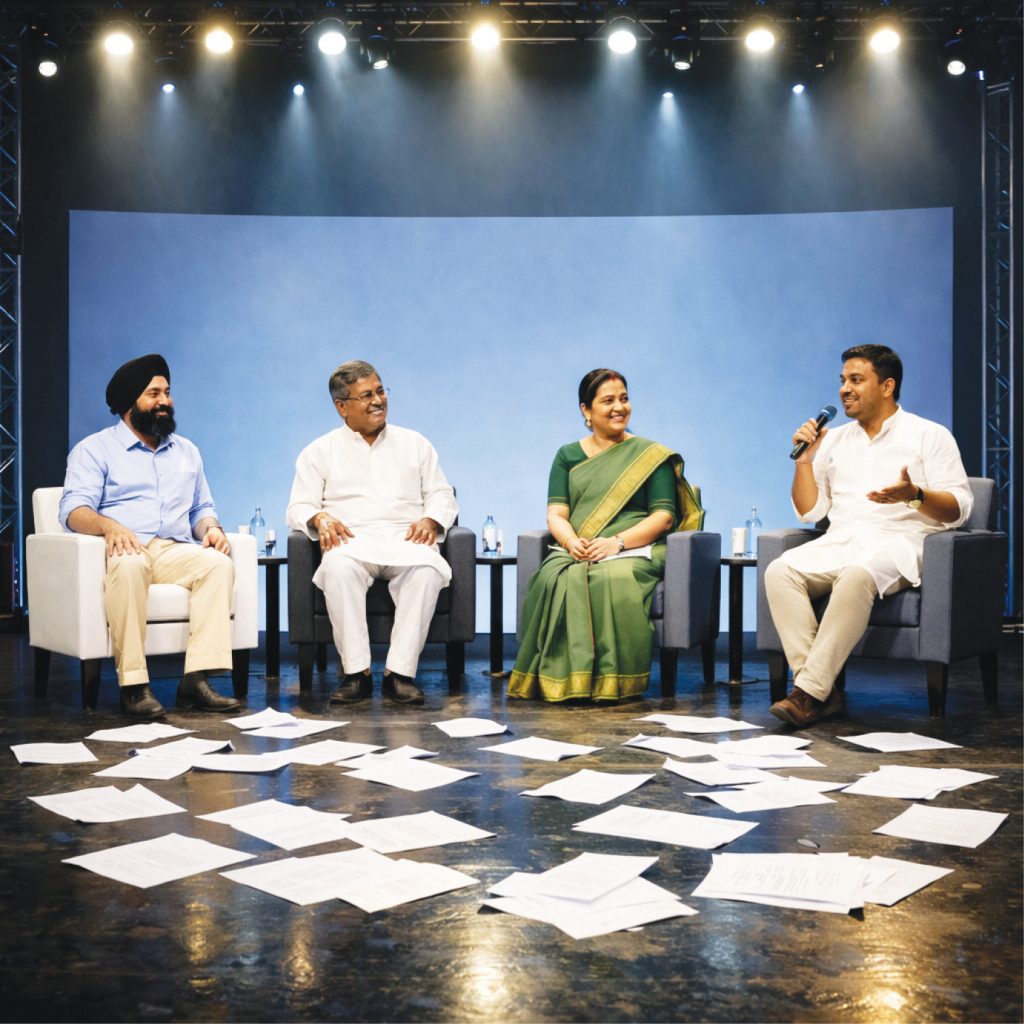
There is no experience quite like a panel discussion to simultaneously inflate your ego and deflate it, sometimes within the same sentence. I have sat on more panels than I care to count and I can say with some authority that the panel discussion is one of modern mankind’s most elaborate rituals of organised confusion dressed up as structured dialogue.
It begins, as most of our misadventures do, with preparation.
The moment the invitation arrives, something shifts inside you. You are, after all, an expert. You have been chosen. The organisers clearly know talent when they see it. You open your notebook or in these times your laptop and you begin to prepare. You anticipate questions with the confidence of a seasoned astrologer. You craft answers that are profound, measured and occasionally brilliant.
Today, you also have your favourite LLM to supplement your research. You find the perfect quote from the Bhagavad Gita that will make the audience go quiet with appreciation. You rehearse the self-deprecating anecdote that will make you seem both accomplished and humble, a combination only truly accomplished people can pull off. You time yourself. You are ready.
You arrive feeling like a man who has done his homework. After the usual delay due to the earlier panel running over time, you settle into the panellists’ chairs, which are always slightly too close together, as though the organisers believe physical proximity will generate intellectual chemistry. You exchange pleasantries with your fellow panellists. In your mind, they sound a little underprepared, but pleasant.
And then the moderator opens his mouth.
The first thing you notice is that the moderator’s question has no question mark in it. It begins somewhere around the French Revolution, passes through the industrial age, touches briefly on climate change and arrives, some four minutes later, at something that resembles a question but is in fact a small essay with a rising intonation at the end. You sit there nodding, partly in intellectual engagement and partly because you have already forgotten how the question began. The moderator, however, looks pleased. He has warmed up nicely.
The second thing you notice is that none of the questions are the ones you prepared for. You had prepared for a thoughtful inquiry into the structural challenges of governance reform. He asks you instead about your childhood influences. Your perfect answer, the one with the Gita quote and the self-deprecating anecdote, sits in your head with nowhere to go, like a well-dressed guest who has arrived at the wrong party.
You improvise. This is, you tell yourself, what experts do.
Meanwhile, you have begun to observe your fellow panellists with greater attention. The person to your left is operating on a simple and effective principle. She is going to speak regardless of what she is asked. The question is merely a social courtesy she acknowledges briefly before proceeding to say exactly what she had planned to say from the beginning. She is, in this sense, more honest than the rest of us.
The person to your right has understood something fundamental about panel discussions, which is that the microphone, once released, may not return. He therefore does not release it. He answers the question, then provides context for the answer, then offers a brief history of why the context matters and then, just as the moderator begins to lean forward with the practiced smile of someone about to interrupt, he starts a new sentence. He is a man in a race where he himself controls both the baton and the finish line.
You watch the moderator try to interrupt. It is like watching someone try to board a moving train. There is effort. There is optimism. There is, ultimately, resignation.
When your turn comes, you speak with what you believe is the perfect balance of depth and brevity. You make your point. You even manage to work in a modified version of the Gita reference, slightly stripped of context but still serviceable. You feel good. The audience claps. This is, you conclude, because you were the most articulate voice on the panel.
Later, a kind colleague tells you that the microphone was not working for the first forty seconds of your answer. You smile graciously and say it does not matter. It matters enormously.
I have been that panellist who over-prepared and under-delivered. I have been the one who grabbed the microphone with slightly more enthusiasm than dignity. I have sat on panels where I was certain I was the only person who had actually read anything on the subject, only to be quietly humbled by a fellow panellist who, in two unhurried sentences, said what I had been trying to say for ten minutes.
The panel discussion endures not because it is an efficient format for exchanging ideas. It endures because it is theatre. And theatre, as we all know, requires performers who believe in the play even when the script has gone missing.
We shall all be back on the next panel. Prepared, optimistic and completely convinced that this time, the moderator will finally ask us the right question.
He will not.
[Dr. R. Balasubramaniam is the Founder of Swami Vivekananda Youth Movement (SVYM). ‘The Lighter Side’ is a series of satirical articles meant to bring a smile by highlighting the funny side of everyday life.]

Recent Comments