


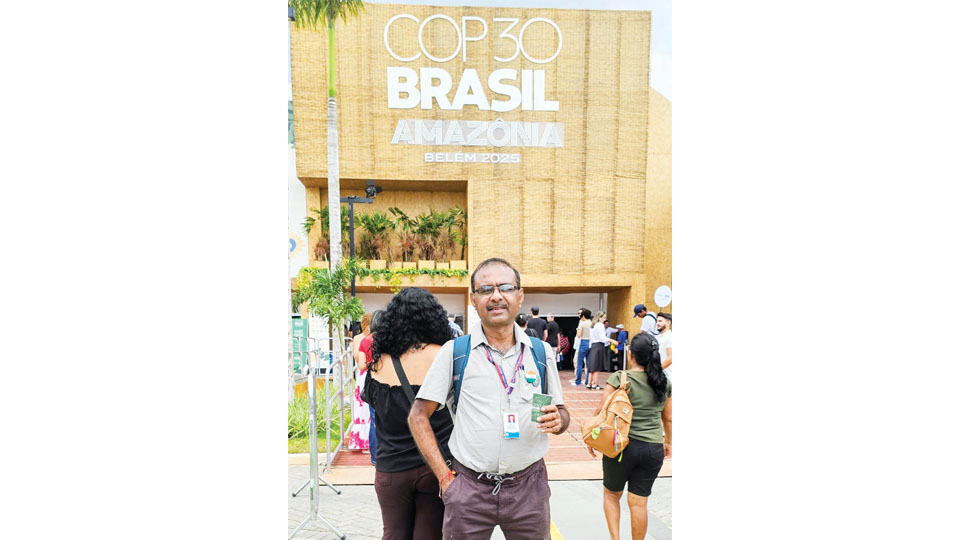
Mysore/Mysuru: Prof. Shamsundar Subbarao, Head, Centre for Renewable Energy and Sustainable Technologies (NIE-CREST), National Institute of Engineering (NIE), Mysuru, is attending the United Nations Climate Change Conference (COP30) in Belém, Pará, Brazil.
He has contributed to global climate discourse and forged new international collaborations. Representing NIE-CREST and India’s academic and technological expertise, Prof. Subbarao participated as a member of the Positive Futures Scenario Committee under the Heinrich-Böll-Stiftung Brasil (HBF Brasil), a German foundation committed to ecological transformation, democracy, and climate justice.
Key engagements
Prof. Subbarao’s presence in Green Zone of COP30 included multiple high-impact sessions:
German pavilion panel: He spoke on “Positive Future Scenarios”, advocating for community-scale bioenergy systems, decentralised microgrids and natural farming clusters rooted in the ecological wisdom of India’s Western Ghats.
Academic session at Federal University of Pará (UFPA), Belém: He drew parallels between the Amazon and Western Ghats ecosystems, highlighting indigenous knowledge and sustainable engineering.
Agroecology dialogue – ‘taste of future’: At this agro-culinary event, he explored forest-food systems and circular bio-economy models, strengthening Indo-Brazilian agroecology linkages.
People’s summit (Cúpula dos Povos): Prof. Subbarao engaged with grassroots movements, including indigenous rights forums, black feminist collectives and youth climate justice groups, documenting perspectives for dissemination in India.
Prof. Subbarao’s participation has elevated NIE-CREST’s visibility on the global stage and initiated pathways for collaboration with HBF Brasil and Latin American institutions.
Key outcomes
Prospects for joint workshops, academic exchanges and climate-scenario modelling across India, Brazil, and Germany.
Strengthened positioning of NIE-CREST as a hub for community renewable energy, bioenergy from waste and net-zero farming systems and enhanced recognition of NIE’s community farming initiatives, such as ‘Susthira Sahabalve’ and ‘Kanana Organic Farm’, within global climate-resilient frameworks.
Prof. Subbarao’s contributions underscore the growing relevance of Indian ecological and technological models in global climate strategy. His engagements at COP30 pave the way for deeper South-South cooperation and position NIE-CREST as a leader in sustainable development rooted in local wisdom and global collaboration.

Recent Comments