


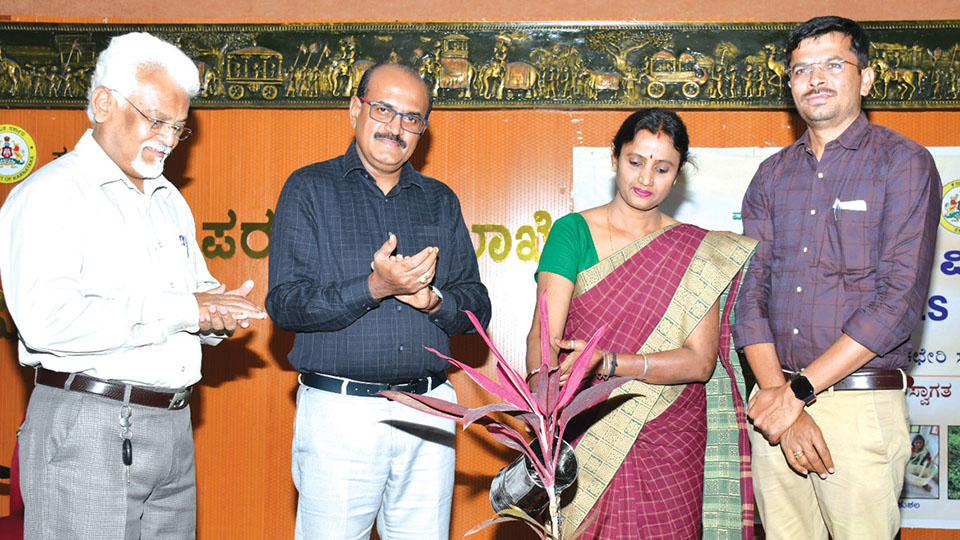
Mysore/Mysuru: Dr. C.S. Anupama, artist from Regional Institute of Education (RIE), Mysuru, has opined that ‘the periods of reign of Mummadi Krishnaraja Wadiyar and Nalwadi Krishnaraja Wadiyar made significant contributions towards the growth of paintings.’
She was delivering a special lecture on ‘Mysore Palace Paintings’ organised by the Department of Archaeology, Museums and Heritage, at its premises in Dasara Exhibition Grounds in the city recently.
Dr. Anupama said, Ambavilas Palace is the guide towards learning the history of paintings patronised by Mysore kingdom. The paintings introduce the precedent set by the artists of Vijayanagar era, along with modern and western styles.
“Vijayanagar kingdom patronised Surpur, Lepakshi, Tanjore, Ganjifa, Mysore and Kinnal styles of paintings. After the fall of Vijayanagar kingdom, Mysore kingdom emerged as the prominent destination for the artists. Hence, one can find the resemblance between Tanjore and Mysore style paintings, known for their intricate art works,” said Dr. Anupama.
Ganjifa art that has its origin in Persia, adopted Mysore style and reached its peak during the rule of Nalwadi. The murals came into popularity, as the various parts of Mysore, especially the walls of the temples, served as the canvas to promote this very art, during Mummadi’s rule. To cite an example, the walls of Prasanna Venugopalaswamy temple at Palace premises, are adorned with the paintings of Krishna Leele, she added.
In the later years came renowned artists Shilpi Siddalinga Swamy and Raja Ravi Verma, who have made enormous contributions towards the growth of Mysore style painting.
“The ceiling of Mysore Palace is replete with the paintings of Shilpi Siddalinga Swamy, while the works of Raja Ravi Verma, introduces Gods and Goddesses and the members of royal family. The paintings at Mysore Palace are a blend of mythology and history, which should be acutely understood by the viewers,” said Dr. Anupama.
A. Devaraju, Commissioner of Archaeology, Museums and Heritage Department said, the method of seeing and grasping the meaning of a painting is also an art. The study of history will be more beneficial in understanding a painting, to gain a better experience.
Veeranna Arkasali, HoD, Photography & Journalism, Chamarajendra Government College of Visual Arts (CAVA) and D.H. Ambreesh, Archaeological Conservation Engineer, were present.



Recent Comments