


By Dr. R. Balasubramaniam
By all accounts, I should have been celebrating. A senior government position in Delhi, the sort of achievement that gets your name embossed in gold on invitation cards and mentioned in reverent tones in drawing rooms. Instead, here I am, clinging to my ordinariness like a child gripping a security blanket, while society tries to squeeze me into a sherwani I neither chose nor can comfortably breathe in.
I come from the land of humble NGO beginnings. The kind where a Rs. 400 jhola is a badge of honour, chappals are acceptable meeting footwear and your phone is a second-hand Android with a cracked screen and emotional history. Meetings happened in dusty community halls with unreliable fans, not five-star ballrooms boasting chandeliers large enough to host a wedding beneath them.
And then… Delhi happened.
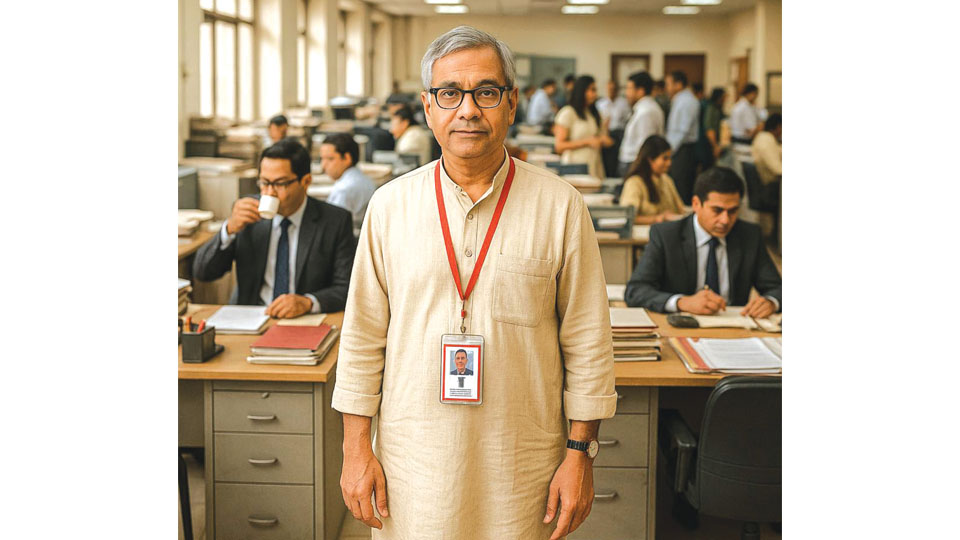
One day I was arguing for education rights under a neem tree and the next I was handed a laminated government ID on a maroon lanyard and told it must be always worn — like a VIP dog tag. Nothing says ‘serious person’ quite like your own face swinging against your chest while you try to look natural in a lift or enter a government building guarded by CISF officers who look like they could spot an under-qualified imposter from space.
Cars have become an unexpected crisis. Earlier, getting into one meant either an emergency and someone needed help or there was no bus going where you were headed. You always opened your own door, sometimes with effort, occasionally from the inside if the handle was broken. That was life. That was normal.
Now I sit in the back seat like a regional crime drama villain while someone else opens the door for me. The first time it happened, I assumed there was a security check. Apparently not. Apparently, “Sir doesn’t open his own door” is now a rule I never agreed to. Lifting a handle, it seems, is beneath my pay grade. And if I even glance longingly at an autorickshaw, the collective disapproval could curdle milk.
Clothes, too, have turned into a negotiation. I used to own three pairs of trousers — two for field work and one that covered weddings, formal events and the occasional RTI hearing. Now I am told I need ‘wardrobe rotation.’ My kurtas, once symbols of simplicity, are now described as ‘minimalist chic,’ which is elite code for ‘still not wearing a blazer’?
I wore Kolhapuris to a department meeting once and someone asked, with genuine concern, if I had lost my luggage. Another colleague tried to gift me cuff-links, unaware that I do not own a single shirt that requires them. I don’t wear symbols of power well. They feel like props in a play I never auditioned for.
Then there is the language. Government meetings operate in a dialect that sounds like Shakespeare collided with a legal notice and dictated by a LLM. I once said, “Let’s just talk to people and ask what they need,” and someone replied, “That would be procedurally premature at this juncture.” I blinked so hard my brain needed a reboot.
I still want to ask questions that begin with “why,” not “with reference to your previous correspondence dated…” I want to say, “this is a bad idea” without translating it into “let us re-evaluate this through a multi-stakeholder lens.” I want to point out when something is plainly ridiculous and then go have chai. I am also still trying to understand why we obsess over numbers while quietly ignoring quality, as if spreadsheets alone can improve lives.
These days, a strange silence follows me into rooms. People look at me, then look again, trying to place me. I don’t fit the archetype. My resume says, ‘senior position reporting to the very top,’ but my general vibe suggests I may have wandered in looking for the stationery cupboard.
People seem unsure how to unpack me even after nearly five years. I can see the question forming behind their polite smiles. Are you pretending to be simple or are you actually like this? The irony is that the confusion sometimes turns into a kind of envy. There is a quiet curiosity about someone who walks in without designer shoes, avoids bureaucratic jargon and still manages to hold a room, not through authority, but by not trying too hard to be important.
In a world where success often means layering on new identities, I am just trying not to shed the one that made me useful in the first place.
Society seems to assume this job should transform me, as if the designation comes with a compulsory software update: remove humility.exe, install jargon++, upgrade wardrobe, switch operating system to ‘do not be candid.’ But I don’t want to be impressive. I want to be useful. I want to sit on a broken plastic chair, talk to people who are usually ignored and be confused about GST like everyone else.
The truth is, being ordinary is surprisingly difficult when everyone expects you to perform importance. In every room, people seem to wait for gravitas or a LinkedIn-worthy sound-bite. I miss being anonymous. I miss not worrying about how I look in official photos or whether my kurta placket is facing the correct ceremonial direction.
Maybe the quietest rebellion in a world obsessed with appearances is to remain stubbornly, cheerfully, unapologetically ordinary.
So, if you ever spot someone in a government building who looks slightly out of place, possibly wearing a kurta and sandals and a mildly confused expression, come say hello. I will probably be sipping chai and wondering whether this form needs to be signed in blue ink or green.
[Dr. R. Balasubramaniam is the founder of Swami Vivekananda Youth Movement (SVYM). ‘The Lighter Side’ is a series of satirical articles meant to bring a smile by highlighting the funny side of everyday life.]
Recent Comments