


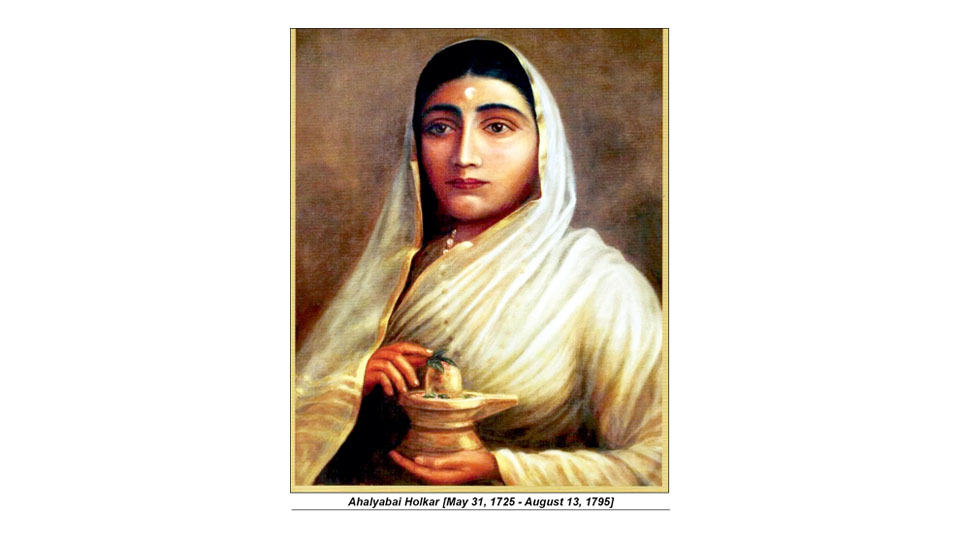
A timeless legacy of courage, governance
By Dr. Manik A.V. Bengeri
India has long been a land of brave and visionary women. Among them, Ahalyabai Holkar, one of the most remarkable rulers of the Indore State, stands out as an enduring example — even in today’s times.
She proved her mettle through sheer determination and leadership, without seeking any form of reservation or concession. Her life and work remain profoundly relevant and inspiring, even centuries later.
The year 2025 marks the Tercentenary of her birth (with her birth anniversary falling on May 31) and her legacy is being commemorated across India. Her contributions as a ruler, administrator and visionary continue to be remembered in golden letters in the annals of pre-Independence Indian history.
As a monarch, she championed education, especially for women, and worked tirelessly for the welfare and progress of her State. Known as a strict yet compassionate ruler, Ahalyabai treated her subjects with motherly care, ensuring their holistic development.
She was also deeply committed to preserving India’s ancient culture. Her efforts included restoring temples, constructing protective riverfront steps known as ‘ghats’ and improving water facilities at pilgrimage sites.
Ahalyabai was born into a shepherd family, and true to her roots, she later became a guiding shepherd for her people. She was born in Choundi, a small village in the Beed district of Maharashtra, in 1725. Her father, Mankoji Shinde, was the village head, known locally as the Patil.
At the age of eight, as per the social customs of the time, Ahalya was married to Khanderao Holkar, son of the legendary warrior Malharrao Holkar, who had earned the province of Malwa through his valiant service to Peshwa Bajirao of Pune. Malwa, now in Madhya Pradesh, later came to be known as Indore State.
Intelligence, potential
From the age of eight, Ahalyabai was mentored by her in-laws, Malharrao and Gautamibai, who recognised her intelligence and potential. Ahalya was quick to grasp the Holkar family’s values and the combination of religious devotion at home and political exposure in court helped shape her into a future leader.
At a time when most women were confined to household duties, Ahalyabai received training both within and beyond the domestic sphere.
Her marriage lasted just over two decades. During this time, she had two children — Malerao, a son and Muktabai, a daughter. In 1754, her husband Khanderao was killed in battle against Surajmal Jat. In keeping with the customs of that period, Ahalyabai was prepared to commit sati.
However, her father-in-law, Malharrao Holkar, intervened and persuaded her not to do so. Instead, he urged her to step into the role of a leader and assist him in administering the State.
Setting aside her personal grief, Ahalyabai accepted the responsibility with resolve. She followed Malharrao’s guidance and soon emerged as a powerful force in Statecraft and governance.
Visionary leadership
A new chapter began in Ahalyabai Holkar’s life, marked by resilience and unwavering commitment. She faced each adversity with remarkable courage. However, fate struck another cruel blow when her only son, Malerao, died of a minor illness.
Devastated, yet determined, Ahalyabai channelled her grief into governance. Her administrative brilliance would shine over the next 28 years of her rule.
When she took charge, the State treasury held Rs. 16 lakh in cash, with an annual revenue of around Rs. 75 lakh. Under her stewardship, revenue collections soared to Rs. 1 crore.
She introduced a transparent financial system, dividing income into two parts — ‘Doulat’ for State functions and ‘Khaasgi’ for royal family expenses. From the Rs. 15 lakh allocated for the royal household, Ahalyabai funded various religious and educational initiatives.
She maintained strict boundaries between State funds and personal finances, even contributing from her private purse to public coffers when needed — a rare example of economic integrity and foresight.
Grassroots governance
Ahalyabai also undertook important reforms. She relaxed the oppressive tax system and introduced grassroots governance by appointing Sarpanchs in various villages, laying the foundation for democratic decentralisation nearly 300 years ago.
She extended support to marginalised communities like the Bhils and Gonds, who had been disrupting civil life. Instead of offering charity, she empowered them through land cultivation and self-reliance, promoting dignity through hard work over dependence or lawlessness.
Her governance extended beyond civil administration. Ahalyabai had a keen understanding of military strategy. She developed and maintained a disciplined army, including a women’s wing, and placed emphasis on the manufacture of cannons and defence equipment, fortifying the borders.
When Diwan Gangoba Tatya of Indore, underestimating her capability, conspired with Raghoba Peshwa to overthrow her, Ahalyabai responded with sharp diplomacy. In a bold letter to Raghoba, she warned:
“If you defeat me, it will not be a great victory. But if I, along with my women’s wing, defeat you, there will be no place for you to hide your face. Think twice before attacking Indore.”
Stunned by her confidence and strategic acumen, Raghoba abandoned his plans and instead chose to visit Indore. There, he experienced her royal yet simple hospitality and was deeply impressed by her popularity, wisdom and leadership.
Mastering Statecraft
Though a woman in a male- dominated era, Ahalyabai mastered the art of Statecraft and politics. She never neglected social responsibilities, actively supporting the needy by distributing food and clothing. She revitalised important pilgrimage sites, including all twelve Jyotirlingas, not only promoting religious unity but also safeguarding India’s ancient cultural heritage.
Ahalyabai’s contributions to temple architecture spanned both North and South India — her name is etched in stone at many revered sites, ensuring her legacy endures. Cities like Maheshwar and Indore, planned and developed under her reign, continue to reflect her vision, efficiency and aesthetic sense.
Their cleanliness and structure today are living testaments to the foresight of an extraordinary woman ruler whose contributions transcend time.
A voracious reader
Ahalyabai Holkar was a voracious reader and her personal library was both vast and valuable. It housed rare handwritten manuscripts by renowned scholars of her time — an extraordinary collection that has been carefully preserved.
Drawing wisdom from these works and the guidance of contemporary thinkers, she not only honoured scholars but also established institutions to disseminate knowledge through schools, colleges and universities.
Her deep commitment to educational equality, social justice and the upliftment of the downtrodden reflected her noble and generous spirit. Understanding the central role of agriculture in the Indian economy, she introduced land reforms, ensured proper irrigation facilities through dams and canals, and safeguarded the livelihoods of farmers, especially during droughts.
Ahalyabai also stood for progressive social reforms. She protected the rights of widows, encouraged adoption and publicly honoured such acts to inspire society. Her awareness extended to the environment as well. She took deliberate measures to protect forests and preserve trees, centuries before ecological conservation became a global concern.
Her selfless governance, transparent administration and unbiased approach made her a role model not just for rulers of her time, but for leaders even today. She did not live for herself or her family alone — her actions were always for the betterment of the people and the State.
Ahalyabai Holkar’s life remains a shining beacon for today’s women. She has been rightfully honoured with the title: “Punyashloki Lokmata Ahalyadevi” (The Virtuous and Revered Mother of the People). She was, and remains, the embodiment of Nari Shakti — a symbol of feminine strength, vision and the inner resilience of Indian culture.
This is the time to salute such a powerful woman, and to adopt her values, her vision and her principles — each one as astonishing as it is authentic. Her legacy continues to inspire generations, reminding us of what true leadership, humility and service can achieve.
It’s ‘Ahalya’ not ‘Ahilya’
There is a common tendency to refer to the revered Queen of the Indore State as ‘Ahilyabai.’ However, it is important to clarify that the correct and original form of the name is Ahalyabai, derived from the Sanskrit word ‘Ahalya’— not ‘Ahilya,’ which holds no such meaning in Sanskrit.
The word Ahalya carries profound symbolism. In Sanskrit, it denotes ‘untouched’ or ‘unploughed land’ — a metaphor for freshness and purity. When likened to a bud, it signifies the promise of a blossom yet to bloom. When associated with a woman, it represents chastity and integrity — a woman untouched and pure, in both physical and spiritual essence.
I have chosen to honour this correct form of her name — Ahalyabai — because she truly embodied these ideals. Her life stands as a beacon of purity, perfection, and service. Her legacy — free from the trappings of political ideology — is one of exemplary governance, vision and deep commitment to values. She was, and remains, a guiding light for all who seek to lead a life of purpose and righteousness.

Recent Comments