


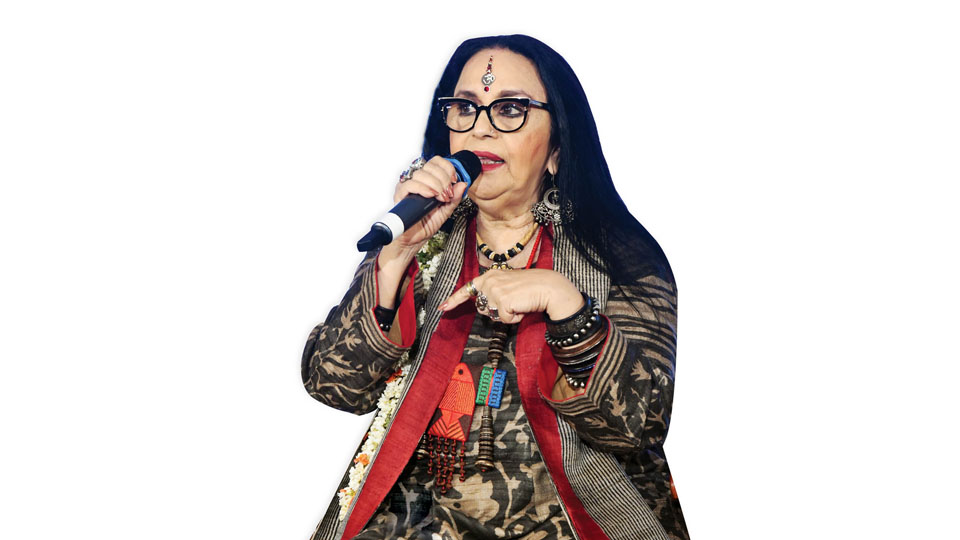
A conversation with celebrated singer and actor Ila Arun, known for her ’90s superhit song Choli Ke Peeche Kya Hai…
Renowned for her unmistakable voice and unapologetic style, Ila Arun rose to national fame with the iconic song ‘Choli Ke Peeche Kya Hai’ from the Hindi film ‘Khal Nayak’, sung alongside Alka Yagnik.
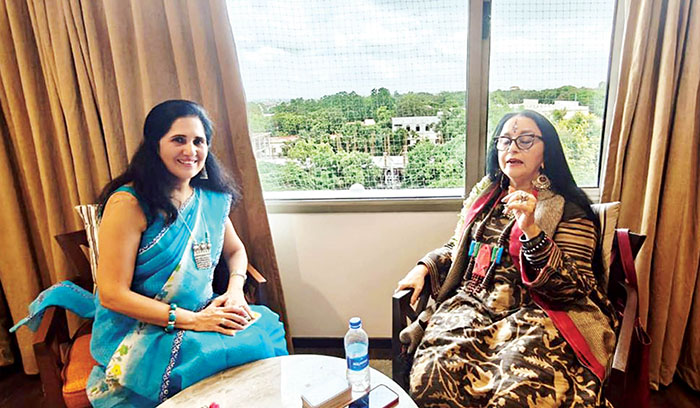
A celebrated folk singer, actor, theatre artiste and playback singer, Ila Arun was in Mysuru for the release of her autobiography ‘Parde Ke Peeche’ at the Mysuru Literature Festival. On behalf of Star of Mysore, Sujata Rajpal caught up with Ila for a conversation where she opens up about her journey through film and folk, her deep-rooted middle-class identity and unwavering love for folk music.
By Sujata Rajpal
Star of Mysore (SOM): Tell us about the beginning, how did this journey start?
Ila Arun: It’s been a long journey; it took me two years just to write about it, so summing it up in a few minutes isn’t easy. I was 15 when I had my first brush with the theatre, playing a 60-year-old woman.
They even blackened two of my front teeth to make me look old. I was never conscious of the roles I played, whether I was 16 or 85 years old. I just performed and enjoyed every bit of it. Back then, no one asked us what we wanted to become; career choices weren’t a thing, especially for girls. It all just happened organically.
SOM: You’ve worn many hats — folk singer, dancer, actor, theatre artiste, playback singer. Which role is your favourite?
Ila Arun: I’ve been involved in theatre for nearly 45 years now and run my own group, called ‘Surnai.’ I write songs, act, sing and do theatre, and I love every role equally. They’re all part of me. All roles are my favourite. I act while singing, and I sing while acting.
These aren’t just roles, they’re forms of expression through which I connect to my roots, celebrate womanhood, and relate to common people. I’m a middle-class person and folk helps me stay grounded. In theatre, I’ve played everything — strong woman, suppressed woman, old and young. I’ve sung bhajans, performed music from across the States. Now, I’m even exploring fusion music with my son-in-law. I never think about age. I want to be known as ‘Ageless Ila.’
SOM: Did your family support your artistic journey?
Ila Arun: Support looked different back then. My parents may not have clapped after every performance, but they never stopped me either. That in itself was encouragement. They never said no to me singing qawwalis, classical singing, Punjabi, even South Indian music or dancing. My career was not planned. Neither they nor I thought that one day I would become Ila Arun. I continued performing and it just happened.
SOM: Do you have a role model?
Ila Arun: Anyone who sings beautifully is my role model — Lata ji, Asha ji, Alka Yagnik, Shreya Ghoshal, Kavitha Krishnamurthy. But Reshma ji from Rajasthan holds a special place in my heart. Her voice was raw and rustic, and we shared the same dialect. More than celebrities, it’s the rural women who inspire me — their strength, their voices, they are my true role models.
SOM: Did you object to the lyrics of ‘Choli Ke Peeche’?
Ila Arun: In the past 35 years since the release of the movie Khal Nayak, I’ve been asked this question so many times that I am tired of explaining. ‘Choli Ke Peeche’ became iconic because it was bold, unapologetic and rooted in folk. I still stand by it. The problem wasn’t the song; it was how people chose to hear it.
In Rajasthani and Punjabi weddings, people sing far bolder songs for fun. What’s behind the choli? It’s her heart, which the woman offers only to her lover. There is no vulgarity in that song. The song was composed by Laxmikant-Pyarelal, written by Anand Bakshi, and directed by Subhash Ghai.
For a professional artiste, everything is art, and there is no vulgarity in anything. And frankly, it’s one of my most loved performances. Every event I attend, people ask for it. If I don’t sing this song, they request it. In my book, a full chapter has been devoted to this song.
SOM: What’s the future of folk music in India?
Ila Arun: Folk music’s future is bright, but we need to nurture it more seriously. The West is increasingly interested in our stories and our authenticity. The Government is doing its bit — especially in Rajasthan, where culture is tourism. Artistes are getting opportunities abroad, which is great, but there’s still a gap. Folk doesn’t get the marketing budgets or Spotify banners like pop or Bollywood.
But young artistes are reviving it in new ways — fusing it with electronic music, collaborating across genres, taking it to YouTube, Instagram, even global stages. What we need is more platforms and respect.
Folk singers must be paid on par with other musicians. If they’re given peanuts while rock stars mint money, they’ll be tempted to move away from their roots. Parents will spend thousands on ‘Coldplay’ tickets for their children, but hesitate to pay Rs. 200 for a folk concert. Charity begins at home. If you love folk, show up for it.
SOM: Was it difficult for a folk artiste to break into mainstream Bollywood?
Ila Arun: I wasn’t conventionally glamorous, nor did I have formal training in playback singing. But my voice had something different — it was earthy, full of raw emotion, rooted in our folk traditions. That’s what eventually set me apart.
Visionaries like Shekhar Kapur and A.R. Rahman took a chance on me, and thankfully, the audience embraced it. I never tried to hide my identity or blend in. In fact, I believe it was my difference that became my strength.
SOM: What are your impressions of Mysuru?
Ila Arun: I love the South Indian culture. The people are simple and have a beautiful culture. Since I arrived in Mysuru, I have worn a gajra of jasmine flowers in my hair inspired by the timeless beauty of South Indian women.
I went to the church because my hairdresser is Christian. I wanted to visit Chamundi Hill, the abode of Goddess Chamundeshwari, but due to Ashada, I was discouraged because it would be very crowded. I hope to visit the Chamundi Temple in my next visit.

Recent Comments