


Horse owners advised to halt inter-district sale, movement
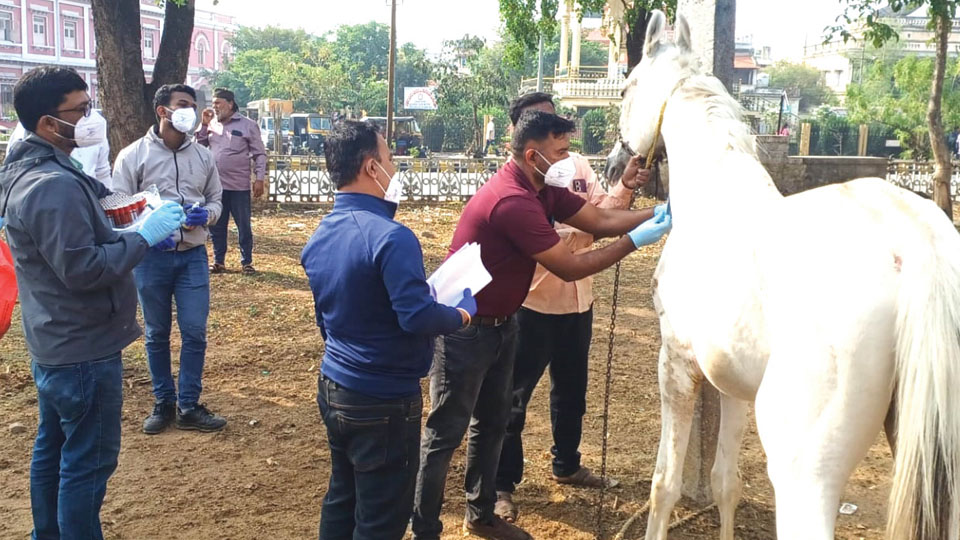
Mysore/Mysuru: The death of a two-year-old horse at Mysore Race Club (MRC) after contracting the deadly Glanders — a zoonotic bacterial disease — has prompted animal health authorities to collect and dispatch 598 blood samples, including those from three donkeys and 595 horses, to National Research Centre on Equines (NRCE) in Hisar, Haryana, for testing.
The incident has raised alarm across race clubs in Mysuru, Bengaluru and Hyderabad, where horses have succumbed to the same infection.
Veterinary officials have stepped up strict surveillance to prevent the bacteria from spreading to other horses and to safeguard caretakers and owners from potential exposure.
Mysuru’s first case a decade ago
Glanders is a fatal bacterial disease that affects only equine species — horses, donkeys and mules. As the infection spreads through direct contact, strict instructions have been issued to avoid congregating horses. The last known case in Mysuru was reported about a decade ago near Kukkarahalli Lake tonga stand, with no cases recorded since then.
In accordance with Central Government guidelines, blood samples have been collected from horses across city.
These include 477 from the MRC, 63 from Mounted Police unit, three from the royal family’s riding school at Bogadi, one from the People For Animals (PFA) shelter, three donkeys and 52 tonga-cart horses.
Samples were collected under the supervision of Dr. M. P. Poornananda, Chief Veterinary Officer (Administration), Taluk Animal Husbandry and Veterinary Services Department and sent to NRCE, Haryana.
The institute has initiated investigations to trace the source of the outbreak and to determine how the infection spread to horses in Mysuru, Bengaluru and Hyderabad.
Risk of transmission
Meanwhile, officials have warned horse owners and tonga-cart operators against bringing in horses from outside the district or selling local horses elsewhere, as such movements could heighten the risk of transmission.
Awareness drives have been conducted at tong stands near the Sub-Urban Bus Stand, Kukkarahalli Lake, Agrahara, Nanjumalige and the Old RMC Circle in city.
Given the potential risk of transmission to humans, the Mysore Race Club has been temporarily shut racing.
Blood samples have been collected from all horses within a two-kilometre radius and sent to the laboratory every 21 days for testing. In addition, samples were taken from all horses within the two-kilometre zone and from 25 percent of the horses located between two and ten kilometres.
For three months, staff from the Animal Husbandry Department will conduct strict surveillance, after which officials will decide whether the area can be declared disease-free.
Only if all three tests return negative will NRCE certify the area as disease-free, following which the Mysuru district administration will lift restrictions on the Race Club.
Peak season blues for tonga operators
December, the peak tourist season in Mysuru, usually draws large numbers of visitors eager to experience the city’s Christmas and New Year attractions, with tonga-cart rides around the Mysore Palace being a major draw.
However, the outbreak of the Glanders infection has severely affected tonga-cart operations, dealing a blow to tourism and hitting the livelihoods of tonga operators hard, as many have lost their primary source of income during the crucial holiday season.
Massive testing drive
Blood samples from 598 equines, including three donkeys, have been collected and sent for laboratory analysis. Awareness has been created among tong-cart operators and horse owners, who have been advised to immediately report symptoms such as high fever, yellowish nasal discharge or nodules with ulcers on the skin. Strict surveillance is being maintained across the city. Glanders affects only equine species and poses no threat to cattle or dairy farming. — Dr. M. P. Poornananda, Chief Veterinary Officer (Administration)


Recent Comments