


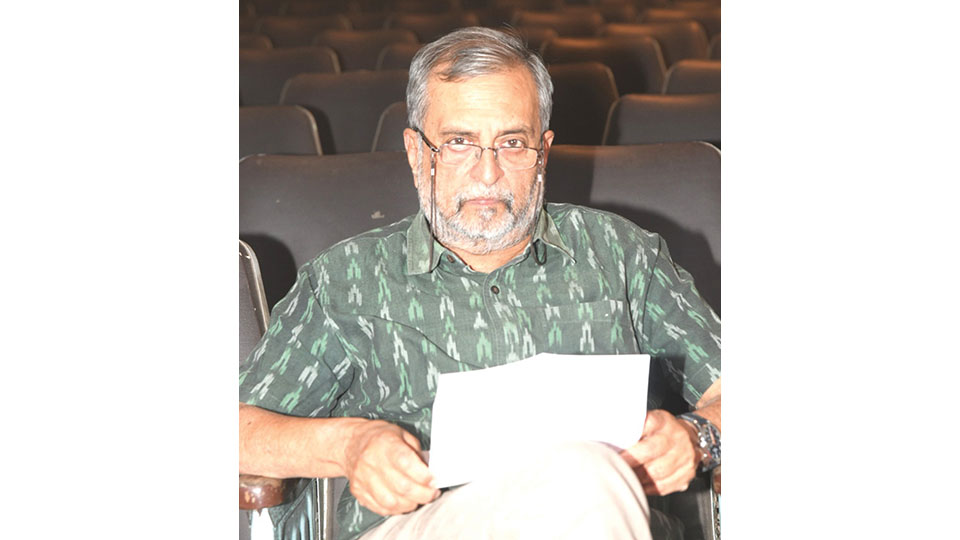
Mysore/Mysuru: “Cinema in India did not begin with fantasy or documentary. It began with mythological films,” said film critic and writer M.K. Raghavendra.
Speaking at a session titled ‘Narration in Indian Popular Cinema and The Mimetic Urge,’ he traced the evolution of representation in art.
“Early cave paintings were attempts to reproduce real-world objects. With the arrival of photography and cinema, mechanical tools emerged to imitate reality. While cinema developed alongside documentary traditions, illusion became central to its expressive power,” he explained.
He referred to French magician Georges Méliès, who recognised cinema’s capacity for illusion, not merely as unreality, but as imaginative creation.
Raghavendra recalled that Dadasaheb Phalke’s (D.G. Phalke) film ‘Raja Harishchandra’ was received by audiences as the truth.
“Truth in cinema was not simply internal (psychological) or external (realistic), but connected to meaning. Sathya Harishchandra’s story carried sacred significance and therefore it was accepted as truth,” he explained.
He explained that Indian popular cinema, by conveying truths connected to life, reflects art’s uncertain purpose and its element of imitation, resulting in works that are modest yet complex.




Recent Comments