



Sri Ramanavami marks not only a spiritual celebration but also a vibrant music season. Mysuru owes much gratitude to Vidwan Mysore Sadashiva Rao, the visionary who transformed this auspicious festival into a grand Sangeetotsava. His legacy continues to inspire and today, several Sabhas across Mysuru celebrate Ramanavami on a grand scale.
Among the prominent organisers are the legendary Bidaram Krishnappa’s Sri Prasanna Seetharama Mandira, Sri Ramabhyudaya Sabha (commonly known as Moole Rama Mandira), Jayanagara Sri Rama Mandira and Sri Rama Seva Mandali Charitable Trust – Mysuru North.
As part of these festivities, Vid. Ramakrishnamurthy gave a grand vocal concert on Apr. 9 under the aegis of Sri Rama Seva Mandali, V.V. Puram, held at the Prasanna Parvathi Kalyana Mantapa. An Informatics graduate from the University of California, Ramakrishnamurthy returned to India with the sole purpose of pursuing music. Trained by several eminent masters, he has blossomed into a refined and expressive artiste.
He was accompanied by Mysore V. Shreekanth on violin and Vid. Arjun Kumar on mridanga. Ramakrishnamurthy is blessed with a resonant voice that effectively conveys the full range of his musical ideas. A seamless blend of gamakas, shuddha shruti, rich manodharma and precise laya control made his performance thoroughly enjoyable. This finesse was evident in every krithi he presented, both with and without kalpana sangeetha. His improvisations displayed intricate melodic and rhythmic patterns that elevated the experience. His raga alapana showcased maturity and confidence, rendered with all the appropriate embellishments. Ragas such as Todi, Kannada, Kapi, Malavi, Abheri and Shankarabharana were explored in their full grandeur. Each phrase flowed with precision and grace, delighting the listeners.
Some of the compositions he chose for the evening included: “Rajuvedale Joothamu Rare” (Tyagaraja), “Shree Mathrubhootham Bhaje” (Muthuswami Dikshitar), “Sumasayaka” (Swathi Thirunal Maharaja), “Idi Nyayama Shree Ramachandra?” (Patnam Subramania Iyer), “Entha Cheluvage” (Purandara Dasa) and “Enduku Peddala” (Tyagaraja).
The varna “Sumasayaka” was particularly charming and concluded with a pleasing ragamalika in the swaras. Shankarabharana was presented with majestic dignity and proved to be a musical highlight. His neraval and kalpana swaras exhibited a royal gait that added to its appeal. However, his Kannada pronunciation, particularly in “Entha Cheluvage Magananu Kottanu,” could benefit from further refinement.
Mysore V. Shreekanth’s violin accompaniment was commendable, impressing the rasikas with his powerful and emotive bowing.
Arjun Kumar, a seasoned percussionist, showcased his expertise on the mridanga with nuanced and supportive rhythms.
The Sri Ramanavami concert series concluded on a high note with Vidwan Ramakrishnamurthy’s evocative performance at Prasanna Parvathi Kalyana Mantapa.
At Bidaram Krishnappa’s Rama Mandira
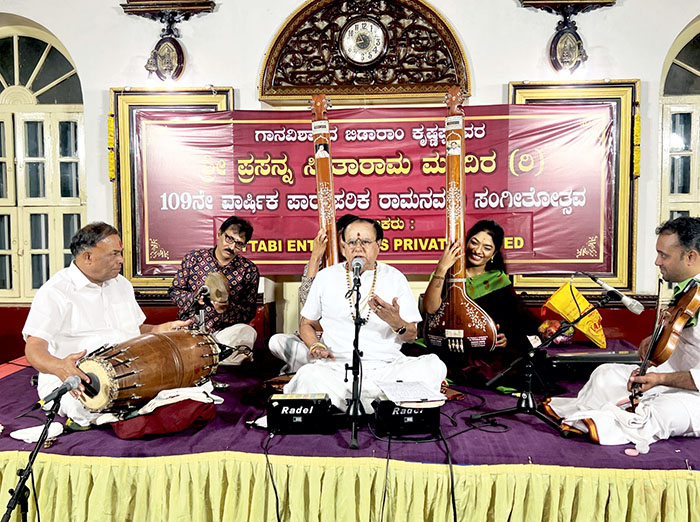
The iconic Sri Prasanna Seetharama Mandira of Bidaram Krishnappa is celebrating its 109th year of Ramanavami. For artistes, performing at this revered venue is as sacred as a pilgrimage to Kashi. This year, Vid. R.K. Padmanabha — renowned singer, writer, composer, organiser, teacher and actor from Bengaluru — was felicitated, followed by his soulful concert.
Padmanabha, who began performing in 1975, has retained his rich and resonant voice over the decades. A seasoned musician, he has received numerous accolades for his contributions to the field of Karnatak music. He was accompanied by Vid. H.N. Bhaskar on violin, Vid. C. Cheluvaraju on mridanga and Vid. A.S.N. Swamy on kanjira.
An ardent devotee of Sri Vadiraja Swamy, Padmanabha invariably begins his concerts with salutations to the saint. This performance included three of his own compositions, including a varna in raga Poorvikalyani dedicated to Sri Vadiraja. A spirited rendition of Tyagaraja’s ‘Sarasa Saama Daana’ in Kapinarayani featured energetic kalpana swaras at “Hithamu Matalento.”
Following another self-composed piece,’ Jaya Jaya Jaya Mathe’ in Kalyani, Padmanabha introduced a rarely heard raga, Nari Reetigowla, which features shuddha dhaivata, adding a unique flavour distinct from the more familiar Reetigowla. This raga is considered a derivative of Kharaharapriya in the Dikshitar tradition. He rendered Dikshitar’s ‘Neelotpalambam Bhajare Chitta’ with finesse and followed it up with an elaborate kalpana swara segment.
The popular Tyagaraja kriti Brova Bharama in Bahudari was followed by a Raga-Tana-Pallavi in Keeravani. The pallavi, “Vani Veenapani Keeravani Pālisu,” was set to a complex tri-taala kale bheda, a challenging combination of three talas: Divya Sankeerna Eka in dvikale, Tisra Eka in ekakale and Roopaka Eka in ekakale. It was a true test of the ensemble’s coordination and rhythmic prowess.
H.N. Bhaskar, one of India’s finest violinists, was exemplary in his melodic and supportive accompaniment throughout the concert. Cheluvaraju, known for his soft yet precise mridanga strokes, along with Swamy on the khanjira, provided excellent rhythmic support.
The concert concluded with a self-composed tillana in Sindhubhairavi, in praise of Lord Anjaneya, leaving the audience uplifted. All in all, it was a vibrant and memorable concert.
—Dr. Rama V. Bennur
Recent Comments