


By Dr. R. Balasubramaniam
There is something deeply philosophical about Indian Railways. It does not merely transport people from one city to another. It transports them from one version of themselves to another. I know this because many years ago, I made the Bengaluru to Delhi journey in an unreserved compartment and arrived a changed man. Not improved, necessarily. Just changed.
The Karnataka Express was scheduled to depart Bangalore City Station at what the time-table described as a specific time. Indian Railways treats time-tables the way some of us treat new year resolutions. The intention is sincere. The execution is aspirational.
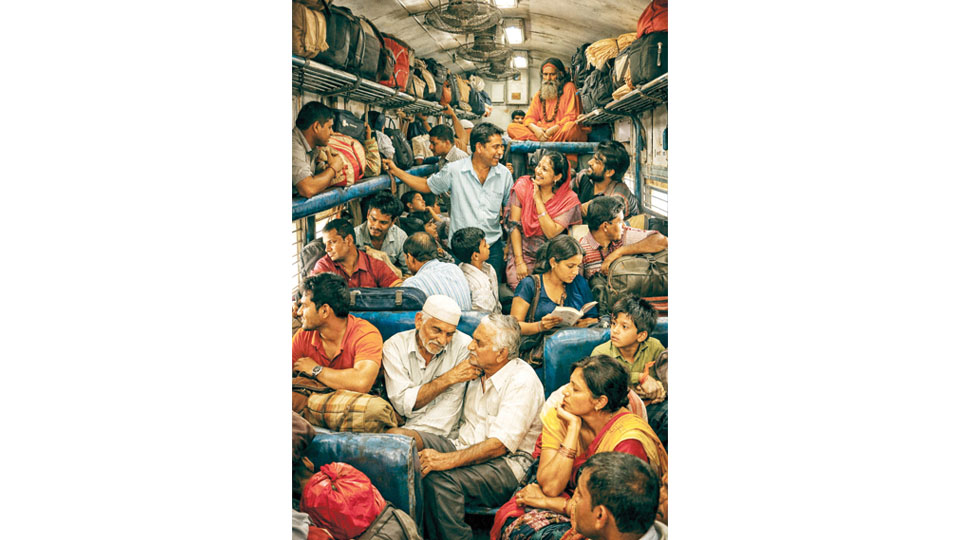
The train finally arrived — itself a personal victory. I joined the surge toward the unreserved compartment with the confidence of someone who had never done this before. Within minutes I understood something fundamental about Indian democracy. It is not merely a system of government. It is a lived philosophy, practiced nowhere more vigorously than in the unreserved compartment of a long-distance express.
The compartment was already full when I entered. This was technically impossible since I had watched the train pull in, but Indian trains operate on spatial principles that transcend geometry. People were sitting where there were seats. People were sitting where there were no seats. People were sitting on people who were sitting in seats. A man near the window had achieved a position that would have impressed a qualified yoga instructor. He appeared comfortable or possibly unconscious.
I found a corner near the door and claimed it with the quiet desperation of someone who has nowhere else to go. The floor was occupied by luggage of every description — suitcases tied with rope, bags bulging with things of no structural category and a sack that moved occasionally, which I chose not to investigate.
Within an hour, the compartment had reorganised into a functioning ecosystem. Strangers divided available space through a negotiation conducted without words — a sophisticated system of elbows, sighs and strategic placement of bodies. By Yelahanka, we had achieved a social compact. By Dharmavaram, we were sharing food.
This is perhaps the most remarkable thing about unreserved compartments. They are deeply commune based. Within two hours I had been offered rice from someone’s tiffin box, advised on my career prospects by a retired post office employee and informed about the medical history of a family I had never met. I knew more about my fellow passengers than I know about some colleagues I have worked with for years.
The journey was thirty-six hours. I use the word loosely. It implies movement. Indian trains moved when they wished to and stopped when they found something interesting. We stopped at stations with no visible platform activity and between stations with no explanation at all. Once we stopped and a goat appeared outside the window. I am not sure what the goat was doing there. The goat seemed equally uncertain about us.
Somewhere past Nagpur, at a deeply inconvenient hour of the night, a family boarded at a small station and needed space. The compartment, which had no space, found space. This is the miracle of Indian public transport. Space is not a fixed quantity. It is a social achievement. Two men turned sideways and created a sliver of bench that had not previously existed in three-dimensional reality.
I reached Delhi in the morning, creased and tired, carrying the smell of a thirty-six-hour unreserved compartment — a smell no cologne addresses and no ventilation fully clears. My back had developed opinions about the journey that it would express intermittently for the next two weeks.
But I had also arrived with something else. A clearer sense of what it means to share space with strangers under difficult conditions and still manage something close to grace. The man with the yoga posture had offered me part of his breakfast without being asked. The retired post office employee had pointed me to the right platform at Delhi. The family that had boarded past Nagpur had nodded goodbye when they alighted at dawn.
Indian Railways, in its unreserved compartments, does something the rest of our lives rarely manages. It puts everyone in the same situation and watches what happens. What happens, more often than not, is kindness. Imperfect, inconvenient, slightly intrusive kindness, but kindness, nonetheless.
We spend much of our time arranging our lives to avoid discomfort — travelling in the right class, sitting in the right seats, interacting only with people we have chosen. But perhaps the unreserved compartment was teaching a lesson that the reserved berth never could.
We share a country the way we share those compartments. Crowded, overlapping, negotiated, unequal in what we each bring aboard, but fundamentally going in the same direction. The question is not whether there is enough space. The question is whether we are willing to make some.
[Dr. R. Balasubramaniam is the Founder of Swami Vivekananda Youth Movement. ‘The Lighter Side’ is a series of satirical articles meant to bring a smile by highlighting the funny side of everyday life.]

Recent Comments