


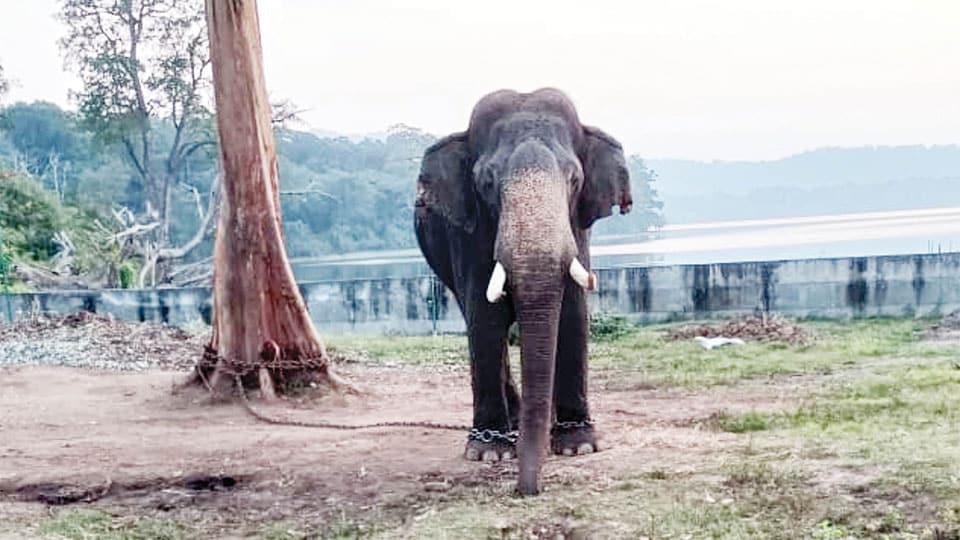
Skewed sex ratio: Of 78 elephants in 8 camps, 64 are males, 9 are females, 5 are female calves
Mysore/Mysuru: Elephant camps in Kodagu and Chamarajanagar districts that supply elephants for the Mysuru Dasara festival are facing a noticeable shortage of female elephants.
According to data available with the Forest Department, of the 78 elephants housed across eight camps, 64 are males. There are only nine females, pointing to a significant gender imbalance. There are five female calves in two elephant camps.
Data with Star of Mysore shows that several camps have very few or no female elephants, raising concerns about breeding and the long-term sustainability of the captive herd.
At the Dubare Elephant Camp in Kodagu, the largest camp in the region, 30 elephants are housed, 25 males, two females and three calves, reflecting one of the sharpest imbalances. Similarly, the Harangi Elephant Camp near Kushalnagar has six elephants, all of them males, with no females or calves. At the Mathigodu Elephant Camp on the Mysuru-Kodagu border, there are 16 elephants, including 12 males, two females and two calves.
At the Bheemanakatte Elephant Camp near Periyapatna, both the elephants housed there are males. In the Nagarahole region, the Doddaharave Elephant Camp has one female elephant, while the Balle Elephant Camp has two elephants, one male and one female.
The Ramapura Elephant Camp, also known as Ainooru Maarigudi Camp near Bandipur Tiger Reserve, houses 20 elephants, including 17 males and three females. At the K. Gudi Elephant Camp near Biligiri Ranganatha Tiger Reserve, there is only one elephant and it is a male.
Skewed ratio, musth condition
With only nine female elephants across all camps, the male-female ratio is heavily skewed. The problem becomes more serious when male elephants enter musth.
Currently, four of the six elephants at Harangi Elephant Camp are in musth. At Dubare, three elephants are in musth, while one tusker at Bheemanakatte is also undergoing the phase.
Elephants in musth experience a surge in testosterone, leading to heightened aggression and a strong urge to mate. The shortage of female elephants during this period can lead to conflicts between bulls for dominance and cause them to behave unpredictably.
Mahouts say controlling elephants in musth is extremely challenging. During this phase, the animals often injure themselves by rubbing against large tree trunks or driving their tusks into them. To prevent accidents, elephants in musth are usually chained and kept isolated. Even other elephants instinctively avoid them. “No one dares to go near a musth elephant. They also refuse to eat and lose weight rapidly,” said J.K. Dhobi, an experienced caretaker who has worked with elephants for more than 50 years.
Calming effect
“Female elephants act as a calming influence on males and are not meant only for mating. That is why the Dasara Howdah elephant is always accompanied by two female elephants on either side during the Vijayadashami procession so that it remains calm. Earlier, the ratio between male and female elephants would be equal at all elephant camps. Now that is not the case,” Dhobi explained.
Wildlife activist Joseph Hoover said that the 64:9 male-to-female ratio is worrying. “Tourists should not be allowed inside elephant camps when male elephants become unpredictable due to the absence of females. The Forest Department must take steps to address the issue,” he said.
Two females to be shifted: DCF
Deputy Conservator of Forests (DCF), Madikeri Division, Abhishek said, steps are being taken to manage the situation.
“We release elephants in musth into the forest in a controlled and monitored manner so that they can mate with wild females. A proposal to shift two female elephants from Ramapura Elephant Camp has been approved. One female will be immediately moved to Harangi Elephant Camp, while the other will be shifted either to Dubare or Mathigodu,” he said.
Recent Comments