


Management matters more than additional infrastructure
Sir,
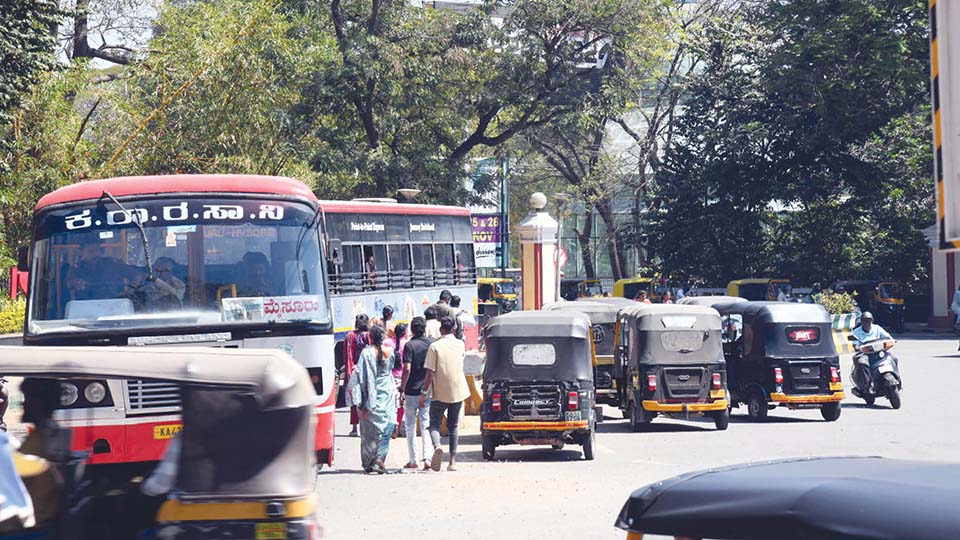
While bus terminals are designed for smooth movement, the infrastructure around them often fails and the area outside the Mysuru Suburban Bus Stand highlights how gaps in planning and management reduce safety and accessibility.
During peak hours, congestion spills onto surrounding roads, with buses frequently looping around Hardinge Circle (Jayachamaraja Wadiyar Circle) before re-entering the terminal, adding delay and pressure to an already busy zone.
At re-entry points, buses intersect with pre-paid autorickshaws, two-wheelers and pedestrians, with little traffic segregation, unclear markings and minimal on-ground control, forcing all users to rely on individual judgement rather than a defined system. Adjacent footpaths are uneven, encroached upon and overcrowded, pushing elderly commuters, passengers with luggage, students, vendors and visitors through narrow and poorly maintained walkways, where risks such as falls and petty crime become routine rather than exceptional.
The issue is not the absence of infrastructure — Mysuru already has roads, terminals and pedestrian facilities — but the lack of effective operational management.
Simple measures such as clear traffic hierarchy, continuous and well-maintained footpaths, visible markings, phased vehicle movement and trained personnel could significantly improve safety and usability.
In an era of climate uncertainty and resource constraints, cities must prioritise optimising existing assets over expanding concrete footprints.
Transport spaces should be inclusive, intuitive and safe for users of all ages and abilities, and a city known for its heritage and calm should not feel chaotic at its gateways. Alongside better management, civic discipline — respecting queues, right of way and shared space — remains essential. Mysuru may not need more infrastructure, but it does need better management and more responsible use of what already exists.
—Rohin Ashvij
Bank Colony, Bogadi
2.2.2026
Recent Comments