


By Maj. Gen. (Retd.) S.G. Vombatkere
The Government of Karnataka is proposing to construct a NIMHANS-model Hospital Complex to serve the people of Mysuru, Mandya and Kodagu districts. Media reports indicate that the site selected for this Project is in Survey Nos. 8, 60 and 68 of Gudumadanahalli village in Varuna Hobli, Mysuru Taluk.
A NIMHANS-model Hospital is prima facie a good idea, so news of residents’ protest against this project prompted a visit to Gudumadanahalli to understand their point of view.
Meeting and interacting with residents of Gudumadanahalli revealed their reasons for opposing the selection of the project site. They suggested ‘kharab’ land or ‘gomala’ land or land already converted for industrial or other non-agricultural uses, as alternative sites for the project. Gudumadanahalli’s agri-based economy is an active asset. It remains green year-round, with cultivation of paddy, coconut, bananas and animal feed-grass, among other produce, including a substantial input of milk to Karnataka Milk Federation (KMF).
Grass is an important product as fodder for animals in Mysuru’s Zoo and Pinjrapole and the Dasara elephants during the festival.
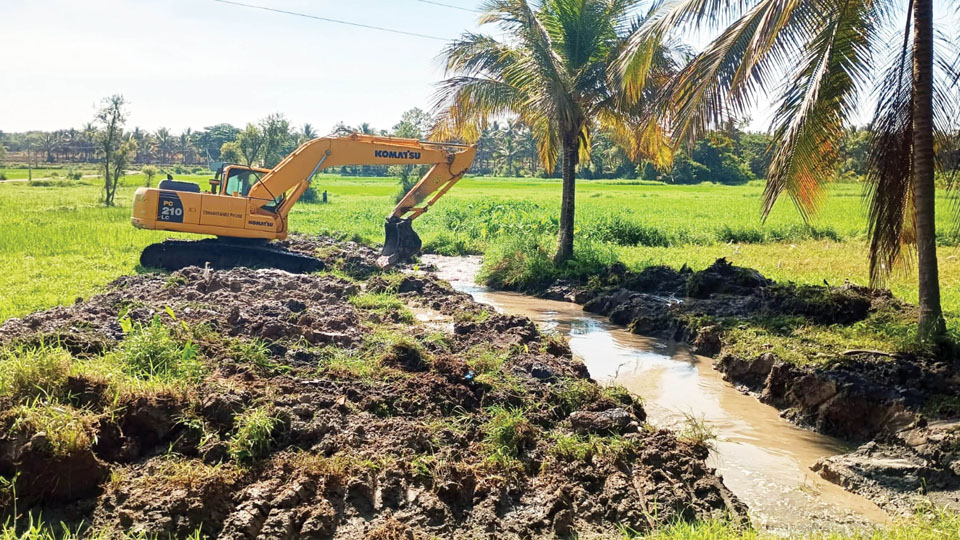
Gudumadanahalli’s successful traditional agricultural activities over several generations of farmers are based upon the cultivated area of Gudumadanahalli being low-lying wetlands. The green oasis of Gudumadanahalli is a cool-spot carbon sink near Mysuru City. Its destruction by constructing buildings will cause irreversible environmental and ecological loss to Mysuru City and Mysuru District.
Mysuru Sewage Farm’s partially untreated effluent flows into Dalvoy Lake, which functions like an aeration pond. Dalvoy Lake overflows into Gudumadanahalli’s low-lying natural wetlands. Natural microbial activity and plant uptake in the wetlands further improve the water quality.
Thus, the Gudumadanahalli wetlands offer natural water purification, while simultaneously providing nutrient-rich water for economically productive agriculture.
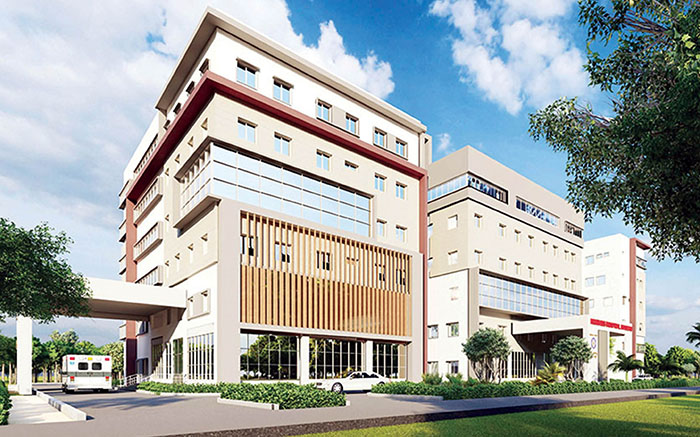
The proposed project will destroy this natural purification process, along with the natural life in the wetlands, thus causing irreversible environmental and ecological damage.
It is self-evident that a wetland, additionally subject to monsoon water-logging, is the wrong choice, especially for a hospital. The malodorous, low-lying wetland surroundings of hospital buildings will be unhealthy and extremely difficult to manage for patients and hospital staff.
The Mysore Airport at Mandakalli is just a half-kilometre from Gudumadanahalli. The noise of aircraft landing and taking off is disturbing, even with the present limited flight operations. Extension of the Airport runway is planned to accommodate larger aircraft and expand operations to national and international destinations.
The extended runway will be even closer to Gudumadanahalli and increased air traffic with the expanded Airport will be a perpetual high-decibel noise disturbance to Hospital patients and staff. It is not good practice to locate a hospital near a source of high-decibel noise. Apart from that, the residents of Gudumadanahalli are small farmers cultivating 3-15 gunta plots and others who are agricultural workers.
Acquiring the agricultural land for the project will displace these families. They will lose both land and livelihood and be obliged to relocate, resettle and rehabilitate themselves.
Displacement will convert this self-supporting farming community into Project-Affected Families (PAFs). Some may argue that PAFs are entitled to compensation. However, the harsh realities of land acquisition administered by the apathetic and corrupt bureaucracy are that many farmers may not get their compensation in full.
We have the examples of the displaced people from the Kabini Dam project from the 1970s and the Upper Krishna Project; some of them are still fighting for their compensation.
Interestingly, sources say that no comparative Environmental, Social and Economic Impact Assessment of alternative sites was conducted in choosing a site for the hospital project!
Even at this late stage, the Government should reconsider Gudumadanahalli for the hospital complex and conduct a comparative study of alternate sites. This green oasis is crucial, especially if you’re considering going ahead with the Greater Mysore project.
Recent Comments