


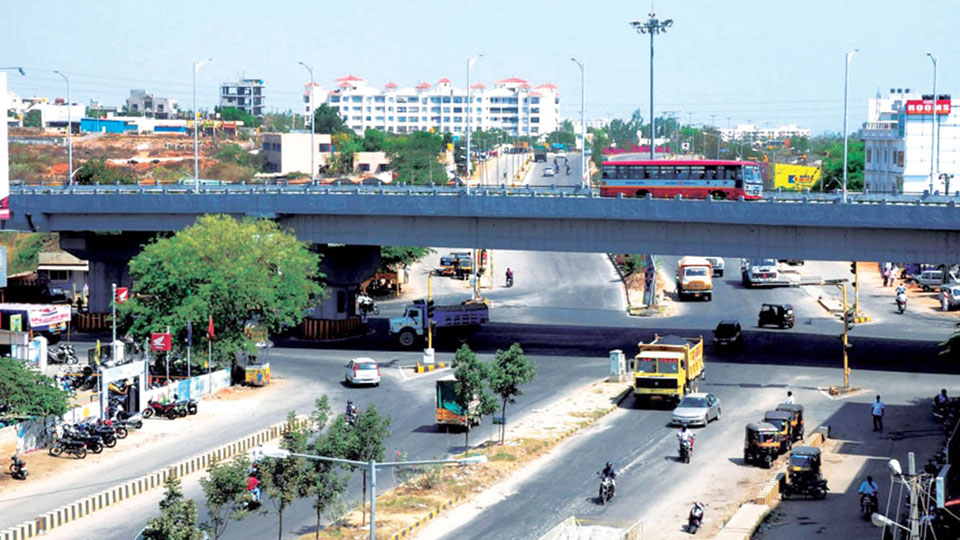
Flyovers in Bengaluru, Mysuru falter amid shoddy construction, neglected maintenance
By Gouri Satya, Senior Journalist
Flyovers are often considered an effective measure in easing traffic bottlenecks and reducing travel time in heavily congested areas. They reduce the likelihood of accidents at the intersections, as they would segregate high-speed or through traffic from local traffic. But these come at a cost.
Construction of flyovers can have a negative impact, particularly on the environment. The felling of well-grown trees causes irreversible damage to the environment and disrupts the ecosystem.
It increases urban heat, causes destruction of habitat, particularly birds in urban areas and affects water cycles, leading to floods and droughts. These disastrous effects are already being experienced in areas where green coverage has suffered.
As regards Mysuru, the construction of flyovers will have an additional impact. Mysuru is a recognised heritage city and known for its aesthetic charm nurtured carefully over centuries.
This aesthetic charm and attractive tourist spots are drawing thousands of visitors regularly. The two flyovers to be built within the city could cause considerable damage to this inheritance of pride. The heritage city should be prepared to face these challenges at a heavy price. This is what the Mysureans are more concerned about.
The two flyovers planned are on Jhansi Lakshmibai (JLB) Road and Vinoba Road (Hunsur Road). They are to be built on heritage roads dotted with heritage structures and a green canopy.
The argument is that flyovers will upset the delicate balance of Mysuru’s urban design, architectural heritage and green boulevards, leading to irreversible changes to the city’s skyline.
No doubt, the Hunsur Road is one of the busiest corridors in Mysuru. It faces frequent congestion, especially between Field Marshal K.M. Cariappa (Metropole) Circle and the Hinkal Ring Road flyover. Long delays, erratic flow and commuter frustration are witnessed.
To resolve this problem, a flyover is proposed along the 5.5 km stretch from Field Marshal K.M. Cariappa Circle to Hinkal. Soil analysis has been taken up to examine the conditions for erecting pillars for the proposed flyover.
The stretch includes seven traffic signals and several intersections, which cause considerable delays. Besides, vehicular traffic is heavy as the road leads to Madikeri (Kodagu). When completed, the flyover will help reduce traffic congestion, decrease air pollution and fuel consumption, as vehicles will spend less time on the road.
However, it has to pass through heritage structures like the old Deputy Commissioner’s Office, Kalamandira, the residences of the Deputy Commissioner and Regional Commissioner, the Karnataka State Open University, Prasaranga, the Central Institute of Indian Languages, the erstwhile Premier Studio premises and major educational institutions.
On Jhansi Lakshmibai Road, the flyover will come up from Babu Jagjivan Ram Circle in front of the City Railway Station, passing via Ramaswamy Circle and Yelethota in Vidyaranyapuram.
It will connect NH-766 at the Nanjangud Road junction. The two flyovers will help relieve congestion, particularly during Dasara. This stretch too will pass through many heritage structures.
Permanent damage
As mentioned, both stretches are surrounded by heritage structures and lined with thick greenery. They have sensitive spots like schools, religious places and hospitals, which may face the brunt of the project during construction and post-construction.
However, the damage after the construction would be of a permanent nature. The prominent structures stand to lose their prominence, the flyovers obscuring them.
A commuter travelling on a flyover would have seen how structures and places, a long-time familiar sight dominating the road, have lost their identity and look diminutive. The heritage structures on these two leading roads cannot be an exception to this.
If these are consequences of a permanent nature, the construction phase disruption, though temporary, would upset the balance along the route until the flyovers are built fully.
Liability rather than priority
Increased traffic jams, hazardous road conditions, high noise levels, significant air quality decline due to dust and emissions and resultant health hazards and public discomfort impacting local businesses would be a normal phenomenon. These may make a flyover a liability rather than a priority.
Even after the construction, safety concerns may persist. For example, on the Mysuru-Bengaluru National Highway,
though some corrective measures have brought down the number of accidents after the loss of many precious lives. Therefore, new infrastructure can introduce new safety challenges if not planned inclusively.
Many examples from Bengaluru
If the construction is shoddy and maintenance is poor, additional problems follow. There are instances of temporary closure or even demolition of flyovers. To cite a few examples in our capital city Bengaluru:
The Somanahalli flyover on the Outer Ring Road had developed a gaping hole only a few years after its completion, the elevated flyover on Tumakuru Road, built by the National Highways Authority of India (NHAI), had to be shut for traffic for two months after cables developed cracks, the steel bridge at Sivananda Circle had to be temporarily closed for repairs within a day of its construction, flyover at Ejipura remained incomplete for over five years, Hebbal flyover had turned a nightmare for a long time and the Jayadeva flyover was demolished to make way for construction of Metro line.
In Mysuru, neglected maintenance of the Hinkal flyover had opened up gaps on the sides, resulting in an unchecked growth of peepal tree plants, as Star of Mysore had reported in November 2023. It had also mentioned the chaos at the point where the flyover ends.
Flyovers, therefore, cannot be a permanent solution to traffic problems, even according to experts. Examples from cities like Bengaluru, where traffic issues persist despite numerous flyovers, are cited in this regard. They may raise new concerns like slow movement of traffic due to increased traffic and bringing more vehicles to a congested point at the flyover terminating point.
Need for a balanced approach
Mysureans are questioning whether flyovers are the only option to tackle traffic hazards for Mysuru, which boasts of exceptional features. Are there no alternative ways to tackle the issues?
Expressing concern over the damage the two flyovers could cause to the image of Mysuru, MP Yaduveer Krishnadatta Chamaraja Wadiyar has voiced strongly against their construction and has called for ‘responsible development’ which would preserve Mysuru’s heritage.
The current debate in Mysuru emphasises the need for a balanced approach that prioritises sustainable, people-centric and context-specific planning rather than indiscriminate concrete expansion, while some suggest alternatives like improved public transport or a metro rail system.
Causes of Mysuru’s travel delays: Signals, turns, pedestrians
A Comprehensive Traffic and Transportation Plan (CTTP) 2009 – 2028 by the State Directorate of Urban Land Transport (DULT) in line with the 2006 National Urban Transport Policy had observed that in Mysuru, fixed delay occurred primarily at intersections due to traffic signals and operational delays by the interference of traffic movements, such as turning vehicles, parking and un-parking vehicles, pedestrians etc. As a result, the overall travel speed was lower than the desirable running speed, causing traffic bottlenecks. After an elaborate study, it had made several suggestions to improve the road transport system to ease the situation by adopting the latest technology.
On building flyovers in the city, an expert commented: “Another disastrous idea. A comprehensive urban mobility plan is needed that includes mass rapid transit, either bus or train. Mono rails will be an ideal substitute for bus rapid transit. Mysuru buses have not changed since 50-plus years, with only routes getting extended. Lack of grid-wise movements and under-utilisation of the Outer Ring Road for public transport is glaring. Bringing highway traffic into the city centre is senseless.”
Recent Comments