


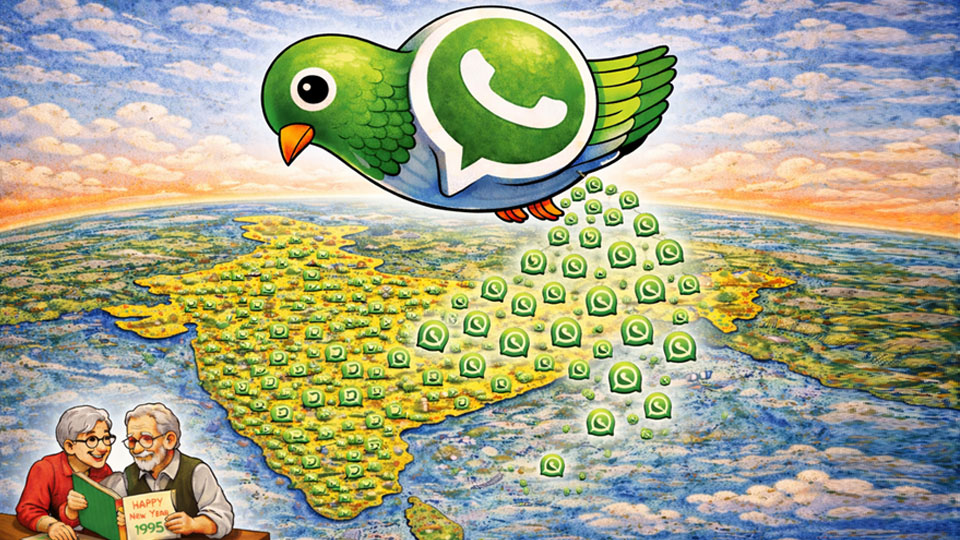

With every passing year, greetings have become increasingly impersonal. What was once an act of intention has now turned into a reflex, executed with the tap of a thumb. We are no longer greeted…we are broadcast to.
The evolution has been swift and revealing. It began with SMS, when messages were short, awkwardly phrased and sent to a limited circle, largely because each one cost money. There was restraint and therefore, some thought.
Today, we have graduated to free WhatsApp greetings and with zero cost comes zero hesitation.
The result is an avalanche of goodwill, generously distributed but barely felt. The scale of this ritual is astonishing.
On Dec. 31 alone, Indians sent over 2,000 crore greetings! No wonder this year, WhatsApp announced New Year offerings such as 2026 sticker pack and animated confetti. Digital embellishments for digital sentiments.
The Company added, with earnest marketing warmth, that these features were designed “to help you share the moment with people who matter most.”
And here, one must pause to ask…
Shouldn’t we be calling “people who matter most” instead of messaging?
Messaging, especially mass messaging, often carries the faint odour of obligation.
It feels transactional, less an expression of care and more a declaration that one has fulfilled a social duty.
There was a time when people called each other personally to exchange New Year greetings. These calls were spread over days, sometimes weeks.
A greeting received on the 10th of January did not feel late, it felt remembered. The delay itself carried sincerity.
Perhaps this explains why, despite being digitally hyper-connected today, we often feel emotionally under-connected.
There was also a time when greeting cards held similar value.
Christmas and New Year cards were displayed on tables and shelves, not deleted after being viewed once.
They reminded us of relationships. People took the trouble to write thoughtful messages. Sentences that reflected familiarity, affection and shared history.
Words mattered because they were chosen, not forwarded.
This year, however, some people went a step further. They sent New Year greetings before the New Year had even arrived.
As though the mass WhatsApp greeting was not impersonal enough, it had to be completed in advance. It felt like a chore to be finished before heading out to the party.
What made this worse was that many of these verbose messages were clearly generated using artificial intelligence. How do I know? Simple.
While the prose in the message read as though it had been penned by Shashi Tharoor, the senders, whom I know personally, possess limited English vocabulary.
Worse still, in their haste to outsource sentiment, some didn’t even bother with spell checks. One wished me a “preposterous year.” Another hoped I’d have a “fanatic year ahead.” I spent a moment wondering about their intentions before realising they meant “prosperous” and “fantastic.”
To all such premature greeters, I am tempted to reply politely: “Thank you, and a very Happy New Year to you too and … Happy Birthday.”
If they can pre-emptively greet for New Year, they should be able to accept pre-emptive birthday wishes too.
Digital greetings may have replaced cards and calls, but one New Year ritual stubbornly survives: The annual diary. At least this tradition retains some utility.
So far, I have received four diaries and what fascinates me is not the blank pages but the encyclopaedic knowledge packed into them.
One diary, sent by our newsprint supplier, was particularly enlightening. It included a calorie chart listing everything from biryani to carrot halwa.
This was followed by pages on medical awareness such as, how to recognise a heart attack, alcoholism and signs of mental health distress.
It struck me that this diary was not merely a gift, but a business strategy: Keep the buyer alive to do business.
One diary even had a section titled “Latin in Common Usage.” I’m not sure when this knowledge will be practically useful, but I now know that Curriculum Vitae means “course of life.” At the very least, I began the year having learned something.
Speaking of the first day of the year, I too made a resolution. I promised myself I would avoid sugar and sweets. But broke it for God’s sake as I consumed a sweet ladoo prasad.
Interestingly, this year, mental well-being has overtaken weight loss as the top resolution globally. And why not?
In an age of selfies, social media, rage-bait and algorithms that feed our prejudices, we seem to be losing not just our attention spans but our critical thinking as well.
Perhaps what we truly need in 2026 is not more messages and reels but fewer greetings and deeper conversations. Less noise and more meaning.
e-mail: [email protected]



Recent Comments