


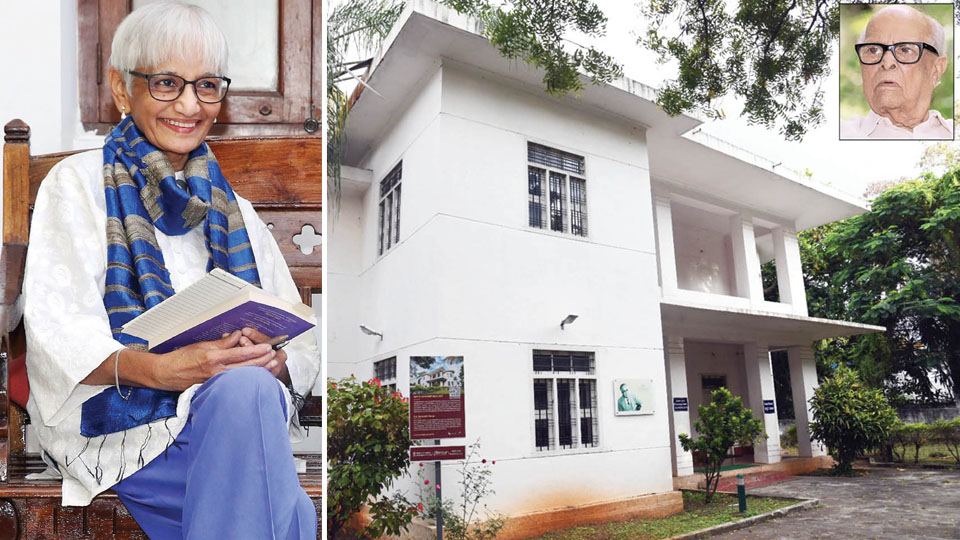
Sita Bhaskar is the author of four books that weave together tradition and contemporary themes. Her latest book, ‘Rukmini Aunty and the R.K. Narayan Fan Club,’ was inspired by newspaper reports on the efforts to preserve R.K. Narayan’s house in Mysuru as a museum and the subsequent struggle to acquire and restore the property.
Sita Bhaskar divides her time between Madison (Wisconsin), USA, and Mysuru, drawing inspiration from both places to enrich her storytelling and build connections across cultures. Shubha Sanjay Urs, Founder-President of Mysuru Book Clubs Charitable Trust and Founder-Director of Mysuru Literature Festival, spoke to Sita Bhaskar on behalf of Star of Mysore to mark the 120th birth anniversary of R.K. Narayan (RKN) and the completion of 15 years of the Mysuru Book Clubs Charitable Trust. Excerpts:
By Shubha Sanjay Urs
Star of Mysore (SOM): What inspired you to create a story centred on Rukmini Aunty and the effort to restore R.K. Narayan’s house?
Sita Bhaskar: I had read ‘The Jane Austen Society’ by Natalie Jenner, which revolves around Chawton, Jane Austen’s final home. I was fascinated by how Jenner drew on characters from Austen’s novels to fictionalise her story. When I later read about the history of R.K. Narayan’s house at Yadavagiri, Mysuru, the germ of an idea took shape and eventually grew into ‘Rukmini Aunty and the R.K. Narayan Fan Club’ (Penguin Random House India).
SOM: R.K. Narayan almost appears as a protagonist in your novel. How and why did that happen?
Sita Bhaskar: It wasn’t intentional. It emerged from the overlap of two books I read around the same time. One of them was Narayan’s autobiography ‘My Days’, which drew me deeper into his life. In my mind, the real protagonist is R.K. Narayan’s house. In the other book I mentioned, Jane Austen’s house also functioned almost like a central character.
SOM: The characters in your story seem to echo some of Narayan’s iconic characters. How did these characters influence your narrative and what do they represent?
Sita Bhaskar: Yes, there are echoes of them. While incorporating these elements, I wanted them to lend themselves to a contemporary retelling. Many in the younger generation feel Narayan’s works belong to a distant past.
Through this modern interpretation, I hope readers see that his characters and stories are timeless. They still resonate in the chaotic world we live in today, though perhaps in altered forms.
SOM: The characters driving the narrative forward are largely women: Janani, Rukmini Aunty, Mukta, Kamini and Hasina. Was that deliberate? Is it a new trend?
Sita Bhaskar: Nothing in fiction is entirely deliberate. Characters tend to wander in and out of a story on their own, unless one is writing a memoir. As for trends, I don’t think writers consciously write with a market or readership in mind. We write simply because that is what we do.
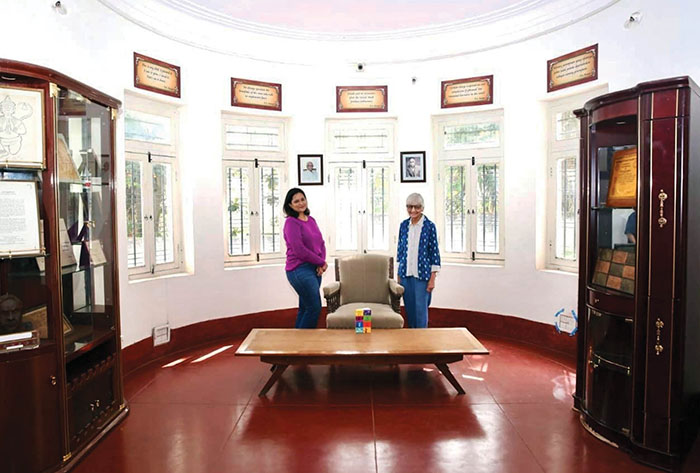
SOM: How have your own experiences and observations of the community influenced the story and its characters?
Sita Bhaskar: Rukmini Aunty and members of her fan club are composites of people I’ve encountered over the years. I borrow a trait from one person, a mannerism from another or a quirky habit from someone else. Human behaviour is my biggest source of inspiration, people’s quirks, their struggles, their attempts to swim against the tide and their battles with life. I am an unapologetic eavesdropper on conversations and an avid observer of people. In the end, the story is still a product of my imagination.
SOM: You move effortlessly between scenes set in Madison and Mysuru. Having lived on two continents, is that inevitable in your writing?
Sita Bhaskar: It becomes inevitable if you allow it to be. If you remain open to learning from the environment around you and avoid getting mentally stuck in one place or time. Rather unscientifically (and with apologies to Albert Einstein), I think of it as a kind of space-time continuum: Where your characters exist in time versus where you, the creator, are physically and mentally situated.
SOM: The novel deals with serious issues, yet you maintain a delightful streak of humour throughout. How do you manage that?
Sita Bhaskar: When I write, I inhabit the minds of my characters. I carry on imaginary conversations without consciously thinking about whether they sound humorous. Often, it is only when I reread what I have written that I realise it carries humour. Forced humour is difficult to write and even harder for readers to enjoy.
SOM: Rukmini Aunty and Shesha Uncle resemble the typical elderly couples of old Mysore — bickering, yet deeply understanding each other. They frame the narrative of the novel in a very R.K. Narayan-like manner. Your comments?
Sita Bhaskar: Is it very R.K. Narayan-esque? That is a lovely compliment. Thank you. Narayan could do that even when he was young; I’m attempting it when I’m not so young! Beyond his style, I tried to follow his way of observing the small details of everyday life, his ironic humour and his attention to nuance. He is a hard act to follow and I don’t presume to come anywhere close to the way his creative mind worked. One can only try.
SOM: What message do you hope readers take away about the importance of cultural heritage and community bonding?
Sita Bhaskar: R.K. Narayan once said he simply wanted to tell stories. “Only the story matters, that’s all.” That is how I see myself as well. I write stories without embedding any overarching message. If readers find meaning or messages in them, that’s entirely up to them.
SOM: What can readers expect from you next?
Sita Bhaskar: I wish I could look into a crystal ball and answer that!

Recent Comments