


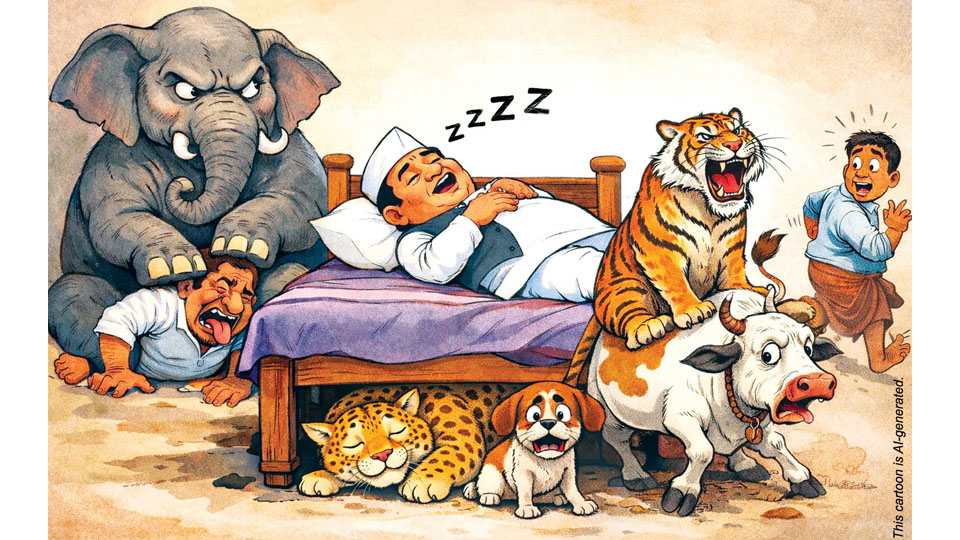

Yesterday morning, a three-year-old leopard that had come down from Chamundi Hill sneaked into a house in Siddarthanagar, got cosy under a bed and went to sleep. Probably after having made a meal out of a street dog. Thankfully, the leopard was captured with no injury to him or to humans.
Across India, human-animal conflict is intensifying at an alarming pace. Between 2019 and 2024, elephant attacks caused over 2,700 human deaths, while tigers were responsible for 349. That is, on average, one human life lost every single day for five years.
On the other hand, the cost to wildlife is equally stark. In 2025, 149 leopards and over 150 elephants were killed by electrocution, train collisions and poisoning. This is a sign of the times to come.
India is projected to become a global hotspot for human-animal conflict by 2070. Yet policy responses remain fragmented, reactive and non-serious. Just consider what is happening in our own State.
Karnataka now ranks among India’s worst human-animal conflict zones, with Kodagu at its epicentre accounting for nearly 38% of deaths in the State. Thirteen people died there in 2023-24. Since January this year, three have died.
In Kodagu, the threat is evolving; it’s not just elephants anymore, now it’s tigers too.
Rising tiger density in protected areas like Nagarahole has pushed big cats into coffee estates, resulting in significant cattle losses and heightened anxiety.
The wildlife populations have increased thanks to conservation success, but habitats have not expanded accordingly.
Forests are fragmented, corridors are disrupted and resources are strained. The inevitable result is wildlife spillover.
This leads to a difficult question that then leads to a taboo question.
First, have we reached ecological carrying capacity in certain regions? Which means have our forests reached their full capacity to sustain the present and future numbers of elephants, tigers and other animals?
If the answer is yes, which many think it is and if not, then it will get there, then it’s time to talk about wildlife management instead of just wildlife protection. Which leads to the taboo question: Are we ready to cull?
Around the world, countries have adopted targeted population control measures to balance ecosystems and reduce conflict.
Namibia and Zimbabwe cull elephants and hippos where overpopulation threatens both habitat and human safety. Australia and the United States implement controlled culling of species like crocodiles and alligators in high-risk areas.
In India, even raising the subject invites outrage.
This is not an argument for indiscriminate culling. It is an argument for scientific, data-driven management of wildlife populations in areas where human-animal conflicts are intensifying.
Meanwhile, those on the frontlines adapt as best they can. Planters are cutting jackfruit trees and banana plantations to deter elephants. It hasn’t worked. Elephants, remarkably adaptable, are now developing a taste for ripe coffee berries.
But there is a silver lining, like the expensive ‘Civet Cat Coffee’ made from collecting coffee beans from its poop, maybe Kodagu can produce ‘Elephant Coffee’. Time to stop picking berries from trees and digging into elephant dung?
For now, if we want the Government to implement a policy to manage human-animal conflicts, we’ll have to hope elephants stray into Mandya district and start enjoying their juicy sugarcane plantations. Why?
Because no one knows how to protest better than the people of Mandya, be it the Cauvery issue or farmers’ deaths. So, when Mandya erupts due to elephant menace, Vidhana Soudha will wet its pants and pull up its socks and push out a policy.
If we continue to treat incidents such as a leopard under a bed, an elephant running amok or a tiger attack as mere spectacles rather than symptoms of a larger issue, we will continue to have big cats turning our pets into their snack and enter our homes to take a cat nap.
P.S. – Siddarthanagar seems to be the most loved place for runaway animals.
In the late 1980s, a rather large chimpanzee named ‘Max’ escaped from the Mysuru Zoo and immediately made the Sports Club on Lalitha Mahal Road its home.
As the Zoo workers chased him, he soon settled down on the terrace of a house in Siddarthanagar.
Back then, Siddarthanagar was not completely built up, so the house the chimpanzee chose did not have houses around it. Then the Zoo Director C.D. Krishnegowda brought three elephants, surrounded the house, keeping the chimpanzee under house arrest.
Meanwhile, since there were no tranquillisers available, the Zoo workers placed some food and water laced heavily with India’s favourite ‘Holi drink’ — Bhaang.
The tired chimpanzee ravenously consumed the food and was soon all ‘bhaanged-up.’ The Zoo officials then carried away a ‘High Max’ who was in a deep drunken stupor.
‘Max’ the chimp lived for a long time after that heady night and even went on to father a son named Vali, who died in 2013.
e-mail: [email protected]

Recent Comments