


By A.C. Lakshmana, IFS (Retd.)
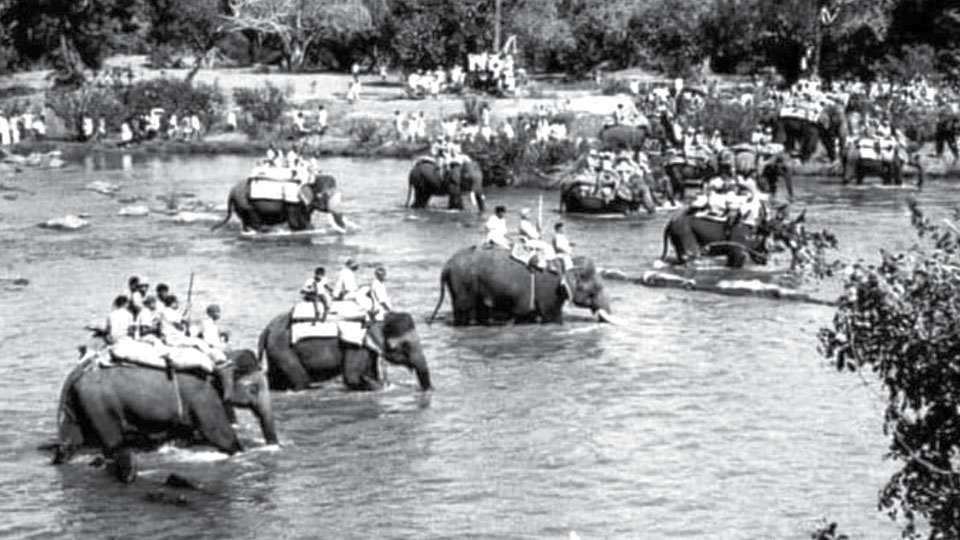
As a recent death during an elephant fight was reported in the media, I couldn’t help but recall my own adventures with these massive and amazing creatures during the last Khedda in Karnataka.
Khedda is the coming together of courage, strategy and intuition to capture the wild elephants. In this operation, tamed elephants are used to herd the wild elephants into an enclosure.
In the early 1900s, wild elephants had to be captured to manage the man-animal conflict in Chamarajanagar. But soon it ended with ‘conservation’ taking centre stage rather than ‘managing’ the conflict.
When the Karnataka Government decided to construct the Kabini Dam, it also decided to conduct the last Khedda Operation in 1971. While it was considered a ‘management’ operation, Khedda was also a show for the VIP’s!
So, preparations started a year earlier in 1970 itself, with thousands of labourers roped in to clear the forest view lines for Khedda and visitors’ galleries were built for VIPs to view the operation.
I, like a few others, joined operations for the last three months. We were housed in two rows of tents in front of the famous bandstand at Karapura near Mastigudi in Nagarahole Forests, now a Tiger Reserve.
My classmate Yellappa Reddy and I shared a tent, and the regular camp cook was in charge of food and other facilities. We, ‘Elephant Warriors’, as we were called, were given a specific tamed elephant along with its Mahout and Kavadi.
The tusker allotted to me was Abhimanyu, a beautiful pachyderm full of grace, power and courage. Abhimanyu was intelligent and a keen observer. More importantly, he perfectly followed his Mahout’s commands.
The day of operation
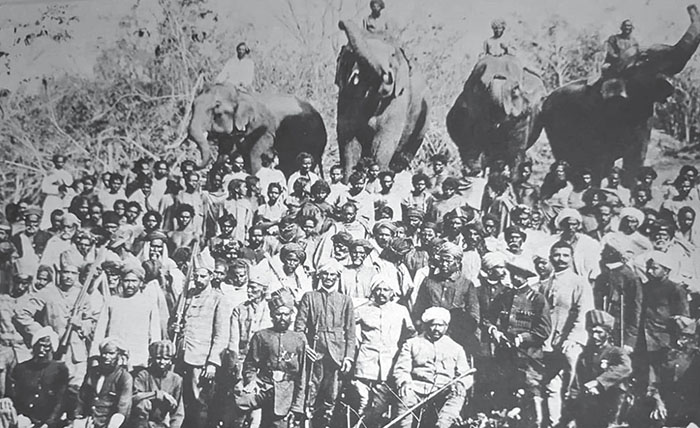
On the said day, Khedda Officer B. Balaiah and Senior Officer D.G. Wesley gave instructions to move with our elephant army to our positions. The foot soldiers, along with guards, tribal and villagers, would surround the wild elephants and chase them towards us.
Experienced men were posted on tree tops to count the number of wild elephants in the group, while we drove them. These wild elephants were to be driven from one ‘block’ to another ‘block’ at a time, while ensuring that they were surrounded by tamed elephants to ensure there were no gaps for elephants to escape.
On that day, we could not do much as we were unable to move enough elephants into the next block. Wesley, Balaiah and other officers decided to call it a day and try the next.
The next two days were met with failure again.
As we got ready for the final Khedda Operation on the fixed date, visitors and VIPs poured in. We drove the wild elephants to the Kabini River and forced them to move upwards in front of the visitors’ gallery.
Wesley was riding a huge tusker and Balaiah was riding Rajendra, who was in musth. I, along with a few colleagues, was making sure one female elephant was between two male elephants.
Sudden commotion
While crossing midstream, a wild tusker broke free from the main herd and ran towards the visitors and a few more wild elephants followed him, triggering commotion among the visitors.
To add to this commotion, some staff decided to shoot at the wild elephants with no regard for the safety of the entire team.
We, who were perched up on our tamed elephants, ducked low enough to hug our elephants in order not to get shot. We shouted at them to stop shooting as we heard and felt bullets flying over our heads and lodging in the tree branches.
A few tamed elephants led by some colleagues and Mahouts managed to drive the wild group back to the river. A disaster was avoided.
As we approached the gates of the enclosure, the wild elephants were suspicious and started resisting our drive. The entry point to the gates was so narrow that all our elephants could not push the wild animals into the enclosure.
Unfortunately, at the gates, a female was left behind and unknowingly, my tusker, Abhimanyu, who was pushing the wild elephants to the enclosure, came close to the other tamed tusker, Rajendra. Rajendra was furious to see Abhimanyu and within a split second, he changed his direction and began charging at Abhimanyu.
Abhimanyu, unable to withstand Rajendra’s blows, gave a shrill, high-pitched trumpet signalling distress and bolted into the Kabini river with the Mahout on top and me.
I was holding on to both my gun and life, hoping all the years of riding practice on elephant back would keep me atop this giant. After holding on to my position, I turned back to see if my Kavadi, who was sitting behind me, was okay. Behold. He was missing.
On bending a little further to one side, I could see Kavadi’s hands holding on to the ropes while his body was dangling. Eventually, Abhimanyu came under control and his pace slowed. I put my gun down and stretched one hand to my Kavadi, who slowly pulled himself up and settled down behind me.
All efforts to turn around Abhimanyu went in vain as he refused to turn back towards the gate.
I knew then that Khedda would not succeed if we did not join the operation. I promised him (Kavadi) that Rajendra would be withdrawn and we would then complete the mission. He agreed.
Convincing tactics
Then I witnessed something amazing. My Kavadi got down from Abhimanyu and spoke to him in his own language, like he was trying to convince this beautiful creature to turn back and complete the task. After some time, Abhimanyu turned around and followed his master towards Khedda like a pet dog.
After walking for a while, my Kavadi climbed back on Abhimanyu, the tusker Rajendra was removed from the operation and we succeeded in putting the wild elephants into the enclosure.
As the last wild elephant was pushed into the enclosure and the doors were shut, a loud cry went out from all of us spontaneously. We all shouted ‘Mastiyamma ki jai’, ‘Mysore Maharajaki jai’, ‘Wesley and Balaiah ki jai’. The ‘jayakaras’ filled the air.
Forest Minister B. Rachaiah shared his joy by throwing a ‘badakhana’ at Karapura main bungalow, where everything flowed, ending a great era of Khedda.
The last Khedda was also a reminder that while elephants look and move gracefully, like kind giants, we should not forget that they are very powerful creatures and you need to give them respect, and the best way to do it is by keeping our distance and admiring from afar their magnificence.Eighty-eight-year-old A.C. Lakshmana retired as Secretary to the Government of Karnataka and was also the Advisor to two Bamboo Mission Committees
Recent Comments