


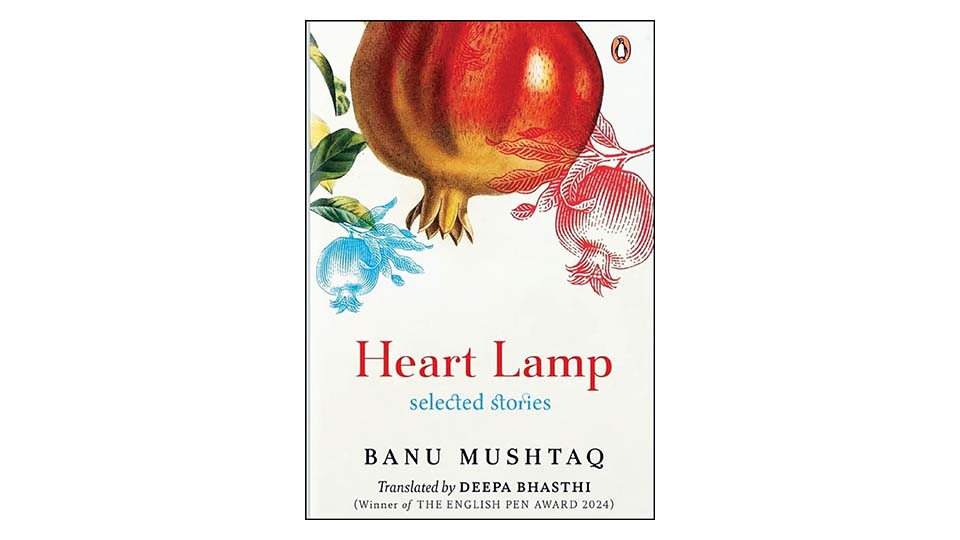
By Ravi Joshi, Former Joint Secretary, Cabinet Secretariat
Title : Heart Lamp
Author : Banu Mushtaq
Year : 2025
Pages : 216
Price : Rs. 399
Publisher : Penguin Random House India Pvt. Ltd.
The Kannada writer’s journey from burka to courtroom reveals the power of authentic storytelling that challenges patriarchy from within — offering Muslim women both mirror and voice in their struggle for freedom and power.
Let us start with the obvious categories of perception, that Banu Mushtaq is a Muslim, a woman and a writer. All three terms are important aspects of her identity. Her lived experience as a Muslim woman undoubtedly shapes the intimacy and empathy with which she writes contributing to the authenticity of her voice.
However, to suggest that her recent honour — the International Booker Prize for her book Heart Lamp — stems from these identity markers alone would be reductive and unfair to her considerable literary merit. Indeed, her identity extends far beyond these markers, as evidenced by her conscious evolution the day she threw off the burka and became an activist, a journalist, a protester in public rallies and wore a black coat as any other lawyer and went to court.
Banu’s characters could well be named Gita and Sita instead of Arifa and Jameela because the poverty that pervades Muslim women pervades the Hindu women too. That’s where her universal appeal lies. However, the oppression of Muslim women is markedly different because the patriarchy that suppresses them is empowered and sanctioned by religious authority.

The subterranean power of the ‘Tablighi Jamaat’ (a group of men that go home to home preaching how to be a ‘good Muslim’) is so pervasive that no woman can dare challenge it. By putting the women in burka, the Muslim men have succeeded in erasing their individual identity. When you see them in a public space, you do not see Arifa and Jameela, you merely see a different gender walking out there. That’s the power of Muslim patriarchy. They control their women’s right to exist as individual beings. The woman first belongs to the family — the father, husband, brother and son.
There is a more important identity of Banu Mushtaq that I wish to focus on — one that she has crafted for herself and suits her far more significantly than anything else. That she is a ‘critical insider.’ She proclaimed this identity, quite justifiably, at a recent event in Mysuru before the Booker Prize was announced.
Belonging, as she does to the ‘Bandaya Movement’ that produced the ‘Bandaya Sahitya’ of the mid-1970s in Kannada literature, critical thinking and questioning were a necessary precondition to her writings and public acts. The pioneers of the movement came from the oppressed classes, the Muslims, Dalits and Women. And she has a foot in two of the three camps — Woman and Muslim. She acknowledges without any hesitation, the contribution of Baraguru Ramachandrappa and P. Lankesh to her own literary and social awareness. It was P. Lankesh who prodded her to become a journalist by filing stories for his famous Lankesh Patrike on the events in her home-town Hassan and its surroundings. Later, he encouraged her to tell her story and the stories of others in her community. From a journalist to an activist to a lawyer, her journey has been one of continuous progression that has found literary expression.
On the issue of being a ‘critical insider,’ let us understand where she stands with the help of her stories. The most frequent characters that recur in her stories are women, mostly poor and uneducated, the maulvis and mutawallis (those who interpret the Sharia laws). All of them operate within the pervasive control of the mosque and the madrassa. They seem to live in a different universe. And different rules and an arcane system of justice apply there. Banu Mushtaq tells their stories with great empathy and at times, wry humour.
Being an ‘insider,’ Banu Mushtaq implicitly accepts her faith, abides by its holy scriptures — the Qur’an and the Hadith. But being ‘critical,’ she questions the men that mediate between her and her Allah. She questions their knowledge of the holy texts and their ability to perceive the humanism and the nobility inherent in it.
She questions the web of institutions and the rules built by the men of religion to subjugate other men and more so, the women. But the critical insider doesn’t go beyond questioning or perhaps that is the journalist in her, who sees her role as the asker of questions rather than the provider of answers.
Her protagonists certainly protest but it seems muffled, and they do not rebel. They seem to have only two options – to die by suicide or fall in line. Walking out of the all-enveloping confines and refusing to the jamaat does not exist as an option in her stories.
In one poignant story, the woman drops the match-stick that she was about to strike after dousing herself in kerosene, at the heartrending cry of her eldest daughter, as in ‘Heart Lamp,’ or the wife of the mutawalli walks out of home, as in ‘Black Cobras’, determined to get a vasectomy operation done for herself.
One must accept that Banu Mushtaq writes of present-day reality in Muslim society with profound insight. And the reality is depressing and disturbing. A poor, uneducated Muslim woman’s life is indeed hellish and brutal. As a ‘critical insider,’ she offers something invaluable to young Muslim girls — a mirror to see their reality clearly and a voice that validates their struggles. Her own journey from traditional constraints to becoming an award-winning writer serves as a powerful testament to what is possible.
— Originally published online by The Wire
Recent Comments